
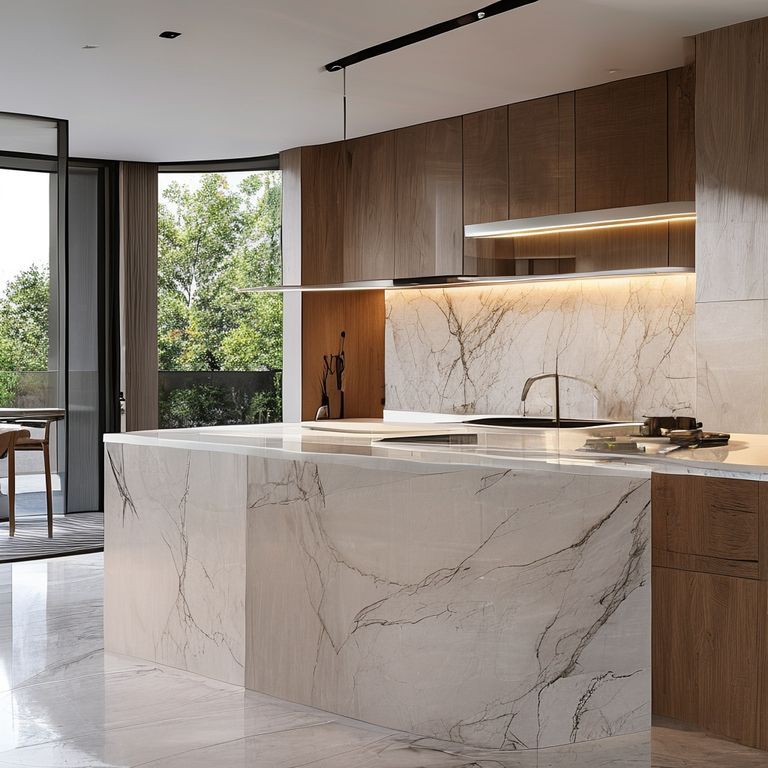
Imagine walking into a kitchen where the island doesn’t just sit in the room—it flows. A singular, monolithic sculpture of pure, velvet-matte white that stretches from the countertop down to the floor without a single visible seam. This isn’t a dream of a futuristic sci-fi film; it is the daily reality made possible by acrylic artificial marble. In the design world, we often talk about the “holy grail” of materials—something that possesses the timeless beauty of natural stone but lacks its frustrating temperaments. For many architects and interior enthusiasts, acrylic artificial marble (often referred to generically as “solid surface”) is the closest we have ever come to that perfection.
To understand why this material has become the darling of high-end residential and commercial projects, we first have to look under the hood. Unlike traditional “faux marble” which might just be a printed laminate or a resin-heavy composite, true acrylic artificial marble is a sophisticated blend of approximately one-third high-quality acrylic resin (Polymethyl Methacrylate or PMMA) and two-thirds natural minerals, primarily Alumina Trihydrate (ATH). This specific “acrylic” designation is vital. While cheaper “polyester-based” solid surfaces exist, they are brittle and prone to yellowing. The acrylic component is what gives this material its legendary “warmth” to the touch and its incredible flexibility.
The most intoxicating advantage of acrylic artificial marble is, without a doubt, its seamlessness. If you’ve ever looked at a natural granite or quartz countertop, you’ve seen the “seam”—that thin, often ugly line where two slabs meet. With acrylic marble, those lines disappear. Using a specialized color-matched adhesive that chemically bonds the pieces together, installers can sand the joints until they are literally invisible to the naked eye. This allows for U-shaped kitchens or massive conference tables that look like they were carved from a single, gargantuan block of stone. It’s a level of aesthetic continuity that natural stone simply cannot provide, and it opens up a world of architectural possibilities that feel both organic and ultra-modern.
But the appeal isn’t just skin deep. In an era where we are more conscious of health and hygiene than ever before, the non-porous nature of acrylic artificial marble is its secret superpower. Natural marble, for all its glory, is a geological sponge. It has tiny pores that soak up red wine, beet juice, and—more alarmingly—bacteria and mold. Acrylic marble is completely solid all the way through. There are no pores, no voids, and no places for germs to hide. This makes it an NSF-certified choice for commercial kitchens and hospitals, and a godsend for the home cook who doesn’t want to panic every time a lemon is squeezed on the counter. You don’t need to seal it every six months; you just wipe it down, and it remains as pristine as the day it was installed.
Furthermore, we must talk about the “Thermoforming” magic. Because of the high acrylic content, this material becomes pliable when heated to a specific temperature. It can be bent, curved, and molded into shapes that would be impossible or prohibitively expensive with natural stone. Think of “S” shaped reception desks, integrated sinks that flow directly out of the countertop without a rim, or even curved wall panels in a luxury shower. It allows the designer to move away from the rigid geometry of traditional masonry and toward a more fluid, biophilic language of design.
Finally, there is the sensory experience. Natural stone is often cold—literally. It draws the heat out of your skin, which can feel harsh in cooler climates. Acrylic artificial marble, however, retains a certain ambient warmth. It feels silky, almost soft to the touch, despite being a hard, durable surface. It’s an inviting material that begs to be touched, making a house feel like a home rather than a cold museum. It bridges the gap between the industrial and the intimate, providing a canvas that is as practical as it is poetic. As we transition into the second part of our exploration, we will look at the practicalities—the “cons” that every buyer should know, the maintenance reality, and how it holds up against the test of time and heat.
While the virtues of acrylic artificial marble are numerous, no material is without its quirks. To truly appreciate this surface, one must understand its limitations, because “perfection” in design is often about choosing the right compromises. If the first half of our journey was an ode to its beauty and hygiene, the second half is a grounded look at the realities of living with this sophisticated composite.
The most frequent critique leveled against acrylic artificial marble is its relationship with heat. Unlike granite or quartz, which can withstand a hot pan for a few seconds (though not recommended), acrylic marble has a lower heat distortion temperature. If you take a searing cast-iron skillet directly from the stove and place it on the surface, you risk scorching it or even causing a hairline crack. It is a material that demands the use of trivets. For some, this is a deal-breaker; for others, it’s a small price to pay for the aesthetic benefits. It’s a reminder that this material, while tough, is ultimately a high-tech polymer-mineral hybrid, not a volcanic rock.
Then there is the question of scratches. Because acrylic marble is slightly softer than natural stone or quartz, it can pick up “character marks” over time—fine scratches from sliding heavy ceramic plates or cutting directly on the surface. However, this “weakness” is actually the source of its greatest strength: repairability. This is where acrylic artificial marble truly outshines every other material on the market. If you scratch a piece of natural marble or chip a quartz edge, you are usually stuck with it forever. But acrylic marble is “renewable.” Because the color and pattern run all the way through the thickness of the material, a professional (or even a dedicated DIY-er with the right pads) can simply sand away the scratches and buff the surface back to its original luster. You can quite literally “reset” your countertops to brand-new condition every five to ten years.
This renewability extends to more serious damage as well. If you were to somehow crack the surface or even melt a small section with a rogue cigarette or a hot soldering iron, the damaged piece can be cut out and replaced with a new “plug” of the same material. Once seamed and sanded, the repair is invisible. This “immortality” makes it an incredibly sustainable choice in the long run; you aren’t replacing the whole counter because of one accident; you are simply healing it.
From a cost perspective, it’s important to position acrylic artificial marble correctly. It is generally more expensive than laminate or basic polyester solid surfaces, and often sits in a similar price bracket to mid-to-high-range quartz or granite. The “luxury” here isn’t just in the material cost, but in the craftsmanship required for the seamless installation. You are paying for the artistry of the fabricator who makes the seams disappear and the curves flow. It is an investment in a specific look—that “clean, modern, architectural” vibe that other materials simply cannot replicate.
In terms of aesthetics, while acrylic marble can mimic the look of Carrara or Calacatta marble with remarkable accuracy, it will never have the “depth” of a translucent natural stone. Natural marble has a crystalline structure that allows light to penetrate deep into the surface. Acrylic marble is more opaque. However, modern manufacturing has come a long way. The latest “veined” collections from top-tier brands offer stunning, sweeping patterns that capture the movement of natural stone without the maintenance nightmares of sealing and acid-etching (where a spill of orange juice or vinegar can permanently dull a natural marble surface).
So, who is acrylic artificial marble for? It is for the homeowner who values a cohesive, minimalist aesthetic. It is for the person who loves the look of marble but hates the “stain-panic” of natural stone. It is for the designer who wants to push the boundaries of shape and form. It is for the hygiene-conscious family who wants a surface that is as safe as it is beautiful.
In conclusion, choosing a surface material is always a balance of priorities. If you want a material that is literally bulletproof to heat and you don’t mind visible seams, perhaps granite is your soulmate. But if you crave a surface that feels like a singular piece of art—seamless, warm, repairable, and infinitely hygienic—then acrylic artificial marble stands alone. It is a testament to human ingenuity: taking the beauty of the earth’s minerals and refining them with the precision of modern chemistry to create something that, in many ways, is better than the original. It’s not just a countertop; it’s a canvas for your life.









