
人工制作石头图案大全简单,人工制作石头图案大全简单又漂亮
The tactile allure of a smooth, cool stone held in the palm of your hand is a sensory experience that dates back to the dawn of humanity. There is something profoundly grounding about earth and mineral, a silent weight that speaks of time and resilience. But what happens when we take these humble fragments of the earth and use them as a canvas? Welcome to the vibrant, surprisingly addictive world of handcrafted stone patterns. If you’ve been looking for a creative outlet that doesn’t require a dedicated studio or a massive investment in supplies, you’ve found it. Stone art is the ultimate “democratized” craft—it belongs to everyone, from the precision-obsessed perfectionist to the casual Sunday afternoon doodler.

The beauty of “simple” stone patterns lies in their accessibility. You don’t need to be a Renaissance painter to create something that looks professional, chic, and soulful. Whether you want to sprinkle a bit of personality into your garden, create custom paperweights for your home office, or simply find a way to quiet your mind after a long day, the process of painting stones offers a unique blend of focus and relaxation. This guide is designed to take you through the entire journey, starting from the very foundation of the craft.
Before we dive into the specific patterns, let’s talk about the canvas itself. Not all stones are created equal. If you’re lucky enough to live near a beach or a riverbed, nature provides the best inventory. Look for stones that have been tumbled smooth by water over decades. These “river rocks” or “beach pebbles” offer a non-porous, slick surface that takes paint beautifully. For beginners, flat, oval stones are the gold standard. They provide a stable base and a predictable surface area. If you aren’t near a natural source, home improvement stores and garden centers sell bags of polished stones that work perfectly. Once you have your stones, give them a warm bath with a bit of dish soap. Removing the dust and grit ensures your designs stay vibrant and don’t flake off over time.
Now, let’s look at the toolkit. You don’t need much. A set of acrylic paint pens is perhaps the greatest invention for the aspiring stone artist. They offer the control of a marker with the durability of paint. If you prefer the traditional route, a few fine-tipped brushes and a set of multi-surface acrylic paints will do wonders. You might also want a “dotting tool”—which can be as fancy as a professional stylus or as simple as the end of a toothpick or a dried-out ballpoint pen.

The first category of simple patterns we’ll explore is the Geometric Minimalist. There is a sophisticated elegance in simplicity. Imagine a slate-grey stone adorned with nothing but crisp, white lines. You can create a “Hedgehog” pattern by drawing a series of radiating lines from a single point, or a “Labyrinth” by creating concentric squares that never quite meet. Triangles, chevrons, and simple grids look incredibly modern when placed in a glass bowl on a coffee table. The trick here is contrast. Use a dark stone with metallic gold paint, or a white quartz pebble with deep navy ink. These patterns don’t require “drawing skills” in the traditional sense; they require a steady hand and a bit of patience.
Moving from the structured to the organic, we find the Nature-Inspired Whimsy. These are the crowd-pleasers. Think of the classic ladybug—a bright red base with a black “T” and a few dots. It’s iconic, simple, and takes less than five minutes. But you can push this further. A single, delicate green leaf painted with fine veins can make a stone look like a fossil. Or consider the “Cactus Stone.” Paint a variety of oval stones in different shades of green, add white “X” marks for spines, and “plant” them in a small pot filled with sand. It’s the ultimate low-maintenance houseplant.
One of the most popular simple patterns is the Dotted Mandala Lite. While professional mandalas can be incredibly complex, the “simple” version is just as stunning. Start with one large dot in the center of your stone. Then, use a different color to place a ring of smaller dots around it. Continue expanding outward, changing colors or dot sizes as you go. The repetitive motion of “dip and dot” is famously meditative. It’s less about the final product and more about the rhythm of creation. By the time you reach the edge of the stone, you’ve created a kaleidoscopic pattern that looks like a burst of energy captured in mineral form.
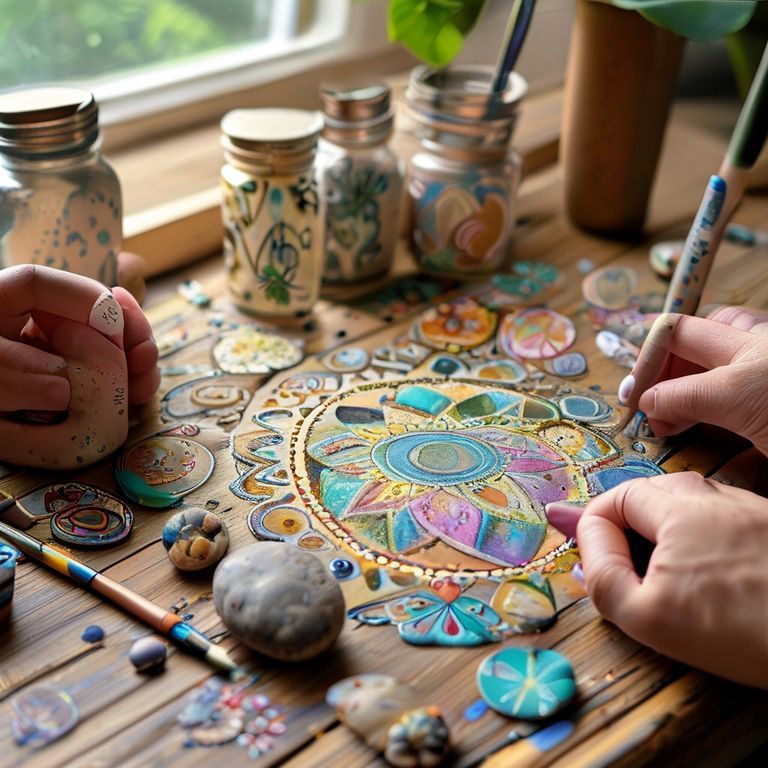
As you begin your journey with these simple patterns, you’ll notice that the stones themselves often dictate what they want to become. A long, thin stone might suggest a feather or a dragonfly; a perfectly round one might want to be a smiling sun or a slice of citrus. This dialogue between the natural shape of the rock and your creative intent is where the magic happens. In the next part, we’ll move beyond the basics into storytelling, seasonal themes, and how to protect your masterpieces so they last a lifetime.
Continuing our exploration into the world of handcrafted stone patterns, we move from the foundational shapes into the realm of Storytelling and Symbolism. Sometimes, the most powerful pattern isn’t a shape at all, but a single word or a universal symbol. “Zen stones” are a perfect example. Using a fine-tipped black marker, you can write words like Peace, Breathe, Seek, or Grow in elegant script. When paired with a simple background—perhaps a wash of soft watercolor-style acrylic—these stones become powerful talismans. You can leave them in public parks for strangers to find, a practice known in many communities as “The Kindness Rock Project.” A simple heart, a crescent moon, or an ancient rune can transform a pebble into a gift that carries deep personal meaning.
If you’re looking to add a bit of seasonal flair to your home, Thematic Stone Patterns are your best friend. Because stones are inexpensive (or free!), they are the perfect medium for rotating decor. For autumn, think of simple orange pumpkins with curly green tendrils, or yellow maple leaves. When winter rolls around, white stones can be turned into minimalist snowmen with just three black dots for buttons and a tiny orange triangle for a nose. For the summer months, nothing beats “Citrus Slices.” Paint a round stone a bright lemon yellow or lime green, then draw white “spokes” and a thick rim to mimic a cross-section of fruit. These look fantastic scattered on an outdoor dining table during a barbecue.
For those who want to venture a bit into the “shabby chic” or rustic aesthetic, the Silhouette Pattern is a game-changer. This technique involves painting the entire stone a solid color—black is a classic choice—and then painting a single, solid silhouette on top in a contrasting color like white or silver. A silhouette of a cat stretching, a lone pine tree, or a bird in flight is remarkably striking. Because you aren’t worrying about shading or intricate details, silhouettes are surprisingly easy to master. They rely on the power of the shape rather than the complexity of the brushwork.
We should also discuss the Abstract “Galaxy” Technique, which sounds difficult but is actually one of the simplest patterns to achieve. You start with a black or deep purple base. While the paint is still slightly tacky, take a small piece of sponge and dab on “clouds” of pink, teal, and dark blue. Once that dries, take a stiff-bristled toothbrush, dip it in white paint, and flick the bristles over the stone to create a “spray” of distant stars. The result is a cosmic, ethereal pattern that looks like a photograph from the Hubble telescope. It’s messy, fun, and every single stone turns out unique.
Once you’ve mastered these patterns, you’ll find that your collection of stones starts to grow rapidly. This is where the Functional Art aspect comes in. Don’t just let them sit in a jar! A larger, patterned stone makes an excellent doorstop. Smaller ones can have magnets glued to the back for the most stylish refrigerator you’ve ever seen. In the garden, you can use stones as “Herb Markers.” Paint the name of the plant—Basil, Rosemary, Thyme—on a stone and place it at the base of the herb. It’s practical, weather-resistant, and adds a handcrafted touch to your greenery.
Speaking of weather-resistance, we must address the “Finish.” To ensure your simple patterns don’t fade under the sun or wash away in the rain, sealing is a vital step. A clear, UV-resistant acrylic sealer is the gold standard. You can choose a matte finish if you want the stone to look natural, or a high-gloss finish if you want it to pop like a piece of polished jewelry. Spray-on sealers are the easiest to apply, providing an even coat that protects your artwork from the elements and gives it a professional “finished” look.
As you progress, you might find yourself looking at the world differently. A walk on the beach becomes a treasure hunt. A trip to the park becomes an opportunity to find the perfect “canvas.” This is the true gift of handcrafted stone patterns. It’s a hobby that encourages you to slow down and appreciate the small, overlooked details of the natural world. There is no “wrong” way to paint a stone. If you don’t like a pattern, you can simply paint over it or wash it off and start again. The stakes are low, but the creative reward is incredibly high.
In a world that is increasingly digital and fast-paced, the act of sitting down with a cold stone and a brush is an act of rebellion. It’s a return to something tactile, something permanent, and something uniquely yours. Whether you are creating a complex mandala or just a series of simple, joyful polka dots, you are participating in a tradition of human expression that is as old as the rocks themselves. So, go out, find a stone that “speaks” to you, and start your first pattern today. You’ll find that once you start rocking, it’s very hard to stop. Your garden, your home, and your spirit will be all the brighter for it.









