
The intersection of human creativity and geological evolution has birthed a new era of interior aesthetics. For centuries, we were beholden to the whims of the earth—quarrying marble, granite, and onyx with the hope that the slab we pulled from the mountain would possess the perfect balance of veining and hue. Today, that dynamic has shifted. We are no longer mere collectors of nature’s accidents; we have become the architects of its beauty. Man-made stone pattern design represents a pinnacle of material science and artistic vision, a domain where the rugged unpredictability of the natural world is harnessed and refined by the precision of human imagination.
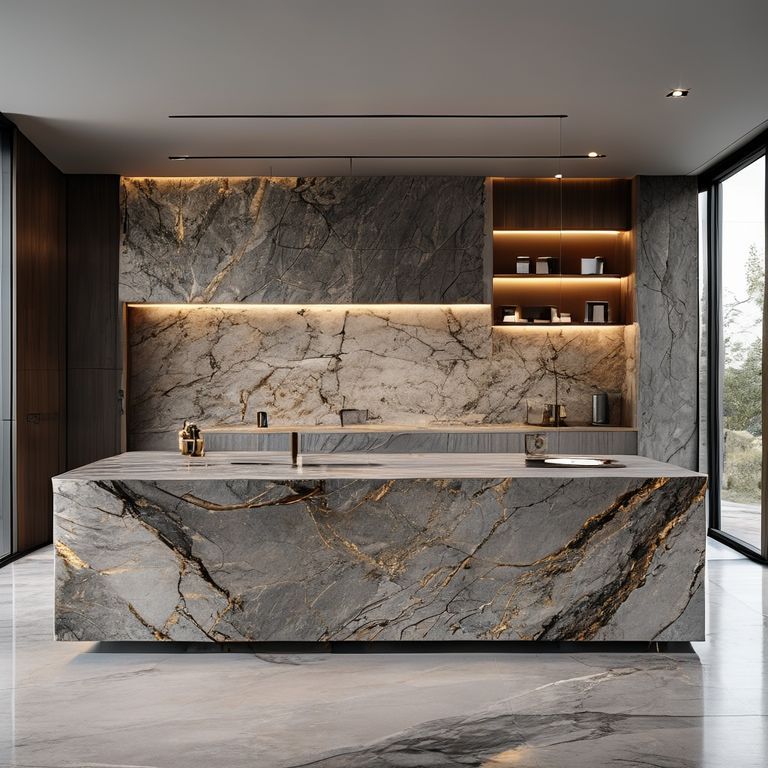
When we talk about “man-made stone,” we aren’t just discussing a replacement for the real thing. We are talking about a transcendence of it. Through processes like sintering and quartz engineering, we are essentially taking the same minerals that form in the earth over millions of years—silica, feldspar, and minerals—and compressing that timeline into hours using immense heat and pressure. But the real magic happens in the “printing” or the “vein-through” technology. This is where the designer’s hand takes over. Unlike natural stone, which can often be “too busy” or contain structural flaws like hidden fissures, engineered stone allows for a curated visual experience. Every swirl of grey, every streak of gold, and every crystalline fleck is placed with intentionality.
The allure of these designs lies in their ability to evoke emotion. Consider a classic Calacatta pattern recreated in a high-grade sintered stone. In its natural form, Calacatta is a rare, expensive luxury. In its engineered form, it becomes a canvas for a specific kind of drama. Designers can manipulate the scale of the veins, making them bolder and more architectural, or softening them into a misty, ethereal haze. This level of control means that a kitchen island or a feature wall is no longer just a surface; it’s a bespoke piece of art that fits the exact proportions of a room. The “pattern” is not just a surface decoration; it’s an exploration of depth and movement.
Furthermore, the evolution of man-made stone has solved the “repeat” problem that used to plague earlier versions of porcelain or quartz. In the past, you could tell a surface was manufactured because you’d see the same vein pattern every few feet. Modern high-end design utilizes “infinite veining” and “book-matching” techniques that are virtually indistinguishable from quarry-cut slabs. You can have a thirty-foot wall where the veins flow seamlessly from one panel to the next, creating a sense of tectonic continuity that would be nearly impossible—and prohibitively expensive—to achieve with natural stone.
The tactile nature of these designs has also undergone a revolution. We have moved past the binary choice of “polished” or “matte.” Today’s man-made stone patterns are often integrated with 3D texture mapping. This means that if you see a deep, rugged vein in the design, you can actually feel the slight indentation with your fingertips. This synesthesia of sight and touch brings an authenticity to the material that challenges the very definition of “artificial.” It’s a sensory experience that grounds a space, providing that “weight” and “permanence” that humans have sought in stone since we first carved dwellings into cliffsides.
As we dive deeper into the aesthetics, we see a trend towards the “hyper-natural.” This involves taking elements from different types of stone and fusing them into a single, impossible design. Imagine the translucent depth of an onyx combined with the structural strength and grey tones of a basalt. These are “designer stones” that don’t exist in nature but look as though they should. It’s a form of creative rebellion against the limitations of the earth, allowing architects to dream up color palettes that go beyond the standard whites, greys, and beiges. We are seeing deep emerald greens with copper webbing, midnight blues with silver striations, and even patterns that mimic the charred, organic look of Shou Sugi Ban wood but in a stone format.
Part of the attraction is also the narrative of the material itself. In an age where we are increasingly conscious of our footprint, the story of man-made stone is one of efficiency and preservation. We are using recycled glass, stone scraps, and sustainable resins to create something that lasts a lifetime. The design isn’t just about looking good; it’s about the intelligence of the craft. It represents a world where we don’t have to strip-mine a mountainside to enjoy the aesthetic of a rare marble. We can recreate that grandeur in a lab, with better durability, zero porosity, and a design that is perfectly tailored to the human eye.
Ultimately, the first part of understanding man-made stone design is recognizing that “man-made” is not a compromise. It is a choice for precision, a choice for durability, and most importantly, a choice for an uninhibited artistic expression. We are entering a phase where the surface under your hands is as much a product of a designer’s soul as it is a product of mineral science.
Moving from the conceptual beauty of man-made stone into its practical and transformative application reveals the true genius of the medium. If the first part of the design process is the “alchemy” of the minerals, the second part is the “symphony” of its placement within the human environment. The versatility of engineered stone patterns has effectively broken the traditional boundaries of where stone can go. Because these materials are non-porous and incredibly thin yet strong, we are seeing stone patterns climb up walls, wrap around curved cabinetry, and even float as ultra-thin shelving.
In the realm of high-end residential design, the kitchen has become the primary gallery for these stone patterns. The “waterfall” island remains a staple, but the trend is moving toward integrated environments. Imagine a kitchen where the countertop, the backsplash, the sink, and even the cabinet fronts are all clad in a singular, continuous stone pattern. This “monolithic” look is only achievable with man-made stone. It creates a sense of serenity and architectural purity that natural stone—with its weight and fragility—simply cannot match. The pattern becomes the thread that sews the entire room together, turning a functional space into a sculptural masterpiece.
But the application extends far beyond the kitchen. The bathroom has been reimagined as a private spa sanctuary through the use of large-format sintered stone panels. In these spaces, designers often opt for patterns that evoke the fluid, calming nature of water or the soft, layered look of sedimentary rock. Because there are no grout lines to interrupt the visual flow, a small bathroom can feel expansive, like a cave carved out of a single block of marble. The “hygiene” factor of man-made stone—the fact that it doesn’t harbor bacteria or mold—is a functional benefit, but it’s the visual cleanliness of the uninterrupted pattern that provides the psychological sense of luxury.
In commercial architecture, the stakes are even higher. Lobbies, hotels, and corporate headquarters use man-made stone to project an image of stability and avant-garde thinking. A massive reception desk clad in a backlit, engineered “onyx” pattern serves as an immediate focal point, signaling both wealth and technological sophistication. Here, the durability of the pattern is key. Unlike natural marble, which might etch or stain in a high-traffic area, man-made stone retains its “just-installed” luster for decades. The design doesn’t fade; it endures. This allows architects to be more daring with their choices, knowing that a bold, dark stone pattern won’t become a maintenance nightmare.
The future of man-made stone pattern design is also being shaped by the “bespoke” movement. We are moving toward a world where a client can walk into a studio and work with a digital artist to tweak the veins on their specific slabs. Do you want a little more gold in the corner to catch the morning sun? Do you want the vein to curve around a specific architectural column? This level of customization is the ultimate luxury. It moves the product from a “commodity” to a “commissioned work.” It’s no longer about what’s in stock at the warehouse; it’s about what’s in the mind of the creator.
We must also consider the “mood” of the modern interior. Currently, there is a strong shift away from the cold, sterile whites of the early 2010s toward warmer, more “grounded” tones. Man-made stone designers are responding with patterns that mimic travertine, limestone, and terracotta—stones that feel “ancient” and “earthy.” These designs often feature “distressed” textures and “honed” finishes that feel soft to the touch, like a pebble smoothed by a river. This “New Mediterranean” or “Japandi” aesthetic relies heavily on the ability of man-made stone to look humble and expensive at the same time.
Lighting, too, plays a massive role in how we perceive these patterns. The newest generation of engineered stone is being designed with varying levels of opacity. Some patterns are designed to be “ghosted”—visible only when backlit by LED panels. This creates a transformative environment where a wall can look like a solid, dark stone during the day and turn into a glowing, ethereal map of golden veins at night. This interplay between light and material is perhaps the most exciting frontier of stone design, turning static surfaces into dynamic, living elements of the home.
As we look toward the horizon, the line between the natural and the engineered will continue to blur until it becomes irrelevant. The “authenticity” of a material will no longer be judged by whether it was pulled from a hole in the ground, but by the quality of the craftsmanship and the beauty of the design it brings into our lives. Man-made stone pattern design is a testament to the fact that we can respect nature while also improving upon it. It is a celebration of the human spirit’s refusal to be limited by what is “available.”
In conclusion, the journey from a pile of raw minerals to a breathtaking, book-matched stone feature is one of the great triumphs of modern design. It is a field that requires the eye of a painter, the precision of an engineer, and the soul of an architect. Whether it’s a subtle, sand-colored surface in a minimalist loft or a dramatic, black-and-gold statement in a luxury penthouse, man-made stone patterns are more than just a trend. They are a permanent shift in how we build our world—one beautiful, intentional, and indestructible surface at a time. The stone age didn’t end; it just evolved, and the results are more stunning than we ever could have imagined.









