
人造石台面使用时要注意什么问题,人造石台面耐用吗
There is a specific kind of magic that settles into a home the moment a new artificial stone countertop is installed. Whether it’s the cool, consistent veining of high-grade quartz or the seamless, silky flow of a solid surface, these materials have redefined the modern kitchen and bathroom. They represent a marriage of human ingenuity and aesthetic desire—a surface that looks like it was pulled from a Tuscan quarry but behaves with the predictable resilience of modern engineering. However, as any seasoned homeowner or interior designer will tell you, “resilient” is not synonymous with “invincible.” To live with artificial stone is to enter into a silent contract: you provide the care, and the stone provides the timeless backdrop to your life’s most delicious moments.

When we talk about artificial stone—commonly encompassing quartz (engineered stone) and solid surfaces like Corian—we are talking about a material that is largely composed of crushed natural minerals bound together by high-performance resins. This composition is exactly why it looks so stunningly uniform. But it is also the reason why you cannot treat it exactly like a slab of raw granite or a block of butcher wood. The resins are the secret sauce, but they are also the “Achilles’ heel” if you aren’t careful.
The first and perhaps most significant rule of engagement involves the element of fire—or rather, the heat generated by your culinary adventures. There is a persistent myth circulating in home renovation forums that artificial stone is heat-proof. This is a dangerous oversimplification. While quartz can technically withstand a fair amount of heat, it is sensitive to “thermal shock.” Imagine the internal stress of the material when a scorching heavy-bottomed cast-iron skillet, fresh from a 450-degree oven, is placed directly onto a surface that is currently at room temperature. The resin within the stone can expand too quickly, or even singe, leading to permanent discoloration or, in the worst cases, a hairline crack that snakes across your beautiful island. The solution is remarkably simple but often overlooked in the heat of a busy dinner service: always use a trivet or a heat pad. Think of it as a fashion accessory for your kitchen; a stylish marble or wooden board not only protects your investment but adds a layer of texture to your decor.
Beyond the temperature, we must address the “sharpness” of the situation. Artificial stone is incredibly hard—on the Mohs scale, quartz sits comfortably near the top. This leads many to believe they can ditch the cutting board and slice their sourdough directly on the counter. While you might not see a scratch the first or second time, you are essentially engaging in a microscopic war of attrition. Over time, the repetitive motion of steel against the resin-mineral bond will dull the factory polish, leaving a “haze” in the areas where you prep your food. Moreover, your expensive kitchen knives will lose their edge faster than you can say “julienne.” Keeping a high-quality wooden or bamboo cutting board at the ready is the hallmark of a cook who respects both their tools and their territory.
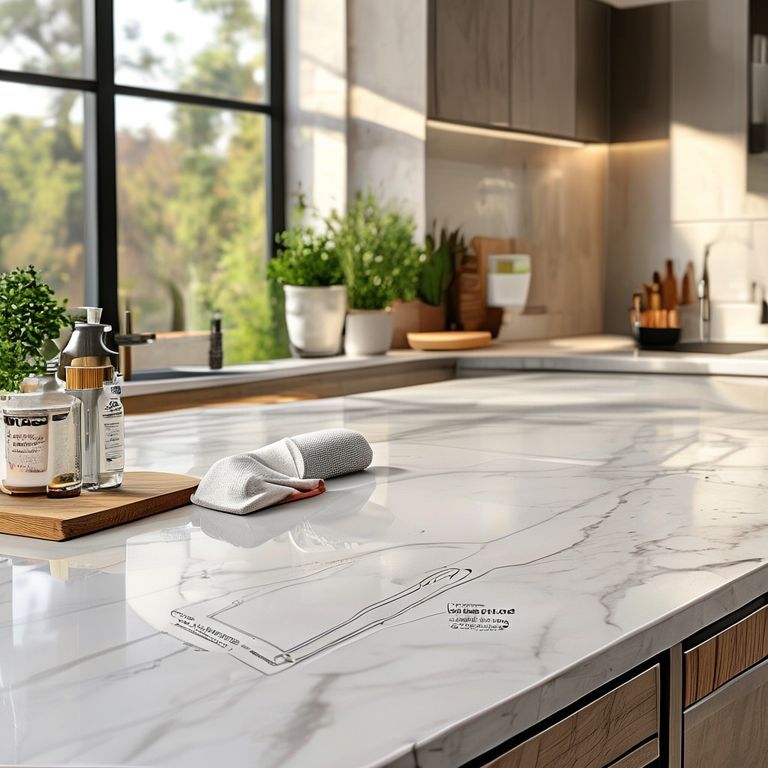
Then, there is the matter of the “heavy-handed” approach. Artificial stone is remarkably dense, which gives it that satisfying, solid clink when you set down a glass. But that density means it lacks flexibility. The edges and corners of your countertops are the most vulnerable points. Dropping a heavy Dutch oven or a rogue marble mortar and pestle on the edge of the sink can result in a chip. While these can often be repaired by a professional using color-matched epoxy, the repair is rarely as perfect as the original surface. Navigating your kitchen with a sense of “spatial awareness”—being mindful of how you move heavy cookware around those sleek edges—goes a long way in maintaining that showroom-fresh silhouette.
As we move through the lifespan of a countertop, we also have to consider the initial “honeymoon phase.” When the stone is new, everything beads up perfectly, and the gloss is blinding. But as the months turn into years, the way you clean the surface dictates whether that gloss remains or fades into a dull matte. Many people reach for the most aggressive cleaners they can find, thinking that “stronger is better.” In the world of artificial stone, the opposite is true. You aren’t trying to scrub away the stone; you are trying to preserve the resin. This brings us to the chemical conversation, a topic so vital it deserves its own deep dive into the pH levels of your cleaning cupboard.
Continuing our journey into the soul of your surfaces, we must talk about the silent chemistry happening in your kitchen every day. Artificial stone is generally non-porous, which is its greatest selling point. It doesn’t harbor bacteria, and it resists deep-set stains better than almost any natural stone. However, “stain-resistant” does not mean “stain-proof.” The enemy here isn’t just the pigment in your red wine or the yellow hue of turmeric; it’s the pH level of the liquids that sit on the surface.

Highly acidic substances—think lemon juice, vinegar, or even certain glass cleaners—can react with the resins over a prolonged period. Even more dangerous are highly alkaline “power” cleaners or oven degreasers. If you accidentally spray a harsh chemical on your quartz and leave it to “dwell,” you might find a permanent bleached spot or a change in the surface texture. The gold standard for cleaning artificial stone is surprisingly low-tech: a drop of mild dish soap and warm water. That’s it. If you feel the need for something more specialized, always ensure it is a pH-neutral cleaner specifically formulated for engineered stone. Avoid the “miracle” scrubbers and abrasive powders that promise to remove every blemish; they often contain particulates that act like sandpaper, slowly grinding away the factory finish until your counter looks tired and aged.
Speaking of stains, let’s talk about the “lingering” spill. Because artificial stone is non-porous, you have a much longer window of time to clean up a mess compared to, say, a white Carrara marble. But don’t let that make you complacent. Things like permanent markers, metal polishes, or even the oils from a leaking bottle of olive oil can, over time, create a bond with the surface that is difficult to break without professional help. A proactive approach is your best defense. If you see a spill, wipe it up. It takes three seconds now, or thirty minutes of panicked scrubbing later. For the occasional stubborn mark, a soft cloth and a bit of isopropyl alcohol can work wonders, but always test a small, inconspicuous area first to ensure your specific stone brand plays well with it.
We also need to address the “vibration” factor. Many modern kitchens house heavy appliances—stand mixers, high-powered blenders, or even espresso machines—directly on the artificial stone. These machines create constant, micro-vibrations during use. While the stone can handle this, if there is a tiny, unseen flaw in the installation or a slight unevenness in the cabinetry below, these vibrations can occasionally exacerbate stress points. Placing a small silicone mat or a felt pad under your heaviest, most active appliances serves two purposes: it dampens the noise and it protects the stone from the “buffing” effect that a vibrating metal base might have on the polish.
Light is another factor that few people consider when choosing their countertop’s placement. While artificial stone is incredibly durable indoors, it generally isn’t a fan of direct, prolonged UV exposure. Most resins used in these slabs are not UV-stable, meaning that if a portion of your countertop is bathed in harsh, direct sunlight for eight hours a day, it may eventually yellow or fade compared to the parts in the shade. If your kitchen features large, floor-to-ceiling windows, consider UV-filtering films or simply be aware that the sun is a powerful force of nature that affects everything it touches, including your premium surfaces.
Finally, the secret to a long-lasting relationship with your artificial stone is the “yearly audit.” Once a year, take everything off your counters. Give them a deep clean with a dedicated stone soap, and then run your hand across the surface. Feeling for small chips or areas that feel “rough” allows you to catch minor issues before they become major headaches. If you have a solid surface (like Corian), you actually have the unique ability to have a professional come in and “re-sand” or buff the entire surface, effectively resetting the clock and making the counters look brand new again. Quartz can’t be sanded in the same way, but a professional polish can restore its luster.
In the end, caring for artificial stone isn’t about being paranoid or living in a museum. It’s about shifting your mindset from “utility” to “investment.” When you use a trivet, when you reach for the cutting board, and when you choose a gentle soap over a harsh chemical, you aren’t just cleaning a counter—you are preserving the heartbeat of your home. Treat your stone with a little bit of grace, and it will reward you with a lifetime of beauty, standing as a silent, shimmering witness to every meal shared and every memory made in your sanctuary.









