
The Renaissance of the Slab: Why Material Choice Defines Modern Luxury
For centuries, humanity was beholden to the whims of the quarry. If you wanted the prestige of stone, you took what the earth gave you—veins, fissures, porous vulnerabilities, and all. But we have entered a new era, one where the “alchemy” of engineering allows us to curate the very DNA of our surfaces. Artificial stone, often referred to as engineered stone or solid surface, isn’t merely an imitation of nature; it is an optimization of it. To understand why these surfaces have become the darlings of interior designers and architects from Milan to Manhattan, one must peel back the polished exterior and look at the recipe.
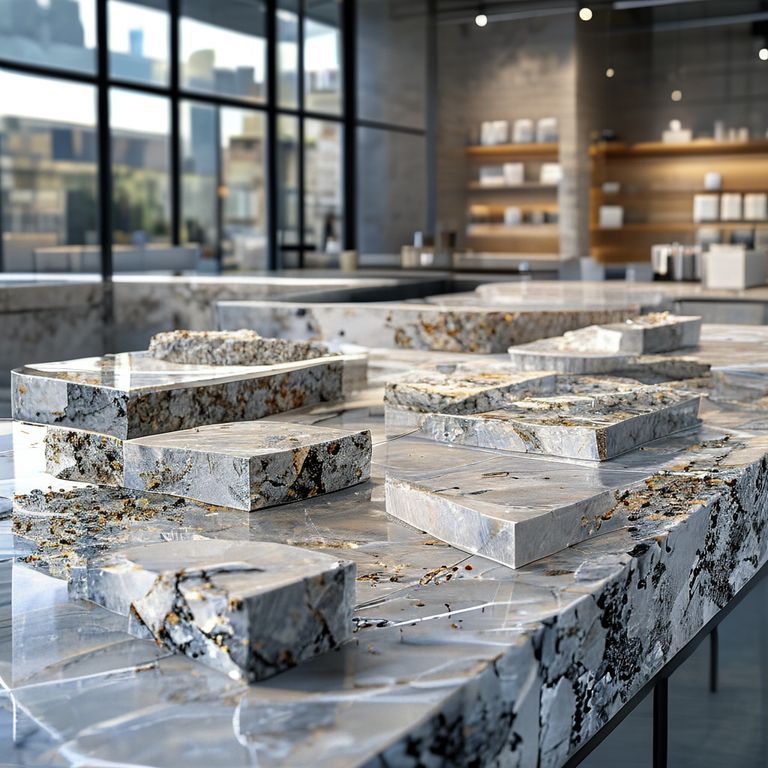
The creation of artificial stone is a high-stakes balancing act between geology and chemistry. It is a process of taking the best parts of the earth—its hardness and its crystalline beauty—and binding them with modern polymers to create something that nature simply couldn’t: a surface that is virtually indestructible and infinitely customizable. The materials used in this process are not chosen by accident; they are the result of decades of research into structural integrity and aesthetic longevity.
The Backbone: Natural Mineral Aggregates
At the heart of every slab of artificial stone lies its primary ingredient: the aggregate. This is the “soul” of the stone, providing the bulk, the texture, and the primary physical properties. In high-quality quartz surfaces, this aggregate typically makes up about 90% to 93% of the total mass.
The most common material used is crushed quartz, one of the hardest minerals on the Mohs scale. Manufacturers source high-purity quartz sand and crystalline granules, which are meticulously graded by size. The variation in these sizes is intentional; by mixing fine powders with larger “chips,” the material achieves a “high-packing density,” leaving minimal gaps for the resin to fill. This makes the final product denser and more resistant to impact.
However, the palette of aggregates isn’t limited to quartz. For different aesthetic effects, manufacturers often introduce granite scraps, glass cullet, mirrors, or even semi-precious stones like lapis lazuli. The use of recycled glass and mirror shards is particularly popular in “eco-luxury” lines, where the reflective properties of the glass create a shimmering depth that natural marble cannot replicate. For “solid surface” products (like Corian), the primary filler is often Aluminum Trihydrate (ATH), a derivative of bauxite ore, which provides a smoother, more “malleable” feel compared to the cold hardness of quartz.
The Soul of the Stone: Polymer Binders
If the minerals are the bones, the resin is the connective tissue. Without a high-performance binder, the crushed stone would be nothing more than a pile of dust. In the world of artificial stone, the choice of resin is the primary factor that determines how the material will behave under stress, heat, and sunlight.
Unsaturated Polyester Resin (UP) is the industry standard for quartz stone. It is a viscous, honey-like liquid that, when cured, creates a rigid, waterproof matrix around the mineral particles. The quality of the polyester resin is paramount; cheaper resins can lead to yellowing over time or a “plasticky” smell. Premium manufacturers invest heavily in UV-stabilized resins that ensure the stone maintains its crisp white or deep charcoal hue even when exposed to ambient light.
For “Solid Surface” materials, Acrylic Resin (Polymethyl Methacrylate or PMMA) is often the preferred choice. Acrylic is the “gold standard” of binders. It is what allows a countertop to be thermoformed—literally bent into curves—without cracking. It also provides a superior level of clarity and a “soft-touch” feel that is warmer to the skin than polyester-based stones. In many high-end applications, a blend of acrylic and polyester is used to capture the benefits of both: the rigidity of polyester and the workability of acrylic.
The Art of Pigmentation: More Than Just Color
Nature is unpredictable with its colors, but artificial stone offers the luxury of consistency. This is achieved through the use of high-grade inorganic pigments. Unlike organic dyes that might fade, inorganic metal oxides—such as iron oxide for reds and browns, or titanium dioxide for those coveted “stark whites”—are chemically stable.
The application of these pigments is where the science becomes art. In the early days, artificial stone was mostly monochromatic or “salt and pepper” in appearance. Today, sophisticated “veining” techniques involve injecting different pigment-loaded resin batches into the mix at specific intervals during the distribution phase. This creates the flowing, dramatic veins that mimic Calacatta marble. Because these pigments are mixed throughout the entire body of the material, the color isn’t just skin-deep; it’s consistent through every millimeter of the slab, allowing for beautiful edge profiles and under-mount sink cutouts that look seamless.
As we move into the second part of our exploration, we will dive into the “secret” additives—the catalysts and coupling agents—that make this chemical marriage possible, and the functional fillers that give these stones their fire-resistant and anti-bacterial superpowers.
The Invisible Architecture: Catalysts, Couplers, and Functional Fillers
While the minerals and resins provide the bulk and the beauty, the true magic of artificial stone happens at a molecular level. To transform a slurry of sand and liquid resin into a slab that can withstand the rigors of a professional kitchen or a high-traffic commercial lobby, manufacturers must employ a suite of “invisible” ingredients. These are the additives that ensure the organic and inorganic worlds don’t just sit next to each other, but actually fuse into a single, inseparable unit.
The Secret Bridge: Silane Coupling Agents
Perhaps the most critical “hidden” ingredient is the silane coupling agent. If you simply mix resin with quartz sand, the bond between the two is purely mechanical. Over time, moisture could seep into the microscopic interface between the stone and the plastic, leading to structural failure.
Silane acts as a molecular bridge. One end of the silane molecule is designed to bond with the inorganic silica in the quartz, while the other end bonds with the organic polymer resin. This creates a chemical “handshake” that is incredibly strong. This coupling agent is the reason artificial stone is non-porous. It seals the material so tightly that bacteria, mold, and even wine stains have no place to hide. It is the silent guardian of the stone’s hygiene and durability.
Fire Resistance and the Role of Aluminum Trihydrate (ATH)
In the world of commercial architecture, safety is not negotiable. This is where Aluminum Trihydrate (ATH) earns its keep. While we mentioned it as a filler in Part 1, its functional role is even more impressive. ATH is a natural fire retardant.
When exposed to high heat, ATH undergoes an endothermic reaction, releasing water vapor. This process effectively cools the material and suppresses smoke production. This is why high-end artificial stones often meet the strictest fire-safety codes for use in hospitals, airports, and public buildings. Beyond safety, ATH gives the stone a unique translucency. When back-lit, surfaces containing high amounts of ATH (like certain solid surfaces) glow with a soft, ethereal light, a favorite trick of luxury hotel designers for bar tops and reception desks.
The Catalysts: Timing the Metamorphosis
The transition from a liquid-and-grain mixture to a solid slab is triggered by catalysts and accelerators. Peroxides are commonly used to initiate the “curing” process. These chemicals are the spark that starts the polymerization of the resin.
The precision required here is staggering. If the reaction happens too quickly, the stone becomes brittle and prone to internal stresses that can cause cracking later. If it happens too slowly, the production line stalls and the material might not reach its full hardness. Manufacturers use a “curing profile” that often involves a combination of chemical catalysts and external heat (vacuum-vibrocompression), ensuring that the stone reaches a state of perfect “cross-linking.” This molecular density is what gives the stone its “clink”—that high-pitched sound when tapped, indicative of a material that is as solid as anything found in nature.
Functional Additives: Beyond the Basics
Modern artificial stone is often “smart.” Depending on the intended use, manufacturers may add:
UV Stabilizers: To prevent the resin from breaking down or “chalking” when exposed to the sun’s ultraviolet rays. Antimicrobial Agents: Silver ions or other biocide additives are sometimes integrated into the mix, especially for stones destined for healthcare environments, providing an extra layer of protection against superbugs. Matting Agents: To control the gloss level of the finished product, from a high-shine mirror finish to a trendy, soft “honed” or “leathered” texture.
The Synergy of Process and Material
It is important to remember that these materials do not simply “set” like concrete. The ingredients are subjected to a process called Vacuum-Vibrocompression. The raw mix is placed into a mold, air is sucked out (to prevent bubbles), and the mold is vibrated at high frequencies while being pressed under immense weight.
This process forces the resin to coat every single grain of quartz and activates the coupling agents. The result is a material that is incredibly dense, with a water absorption rate near zero. When you look at a piece of artificial stone, you aren’t just looking at stone and plastic; you are looking at a highly engineered composite where every ingredient has been optimized for performance.
The Future: Sustainable Innovation
As we look forward, the “recipe” for artificial stone continues to evolve. We are seeing a shift toward “Bio-Resins”—binders derived from renewable vegetable sources rather than petroleum. We are seeing the rise of “Sintered Stone,” which removes the resin entirely and uses extreme heat and pressure to fuse minerals together (a process that mimics metamorphic rock formation in seconds).
The beauty of artificial stone lies in this constant evolution. By meticulously selecting the finest quartz, the most resilient resins, and the most advanced chemical additives, we have created a material that pays homage to the earth’s beauty while surpassing its limitations. It is a testament to human ingenuity—a surface that is as practical as it is poetic, designed to last as long as the buildings it inhabits. Whether it’s a kitchen island that survives a decade of family dinners or a lobby floor that stays pristine under a million footsteps, the secret is always in the ingredients.









