
Walking into a showroom filled with slabs of engineered stone is a sensory experience that can quickly turn into a mathematical headache. You run your hand over a polished surface that looks like Calacatta marble but feels as cold and hard as a mountain peak. Then, the sales representative drops the technical specifications on you: “This is a 1.5cm slab, but we also have it in 2.0cm.” Suddenly, your vision of a perfect kitchen island is clouded by a series of questions. Is thicker always better? Why does that extra half-centimeter feel like it’s pulling significantly more money out of your pocket? The price gap between 1.5cm and 2.0cm quartz isn’t just about the volume of material; it’s a reflection of engineering, logistical complexity, and the evolving philosophy of modern interior design.
To understand the pricing of 1.5cm and 2.0cm quartz, we have to look past the stone itself and into the heart of the manufacturing process. Quartz isn’t quarried in massive blocks like granite or marble; it’s an engineered marvel, a cocktail of roughly 90-93% crushed natural quartz crystals bound together by high-quality polyester resins and pigments. When a factory calibrates its machinery to produce a 1.5cm slab, they are aiming for a specific balance of weight and flexibility. This thickness, often referred to as 15mm in international markets, has long been the darling of the European design scene. It’s sleek, it’s lean, and it speaks to a minimalist aesthetic that favors clean lines over bulk. Because it uses less raw material, the base price per square meter is naturally lower. However, “lower” doesn’t always mean “cheap.” The precision required to ensure a 1.5cm slab doesn’t warp or crack during the curing process is immense.
In contrast, the 2.0cm (20mm) slab is the traditional heavyweight champion, particularly in North American and Australian markets. There is a psychological comfort in thickness. When you see a 2.0cm profile, your brain registers “sturdiness” and “longevity.” From a pricing perspective, the 2.0cm slab demands more raw quartz, more resin, and more pigment. But the cost increase isn’t linear. You aren’t just paying for 33% more material. You are paying for the structural integrity that allows for longer overhangs on breakfast bars without the need for additional support. You are paying for a slab that can be fabricated with more intricate edge profiles—bullnose, ogee, or bevel—which simply aren’t possible on a thinner 1.5cm base without a mitered edge.
The aesthetic shift over the last decade has created a fascinating tension in the market. We are seeing a “race to the bottom” in terms of thickness for ultra-modern, “thin-is-in” designs, while simultaneously seeing a “race to the top” for chunky, 4cm or 6cm looks. Wait, if the market wants 6cm looks, why talk about 1.5cm and 2.0cm? This is where the price of 1.5cm quartz becomes incredibly attractive. By using a “mitered apron” technique, a fabricator can take a 1.5cm slab and make it look like a 10cm thick monolith. Since 1.5cm slabs are lighter and often more affordable, they are the preferred choice for designers who want to create a massive-looking island without the massive weight or the massive material cost of a solid 2.0cm or 3.0cm slab.
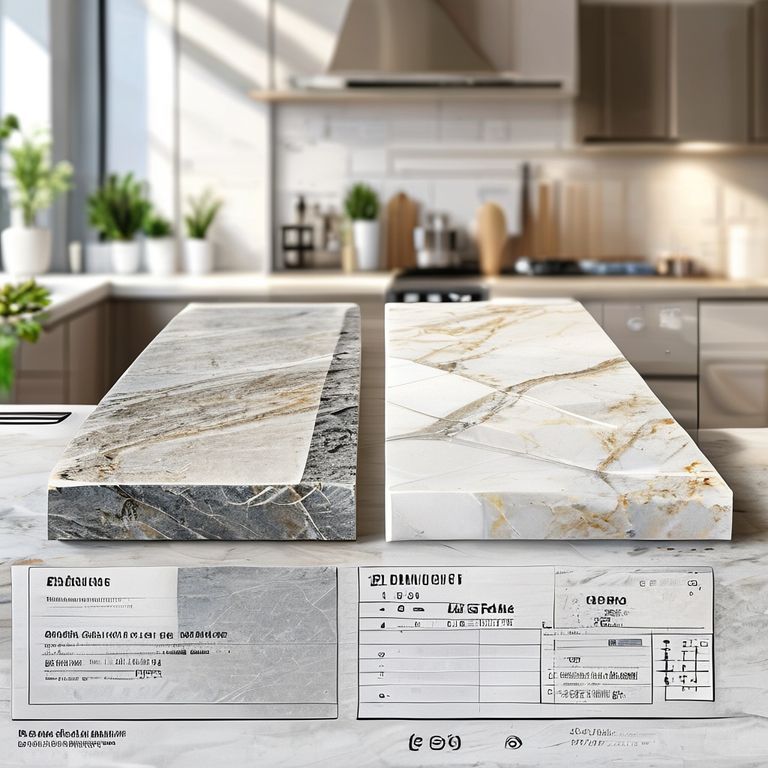
However, price is also dictated by the “unseen.” Shipping a 2.0cm slab costs more because of the weight. A standard shipping container can hold significantly more 1.5cm slabs than 2.0cm slabs before hitting the weight limit. For importers and wholesalers, this means the landed cost of 1.5cm quartz is often much more competitive. When you walk into a local stone yard, those savings are sometimes passed down to you, but often they are absorbed by the fabricator who has to deal with the increased fragility of the thinner stone during transport and cutting. It’s a delicate dance of economics. If you’re looking at a standard mid-range quartz, you might find the 2.0cm version costs 15% to 25% more than the 1.5cm version. If you’re looking at high-end, brand-name quartz with intricate veining that mimics rare natural stone, that gap can widen even further because the complexity of the pattern is harder to maintain in a thinner cross-section.
Ultimately, the choice between 1.5cm and 2.0cm thickness is the first major decision in your renovation budget. It sets the tone for everything that follows—from the strength of your kitchen cabinets to the complexity of your plumbing fixtures. If you’re aiming for a budget-conscious yet stylish apartment renovation, the 1.5cm price point offers an entry into the world of luxury stone that was once inaccessible. But if you’re building a “forever home” where the kitchen is the literal and metaphorical center of gravity, the 2.0cm slab offers a sense of permanence that many find worth the premium. As we move into Part 2, we’ll explore how these prices translate into real-world installation costs and why the “cheaper” option might sometimes end up costing you more in the long run.
While the sticker price on a raw slab of quartz is the most visible number, the true cost of choosing between 1.5cm and 2.0cm emerges during the fabrication and installation phases. This is where the “soft” part of the article becomes a “hard” reality check for many homeowners. Let’s talk about the labor. A 2.0cm slab is heavy. It requires more manpower to move, more sophisticated equipment to lift, and a very sturdy set of cabinets to rest upon. You might think, “Well, if 1.5cm is lighter, the labor should be cheaper, right?” Not necessarily. Because 1.5cm quartz is thinner, it is more susceptible to snapping during the cutting process, especially when creating large cutouts for under-mount sinks or cooktops. Fabricators often charge a “risk premium” or require additional reinforcement (like fiberglass backing or rods) for 1.5cm slabs, which can quickly close the price gap between it and the sturdier 2.0cm option.
Then there is the “edge” of the argument. In the world of quartz, the edge profile is the signature of the kitchen. If you opt for 1.5cm quartz, your options for a standard edge are limited. A 1.5cm eased edge can look a bit “skimpy” in a large, open-concept kitchen. To fix this, most people opt for a mitered edge, where the fabricator cuts the stone at a 45-degree angle and joins it to a vertical strip of the same stone. This creates the illusion of a much thicker slab. While this looks stunning, the labor cost for a mitered edge is significant. You might save $500 on the slab by choosing 1.5cm over 2.0cm, but then spend $1,000 extra on the fabrication labor to make it look thick. In this scenario, the 2.0cm slab, which looks substantial enough with a simple, inexpensive eased edge, actually becomes the more economical choice.
The price of 1.5cm and 2.0cm quartz also fluctuates based on the application. For bathroom vanities or wall cladding, 1.5cm is almost always the winner. There is no need for a 2.0cm thick stone on a vertical surface where weight is the enemy and structural impact is low. In fact, for backsplashes, using 1.5cm quartz (or even thinner 1.2cm versions) is a brilliant way to save money while maintaining a cohesive look with your countertops. It allows for a more seamless transition behind the stove and is much easier for installers to handle in tight spaces. If you are looking to maximize your budget, mixing thicknesses—2.0cm for the heavy-use island and 1.5cm for the perimeter and backsplash—is a pro move that many savvy designers use to balance the books without sacrificing the “wow” factor.
Let’s look at the longevity and resale value. Real estate is a game of perceptions. Potential buyers often can’t tell the difference between a high-grade quartz and a mid-grade one, but they can feel the difference in thickness. A 2.0cm countertop feels premium; it has a certain “thud” when you set down a coffee mug. In many markets, 2.0cm is considered the standard for high-end residential builds. If you’re looking at your renovation as an investment, the extra cost of the 2.0cm stone might be recouped in the perceived value of the home. However, if your design is ultra-modern—think handleless cabinets, integrated appliances, and a monochromatic palette—the 1.5cm slab is actually the “designer’s choice.” In the world of high-end Italian and German kitchens, the thin 15mm profile is a sign of sophistication and technical prowess. In that context, the “cheaper” 1.5cm price tag is actually a badge of style.
Pricing is also influenced by the brand and the origin of the stone. Market leaders like Caesarstone, Silestone, and Cambria have standardized their pricing models, but you’ll find that regional variations play a huge role. In some regions, 2.0cm is so dominant that 1.5cm is treated as a “special order” item, which paradoxically makes it more expensive due to shipping and handling. In other regions, particularly near major manufacturing hubs in Asia or Europe, 1.5cm is the commodity standard, and you’ll find incredible deals on it. Always ask your supplier what they have in stock. A “remnant” of a 2.0cm slab from a previous project might actually be cheaper than ordering a brand-new 1.5cm slab for a small bathroom.
In the end, the price difference between 1.5cm and 2.0cm quartz is a reflection of your priorities. Are you prioritizing the raw material cost, the finished aesthetic, or the ease of installation? If you are a DIYer or working with a contractor who isn’t a stone specialist, the 2.0cm slab is a safer, more forgiving choice. It’s the “plug and play” version of luxury. But if you are working with a master fabricator and have a vision for a sleek, modern masterpiece, the 1.5cm slab offers a world of creative possibilities that can actually save you money on material while allowing you to spend that budget on custom details.
Don’t let the numbers on the quote be the only thing that guides you. Touch the slabs, look at the edge samples, and talk to your fabricator about the “total installed cost.” Sometimes, the most expensive slab is the one that’s easiest to install, and the cheapest slab is the one that requires the most work to look right. Whether you choose the lean 1.5cm or the robust 2.0cm, quartz remains one of the best investments you can make in your home. It’s the bridge between the beauty of nature and the resilience of modern technology, and whether it’s 15mm or 20mm thick, it’s going to be the backdrop to your life for decades to come. Choose the thickness that fits your lifestyle, and the value will follow.









