
For centuries, humanity has looked to the earth’s crust for the foundations of its monuments. We have labored in deep quarries, prying slabs of marble and granite from the stubborn grip of mountains, only to find that nature is as fickle as it is beautiful. Natural stone carries with it the ghosts of geological history—veins that may crumble, pores that invite stains, and a structural unpredictability that can turn a masterpiece into a liability. But what if we could take the “DNA” of the earth—the quartz, the minerals, the crystalline structures—and rebuild them? What if we could perfect the mountain?
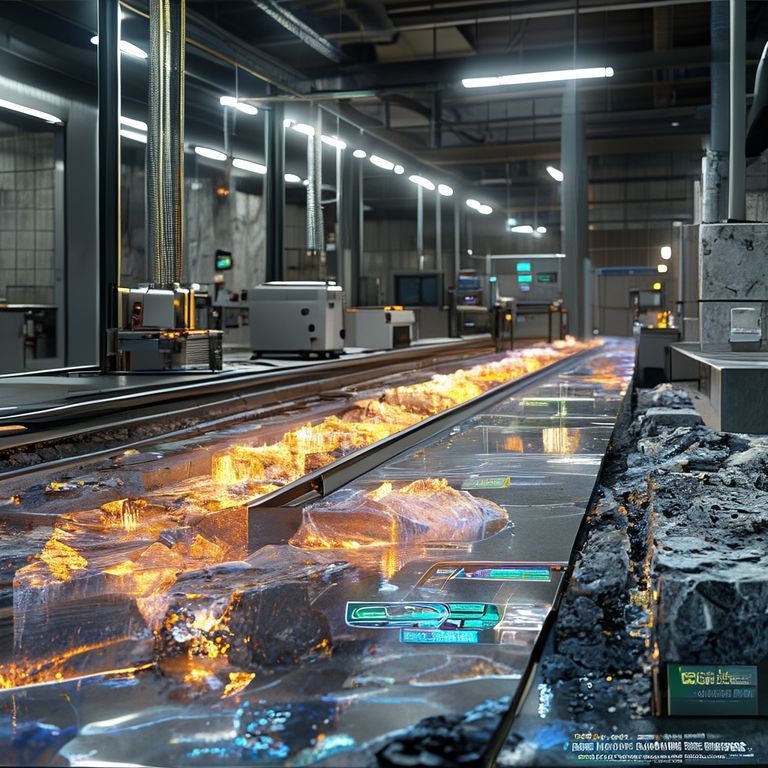
This is the central premise behind the manufacturing of artificial stone. It is a field often described as “industrial alchemy.” It is the transition from a passive reliance on what the earth provides to an active, creative mastery over the very elements of geology. The result is a material that doesn’t just mimic nature; it transcends it. To understand how we get from a pile of crushed minerals to the sleek, gleaming surfaces of a high-end penthouse, we must peel back the curtain on a process that balances brutal physical force with delicate chemical precision.
The journey begins with the selection of raw materials. In the world of high-quality engineered stone, particularly quartz, the “recipe” is everything. About 90% to 93% of the final product consists of crushed natural quartz—one of the hardest minerals on the planet. This isn’t just any sand. Manufacturers source specific grades of quartz, ranging from fine powders that create a smooth, monolithic look to larger translucent chunks that provide depth and a “crystalline” shimmer. To this base, we add the “connective tissue”: high-quality polyester resins or specialized polymers. These resins act as the binder, filling the microscopic voids between the quartz particles. Finally, pigments and aesthetic additives—think mirror chips, glass shards, or metallic flecks—are introduced to define the stone’s visual soul.
The magic truly begins in the mixing room. Imagine a massive, computerized blender where the ratios are controlled to a thousandth of a decimal point. This isn’t a simple stir; it’s a high-energy homogenization. The goal is to ensure that every grain of quartz is perfectly coated in resin and that the pigments are distributed with intentionality. If the mix is off by even a fraction, the slab might suffer from “color pooling” or structural weak points. In this stage, the manufacturer is essentially playing God with the composition of the rock, ensuring a consistency that a natural quarry could never guarantee.
Once the mix is ready, it is transferred into a massive mold, resembling a shallow, rectangular tray the size of a kitchen island. But it is still just a loose, damp slurry. To turn it into stone, we need to replicate the pressure of the tectonic plates, but at a vastly accelerated pace. This is where “Vacuum Vibration Pressing” technology comes into play.
The mold enters a massive press. First, a vacuum is pulled to remove every single bubble of air from the mixture. This is the secret to the stone’s longevity. Natural stone is porous; it breathes, it absorbs red wine, it harbors bacteria. By removing the air during the pressing phase, we create a material that is virtually non-porous. Simultaneously, the machine applies immense pressure while vibrating at high frequencies. This vibration “settles” the quartz particles into the most compact arrangement possible, a process known as densification. In a matter of minutes, the loose slurry is transformed into a dense, solid “green” slab. It is heavy, cold, and remarkably strong, even before it has fully cured.
However, the slab is not yet “stone” in the functional sense. It is a pressurized composite held together by the temporary grip of the resin. To lock its molecular structure into place, the slab must move to the curing kiln. Within these specialized ovens, the slabs are heated to specific temperatures that trigger a chemical reaction in the resin—a process called polymerization. The liquid binder undergoes a phase change, hardening into a rigid, cross-linked matrix that grips the quartz grains in an eternal embrace. This is the moment of metamorphosis. The slab emerges from the kiln not as a collection of ingredients, but as a singular, monolithic entity.
This first half of the manufacturing cycle represents the triumph of engineering over chaos. We have taken the raw, disparate parts of the earth and forced them into a state of perfect density and uniform strength. But a slab of artificial stone is more than just a structural marvel; it is an aesthetic object. The transition from a raw, cured slab to a shimmering centerpiece of architecture requires a different set of skills—the touch of the artisan and the precision of the polisher.
Once the slabs emerge from the curing kiln, they are structurally complete but aesthetically “raw.” They look like dull, matte planks of industrial material—hardly the luxury surfaces we see in architectural digests. The second half of the manufacturing process is where the stone finds its voice and its shine. This stage is a high-tech choreography of calibration, polishing, and quality control that ensures the final product feels as good as it looks.
The first stop is the calibration line. During the pressing and curing process, the slabs can emerge with slight variations in thickness or minor surface irregularities. Using massive, diamond-tipped grinding wheels, the slabs are shaved down to a precise, uniform thickness. This isn’t just about looks; it’s about engineering. When a fabricator installs a large-scale countertop, they need to know that every millimeter of that slab is consistent, allowing for seamless joints and perfect leveling.
After calibration comes the most visually dramatic phase: the polishing train. This is a long conveyor system equipped with a series of rotating heads, each fitted with increasingly fine abrasive pads. The slab moves under these heads, beginning with coarse grits that strip away the dull outer layer and ending with pads so fine they are essentially buffing the stone at a microscopic level. It is here that the quartz crystals begin to catch the light. The colors deepen, the “veins” gain clarity, and the surface takes on that characteristic cold, mirror-like luster.
But modern design demands more than just a high-gloss finish. The manufacturing process has evolved to offer a variety of textures. By changing the abrasive heads, manufacturers can create a “honed” finish, which is smooth but matte, or a “leathered” finish, which has a subtle, organic texture that mimics the feel of natural stone weathered by water. This versatility is a major reason why artificial stone has overtaken natural materials in modern interiors; it allows designers to dictate the tactile experience of a room without sacrificing the durability of the surface.
While engineered quartz (using resin) dominates the market, we must also look at the “new frontier” of artificial stone: Sintered Stone. This represents an even more extreme leap in manufacturing technology. Unlike quartz, which uses a resin binder, sintered stone is made using “Sintered Particle Technology.” The raw materials—clays, feldspar, and silica—are subjected to even higher pressures and then fired in a kiln at temperatures exceeding 1200°C.
This process mimics the way metamorphic rocks are formed in the Earth’s crust over millions of years, but condensed into a few hours. Because there are no resins involved, sintered stone is practically indestructible—it is fireproof, UV-resistant, and can be used on the exterior of skyscrapers. The manufacturing of sintered stone is a testament to how far we have come; we are no longer just “gluing” minerals together; we are literally fusing them at a molecular level to create a “super-stone” that never existed in nature.
The final, and perhaps most critical, step in the manufacturing of any artificial stone is quality control. In a world of mass production, the “eye” remains the ultimate judge. Every slab is scanned by high-resolution cameras and inspected by human technicians under specialized lighting. They look for “water spots,” pigment clumps, or tiny fissures. In high-end facilities, slabs that don’t meet the grade are recycled back into the process, ensuring that the industry remains a leader in sustainable manufacturing.
This brings us to the environmental narrative. The manufacturing of artificial stone is increasingly becoming a story of circularity. Many modern plants now use recycled glass and “pre-consumer” stone waste—the scraps left over from natural marble quarries—to create their products. By diverting this waste from landfills and using advanced water filtration systems that recycle 95% of the water used in polishing, the artificial stone industry is proving that we don’t have to scar the earth to build a beautiful home.
In conclusion, the manufacturing of artificial stone is a beautiful contradiction. It is “artificial” in the sense that it is man-made, but it is “stone” in its very soul. It represents the perfect marriage of the ancient and the futuristic. We take the raw grit of the earth and, through a symphony of vacuum pressure, chemical bonding, and diamond polishing, we turn it into something that can withstand the rigors of daily life while looking like a piece of art.
When you run your hand across a cool, veined countertop of engineered stone, you aren’t just feeling a product of a factory. You are feeling the result of decades of innovation, a material that has solved the puzzles of nature to provide us with the ultimate surface. It is more than just a building material; it is the physical manifestation of our desire to take the best parts of the world around us and make them even better. The mountain has been perfected, and the results are nothing short of spectacular.









