
The modern interior is a landscape of textures, but few materials command the room quite like artificial stone. Whether it’s the cool, clinical perfection of a quartz kitchen island or the fluid, organic curves of an acrylic solid surface in a luxury bathroom, artificial stone—often referred to as “engineered stone”—has redefined our expectations of what a surface can be. However, the true beauty of these materials doesn’t lie within the slab itself, but in the rigorous, almost obsessive “施工工艺” (construction process) that brings them to life. To understand artificial stone is to understand the marriage between industrial precision and artisanal craftsmanship.
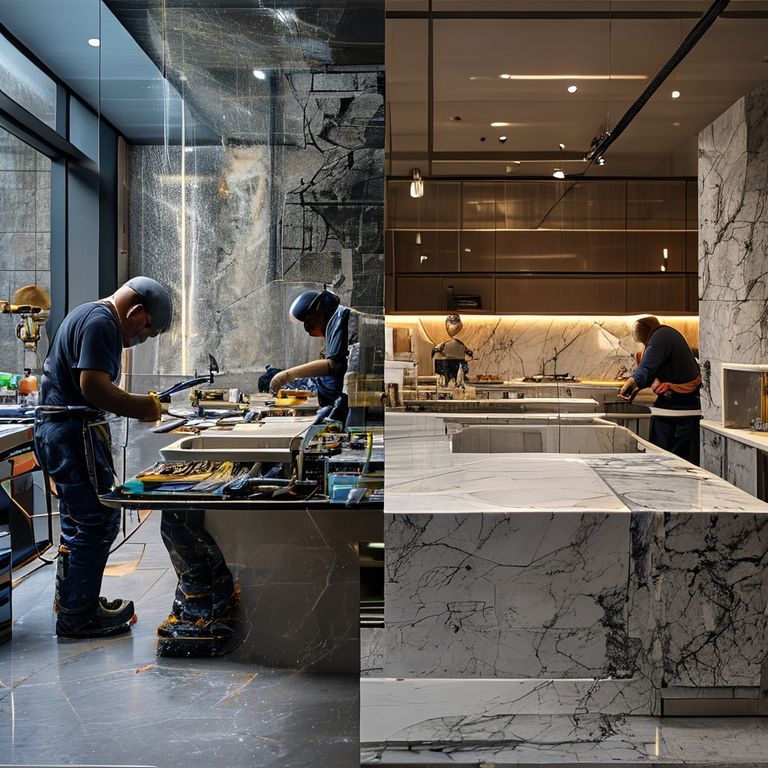
The journey begins long before a single blade touches the stone. It starts with the “Templating” phase—a step where the margin for error is non-existent. In the old days, craftsmen used strips of luan wood and hot glue to create physical skeletons of the cabinets. Today, the industry has embraced the digital frontier. Technicians use laser scanners to map the room in a three-dimensional cloud of points. They capture every slight bow in the drywall and every out-of-square corner that the naked eye would miss. This digital DNA is then fed into CAD software, ensuring that when the stone eventually arrives, it fits like a tailored suit. If the templating is flawed, the entire installation is a house of cards. This is the foundation upon which the “seamless” dream is built.
Once the digital blueprints are finalized, we move into the “Fabrication” stage, which usually takes place in a controlled factory environment. This is where raw slabs—massive, heavy, and imposing—undergo their transformation. For quartz and sintered stone, high-pressure water jets and bridge saws equipped with diamond-tipped blades do the heavy lifting. The water jet is a marvel of physics; a concentrated stream of water mixed with garnet abrasive slices through three centimeters of stone as if it were soft butter, allowing for intricate cutouts for under-mount sinks and cooktops.
For acrylic solid surfaces (like Corian), the process is slightly different and arguably more “plastic” in its potential. These materials can be thermoformed—heated until they reach a state of pliability that allows them to be bent into radiused corners or complex, three-dimensional shapes. This is a favorite for avant-garde designers who want to move away from the rigid geometry of traditional stone. During fabrication, “Edge Profiling” also takes place. Whether a client wants a simple eased edge for a minimalist look or a complex triple-pencil edge for a more classical aesthetic, this is where the stone’s personality is etched. The edges are ground down through progressive grits of polishing pads, moving from coarse to fine until the surface reflects light with the desired intensity.
One of the most critical aspects of the construction process that often goes unnoticed by the homeowner is “Back-reinforcement.” Artificial stone is incredibly strong under compression but can be brittle under tension. To prevent cracking, especially around thin strips of stone near sink or stove cutouts, fabricators often “rod” the stone. They cut narrow grooves into the underside of the slab and embed fiberglass or steel rods encased in high-strength epoxy. It’s a hidden layer of skeletal integrity that ensures the stone survives the stresses of transport and the daily rigors of a busy household.
As the slabs are loaded onto specialized A-frame trucks, the anticipation shifts from the workshop to the job site. The installation phase is where the “soft” art of the process meets the “hard” reality of construction. A professional crew doesn’t just “drop” a countertop; they calibrate it. They check the leveling of the base cabinets with a precision that borders on the neurotic. If a cabinet is even two millimeters off-level across a four-meter run, the stone could potentially crack under its own weight over time. Shims are placed with surgical care, ensuring a perfectly flat plane. Only then is the stone brought in, often requiring a team of four or five people—or specialized vacuum-cup lifting rigs—to maneuver the massive pieces into place. The stage is now set for the most magical part of the entire process: the creation of the invisible seam.
If templating is the brain of artificial stone construction, then “Jointing” is its soul. This is the moment where two separate pieces of stone become one continuous, monolithic entity. In the world of high-end artificial stone, a visible seam is a failure of craft. To achieve the “seamless” look, installers use a two-part color-matched adhesive. This isn’t just any glue; it’s a chemically engineered resin pigmented to match the specific base color and “veining” of the stone.
The installers apply the resin to the edges and then use “seam setters”—powerful vacuum-tensioning tools that pull the two slabs together with thousands of pounds of force. As the resin squeezes out of the top, the installers use leveling dials on the seam setters to ensure the two pieces are perfectly flush. Once the resin cures, it becomes as hard as the stone itself. The excess is then carefully scraped away, and the joint is sanded and polished. When done correctly, the seam vanishes. You can run your hand across it and feel nothing but a smooth, uninterrupted surface. In the case of acrylic solid surfaces, this chemical bond is so complete that the two pieces essentially melt into one another, creating a truly non-porous, hygienic surface that is a favorite in medical and high-traffic commercial environments.
Following the jointing, we enter the “Final Polishing and Finishing” stage. While much of the polishing happens in the factory, the on-site touch-ups are what separate the amateurs from the masters. This is particularly true for “satin” or “honed” finishes, where the installer must ensure that the sheen at the seams perfectly matches the factory finish of the rest of the slab. Using wet-polishing pads and a steady hand, the craftsman buffs the surface, gradually increasing the grit until the light dances off the stone in a uniform glow.
Then comes the “Sink and Appliance Integration.” If it’s an under-mount sink, the stone has already been polished on the inner rim. The sink is braced from below using specialized hardware—never just glued—to ensure it can handle the weight of a full basin of water and a garbage disposal’s vibration. The transition between the stone and the sink is sealed with high-grade, mold-resistant silicone, applied with a bead so fine it’s almost imperceptible.
The “Backsplash” installation follows, which is the final aesthetic flourish. Whether it’s a standard four-inch splash or a full-height wall cladding that extends to the upper cabinets, the alignment must be perfect. Professionals often use “scribed” fits, where the stone is custom-shaved to follow the exact contours of an uneven wall, eliminating the need for thick, ugly caulk lines. This level of detail creates a “built-in” look that elevates the entire room’s architecture.
Before the crew packs up, there is the “Quality Control and Protection” phase. The stone is thoroughly cleaned with pH-neutral cleaners to remove any fabrication dust or adhesive residue. It’s then inspected under high-intensity “work lights” to check for any micro-scratches or dull spots. For certain types of engineered stone, a high-performance sealer might be applied, though many modern quartz surfaces are essentially non-porous and don’t require it. Finally, the surface is covered with heavy-duty protective paper or “Ram Board” to protect it from other trades—plumbers, electricians, and painters—who might still be working on the site.
The “施工工艺” of artificial stone is a testament to the fact that luxury isn’t just about the material you buy; it’s about how that material is handled. A cheap slab installed by a master will always look better than a premium slab installed by a novice. When you look at a perfectly executed artificial stone installation, you aren’t just looking at quartz or acrylic; you are looking at hours of digital mapping, the raw power of water-jet technology, the chemistry of resin bonding, and the steady hand of a polisher who knows exactly how light should bounce off a surface. It is a seamless blend of technology and human touch, resulting in a surface that is as durable as it is beautiful, designed to stand the test of time and the scrutiny of the most discerning eyes. This is the art of the stone, perfected.









