
part 1:
In the realm of interior design, there is a quiet revolution happening right beneath our fingertips. For centuries, the gold standard of luxury was written in the language of the earth: cold marble, rugged granite, and the ancient grains of limestone. But as our architectural ambitions grew and our lifestyles became more demanding, nature—as beautiful as it is—started to show its cracks. Literally. Enter the era of artificial stone, a triumph of human ingenuity that blends the raw beauty of the planet with the precision of modern science.

But what exactly is artificial stone? To the uninitiated, the term might sound a bit clinical, perhaps even synthetic. However, “artificial” in this context isn’t about being “fake”; it’s about being “perfected.” Artificial stone is an umbrella term for a range of man-made materials designed to mimic the appearance of natural stone while shedding its inherent weaknesses. If natural stone is a wild, unpredictable stallion, artificial stone is the high-performance electric vehicle—sleek, reliable, and engineered for the future.
At its core, artificial stone is a composite material. Think of it as a meticulously crafted recipe. The primary ingredient is usually a high percentage of natural stone “crush”—pieces of marble, quartz, or granite that have been pulverized. These are then mixed with a specialized binding agent, typically a high-quality polyester resin or an acrylic polymer. To give it its soul—the color, the veining, the shimmering flecks—manufacturers add pigments and decorative elements like glass, mirrors, or metallic powders. This mixture is then subjected to immense pressure, vibration, and heat in a vacuum environment. The result? A slab that is denser, harder, and more versatile than almost anything pulled directly out of a quarry.
The most dominant player in this category is undoubtedly Engineered Quartz. If you’ve stepped into a high-end kitchen in the last decade, you’ve likely run your hands over it. Comprising roughly 90% to 94% ground quartz (one of the hardest minerals on Earth) and 6% to 10% resins, it is a beast of a material. Unlike marble, which “breathes” (and therefore absorbs red wine and lemon juice like a sponge), quartz is non-porous. It doesn’t need sealing. It doesn’t harbor bacteria. It is the answer to the prayer of every home cook who wants the “Carrara look” without the “Carrara anxiety.”
Then, we have the “Solid Surface” category, often associated with brands like Corian. These are more “man-made” in their DNA, utilizing acrylic or polyester resins mixed with bauxite ore. The magic here isn’t just in the durability, but in the seamlessness. You can join two pieces of solid surface stone together, and the seam disappears. It can be “thermoformed”—meaning it can be heated and bent into curves, waves, and organic shapes that would be impossible for a traditional stonemason to achieve without a miracle.
Why has this material captured the imagination of designers worldwide? It comes down to the “Curated Aesthetic.” Nature is beautiful, but it is inconsistent. If you fall in love with a specific vein of gold in a marble slab, there is no guarantee you’ll find another one like it for your backsplash. Artificial stone removes that gamble. It offers a level of “controlled beauty.” Architects can plan massive commercial projects knowing that every square inch of the lobby floor will match perfectly. Designers can offer clients “concrete looks” that don’t crack or “wood looks” that don’t rot.
Furthermore, the “materiality” of artificial stone has evolved. We have moved past the days of “plastic-looking” counters. Today’s premium artificial stones use 3D inkjet printing and advanced molding techniques to create textures that feel like leather, honed slate, or raw silk. When you touch a high-end sintered stone—a cousin of artificial stone made through extreme heat—you aren’t just touching a product; you’re touching a technological milestone.

The rise of artificial stone is also a story about the democratization of luxury. It allows a young couple renovating their first apartment to have the look of exotic Brazilian granite at a fraction of the cost and with ten times the lifespan. It’s about taking the raw materials the Earth gave us and using our collective intelligence to make them better, stronger, and more beautiful. As we move further into Part 2, we will explore the practical “superpowers” of these materials and how they are shaping the sustainable homes of tomorrow.
part 2:
While the aesthetic allure of artificial stone is what draws people in, it is the sheer, uncompromising performance that keeps them there. To truly understand what this material is, you have to look at what it does under pressure. In the chaotic theater of a modern home—where hot pans are dropped, wine is spilled, and children use the island as a craft station—artificial stone is the ultimate protagonist.
The “superpower” of artificial stone lies in its density. Because it is manufactured in a vacuum, every microscopic air bubble is removed. This makes the material incredibly resistant to impact. While a dropped heavy pot might chip the edge of a natural granite slab, artificial stone—particularly quartz and sintered versions—absorbs the shock with grace. But perhaps the most celebrated trait is its non-porous nature. In the world of hygiene, this is a game-changer. Natural stones have “pores”—tiny microscopic tunnels that can trap moisture, oils, and bacteria. Artificial stone is a fortress. Nothing gets in, which means nothing grows inside. For hospitals, laboratories, and high-traffic kitchens, this isn’t just a design choice; it’s a health standard.
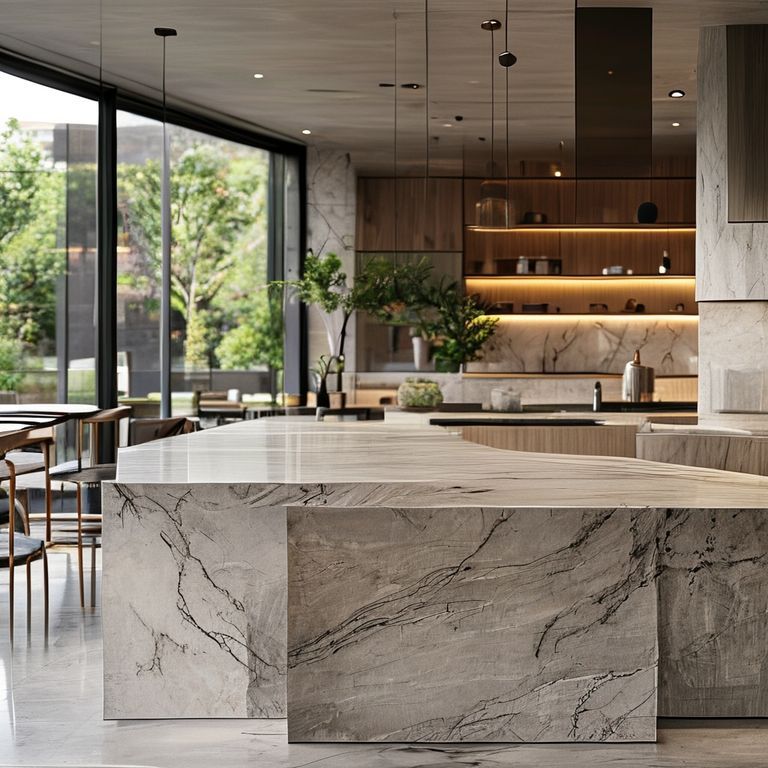
Then there is the matter of maintenance, or rather, the lack thereof. If you own a natural marble countertop, you are essentially its servant. You must seal it annually, use special pH-neutral cleaners, and live in constant fear of acidity. Artificial stone flips the script. It serves you. A damp cloth and a bit of mild soap are usually all that’s required to keep it looking brand new for twenty years. It doesn’t fade, it doesn’t “yellow” under UV light (in the case of high-quality outdoor-rated versions), and it stands up to the rigors of daily life without complaining.
But let’s talk about the future, because that is where artificial stone is truly shining. We are currently witnessing the birth of “Eco-Engineered” stone. As the world pivots toward sustainability, manufacturers are finding ways to turn waste into wonder. Some of the most exciting new artificial stones on the market are made from 100% recycled glass, mirrors, and even porcelain scraps, bound together with bio-resins derived from vegetable oils. This shifts the narrative from “extraction” to “upcycling.” We are no longer just cutting chunks out of mountains; we are taking the remnants of our industrial world and forging them into something elegant.
The versatility of the material has also allowed it to migrate from the kitchen to everywhere else. We see artificial stone being used as “thin-set” large-format cladding on the exteriors of skyscrapers, providing a lightweight yet indestructible skin. We see it in bathrooms, where it forms integrated sinks and bathtubs that feel like they were carved from a single block of ice. We even see it in furniture design—minimalist dining tables that are as thin as a smartphone but can support the weight of a feast.
For the homeowner or the architect, choosing artificial stone is an act of empowerment. You are no longer limited by what the local quarry has in stock. You can specify the exact shade of “Greige” that matches your cabinetry. You can choose a matte finish that hides fingerprints or a high-gloss finish that reflects the city lights. You are the conductor of the symphony, and the material is your instrument.
However, the “what” of artificial stone is also defined by quality. It’s important to recognize that not all man-made stones are created equal. The market ranges from budget-friendly options to ultra-premium slabs that cost more than natural stone. The difference usually lies in the quality of the resin and the complexity of the design. High-end slabs have “through-body” veining, meaning the pattern goes all the way through the thickness of the stone, allowing for beautiful edge detailing. Cheaper versions might only have the pattern printed on the surface.
In conclusion, artificial stone is the bridge between the organic world and the digital age. It represents our desire to surround ourselves with the textures of nature while enjoying the comforts of modern technology. It is a material that doesn’t just sit there looking pretty; it works, it protects, and it evolves. Whether it’s the recycled glass shimmer of a sustainable countertop or the stoic, silent strength of a quartz island, artificial stone is a testament to the fact that sometimes, the things we make with our own hands are exactly what we need to make a house feel like a home. It is the new classic, the modern heirloom, and the foundation upon which the next century of design will be built.









