
人造石是什么,人造石是什么材料做的英语怎么说
When you step into a high-end kitchen or a boutique hotel lobby, there is a specific kind of silence—a visual hush—that emanates from the surfaces. It is the look of perfection: a seamless, cool-to-the-touch expanse that feels both ancient and futuristic. For decades, the gold standard for this feeling was marble or granite, hewn directly from the earth’s crust. But a quiet revolution has taken place. If you look closer at the most stunning interiors of the 21st century, you aren’t looking at raw nature; you are looking at the pinnacle of human ingenuity. You are looking at artificial stone.
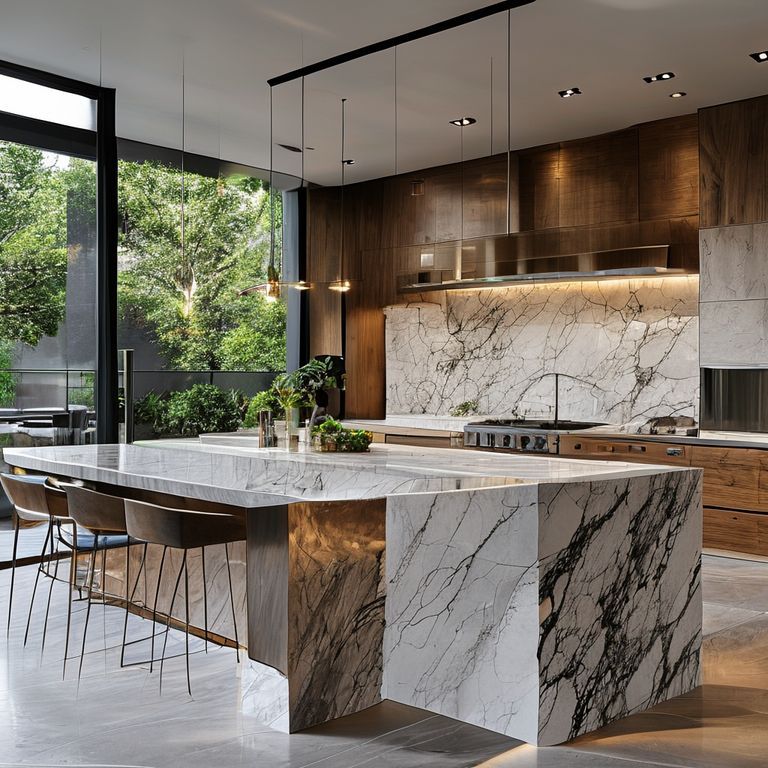
But what, exactly, is artificial stone? To understand it, we have to move past the old-fashioned “man-made” labels that once suggested cheap imitations. Today’s artificial stone—often referred to as engineered stone, quartz, or solid surface—is a masterclass in alchemy. It is the result of taking the best parts of the earth (natural minerals, crushed stone, and pigments) and binding them with high-performance polymers and resins. The result is a material that doesn’t just mimic nature; it improves upon it.
The journey of artificial stone began as a solution to a problem. Natural stone, for all its romantic beauty, is temperamental. Marble is porous and prone to staining; granite can have structural “fault lines” that lead to cracking; and both are notoriously difficult to source in perfectly consistent patterns. If you wanted a twenty-foot kitchen island with a perfectly continuous vein, nature rarely cooperated. Artificial stone changed the conversation. By controlling the manufacturing process, designers realized they could create slabs that were harder than granite, non-porous, and visually flawless.
The most popular inhabitant of this category is Engineered Quartz. Comprising roughly 90% to 94% ground natural quartz—one of the hardest minerals on Earth—mixed with polyester resins, this material has become the darling of the design world. It is the workhorse of the modern home. Because it is manufactured under intense pressure and vacuum, it is devoid of the microscopic holes found in natural stone. This means your red wine spills, your morning coffee drips, and your turmeric stains don’t stand a chance. It is a surface that invites you to actually live in your kitchen, rather than treating it like a museum.
Then, there is the world of Solid Surface materials. If Quartz is the “rock” of the family, Solid Surface is the “chameleon.” Typically made from acrylic or polyester resins mixed with bauxite ore, these materials are famous for their ability to be “thermoformed.” This means that under high heat, they can be bent and shaped into curves that would be impossible for natural stone. Imagine a sink that flows seamlessly out of the countertop without a single visible seam, or a reception desk that curves like a ribbon. This is the playground of artificial stone. It removes the limitations of the straight line, allowing architects to think in fluid, organic shapes.
Beyond the technical specs, there is an emotional component to choosing artificial stone. We live in an era where we crave control over our environment. We want our homes to reflect a specific aesthetic—perhaps a minimalist “Concrete” look, or a dramatic “Calacatta” marble vibe—without the anxiety of maintenance. Artificial stone offers this psychological freedom. It provides the “visual weight” and prestige of stone, but with a structural integrity that feels reassuring.
The manufacturing process itself is a marvel. It’s a bit like baking the world’s most expensive cake. Huge mixers combine the raw minerals with binders, and the mixture is poured into molds. It is then vibrated to remove any air pockets, compressed at incredible pressures, and cured in ovens. The final slab is then polished to a mirror-like shine or given a “honed” matte finish. This precision allows for a color palette that nature could never dream of. While nature gives us whites, greys, and blacks, artificial stone gives us “Sparkling Midnight Blue,” “Industrial Rust,” or “Translucent Alabaster.”
As we look at the evolution of “What is artificial stone,” we see it moving from a functional alternative to a luxury preference. It is no longer the “budget” option; in many cases, high-end engineered stones and sintered stones are more expensive than mid-range marbles. This is because you aren’t just paying for the material; you are paying for the technology, the durability, and the artistry of the design. It is a testament to the fact that we have reached a point where human-made beauty can stand toe-to-toe with the wonders of the natural world, offering a harmony of form and function that is perfectly calibrated for the way we live today.
As we delve deeper into the narrative of artificial stone, we must address the “New Guard” of the industry: Sintered Stone and Ultra-Compact surfaces. If quartz was the revolution of the 90s, sintered stone is the revolution of the now. While traditional engineered stone uses resins as a binder, sintered stone uses nothing but heat and pressure to mimic the metamorphic process that happens over millions of years in the earth’s crust—only it does it in a matter of hours. This results in a material that is virtually indestructible. You can torch it, scratch it with a knife, or leave it in the freezing rain, and it remains unchanged.
This level of durability has opened up a whole new frontier for artificial stone: the Great Outdoors. Historically, putting a luxury stone surface in an outdoor kitchen was a gamble. UV rays would yellow the resins in quartz, and natural stones would weather and crack. Sintered artificial stones, however, are immune to the elements. This has allowed for a “seamless transition” in modern architecture, where the same flooring and wall cladding can flow from the living room out to the poolside patio, blurring the lines between indoor comfort and outdoor freedom.
But let’s talk about the aesthetic “magic” that happens when technology meets artistry. One of the most common questions people ask is, “Can you tell it’s fake?” Ten years ago, the answer might have been a tentative yes. Today, the answer is a resounding “only if you’re an expert.” Modern digital printing technology allows manufacturers to print high-definition “veining” not just on the surface, but through the entire body of the slab. This means that when you cut an edge or carve a mitered corner, the pattern continues through the stone, just like a piece of Carrara marble pulled from a Tuscan quarry.
This “controlled beauty” is why artificial stone is the secret weapon of commercial design. Think about high-traffic areas: airport terminals, luxury malls, or hospital corridors. These spaces require materials that can withstand thousands of footsteps every day while maintaining a sterile, pristine appearance. Artificial stone is naturally antimicrobial and incredibly easy to sanitize, making it as much a health-conscious choice as an aesthetic one. In a post-pandemic world, the value of a non-porous surface that doesn’t harbor bacteria cannot be overstated.
Furthermore, there is a growing conversation about sustainability that artificial stone handles with surprising grace. While quarrying natural stone involves massive excavations and transport costs, many artificial stone manufacturers are moving toward a circular economy. They are utilizing recycled glass, mirrors, and even “waste” stone dust from natural quarries to create their slabs. By giving these materials a second life, they are reducing the environmental footprint of luxury design. When you choose a surface made from 40% recycled content that will last for 50 years, you are making a decision that favors the future of the planet.
For the homeowner, the appeal often comes down to the “life-proof” nature of the product. Imagine a Saturday morning: your kids are eating messy pancakes, you’re prepping a dinner party, and someone accidentally drops a heavy cast-iron skillet on the counter. With natural stone, you’d be checking for chips or cracks with a racing heart. With a high-quality artificial stone, you simply wipe the surface clean and move on with your day. It is this lack of “preciousness” that makes it truly luxurious. Real luxury isn’t something you have to baby; real luxury is something that serves you.
Looking toward the future, the possibilities for artificial stone are limited only by our imagination. We are already seeing “smart surfaces” where induction charging for your phone is built directly into the stone countertop, or where the stone itself can act as an induction cooktop, allowing you to cook your eggs directly on the surface without a visible stove. We are seeing translucent stones that can be backlit to create glowing walls of light, turning a bathroom or a bar into a piece of luminous art.
In the end, what is artificial stone? It is a bridge. It is the bridge between the raw, chaotic beauty of the geological world and the precise, demanding needs of modern life. It is a material that acknowledges our love for the look of the earth but respects our need for performance, hygiene, and consistency. It is a canvas for designers, a sanctuary for homeowners, and a feat of engineering that continues to redefine what we mean by “quality.”
Whether you are renovating a kitchen, designing a skyscraper, or simply dreaming of a space that feels both timeless and effortless, artificial stone offers a solution that nature alone cannot provide. It is the ultimate expression of human creativity—taking the dust of the earth and turning it into something extraordinary. So, the next time you run your hand across a smooth, cool countertop, take a moment to appreciate the science and the soul behind it. It isn’t just a stone; it’s a masterpiece of modern alchemy.









