
When you walk into a room that feels truly expensive—not just costly, but curated—there is often a silent hero at play: the scale of the surfaces. In the modern era of interior architecture, we have moved far beyond the era of small, disjointed tiles and the limitations of quarried rock. We are living in the age of the engineered stone revolution. This isn’t just about chemistry or durability; it is a story about dimensions. The size of an engineered stone slab is the canvas upon which the poetry of a home is written. If the slab is too small, you are left with a patchwork of seams that interrupt the visual flow. If it is sized perfectly, you achieve a monolithic grandeur that feels as if it were carved from a single, celestial mountain.
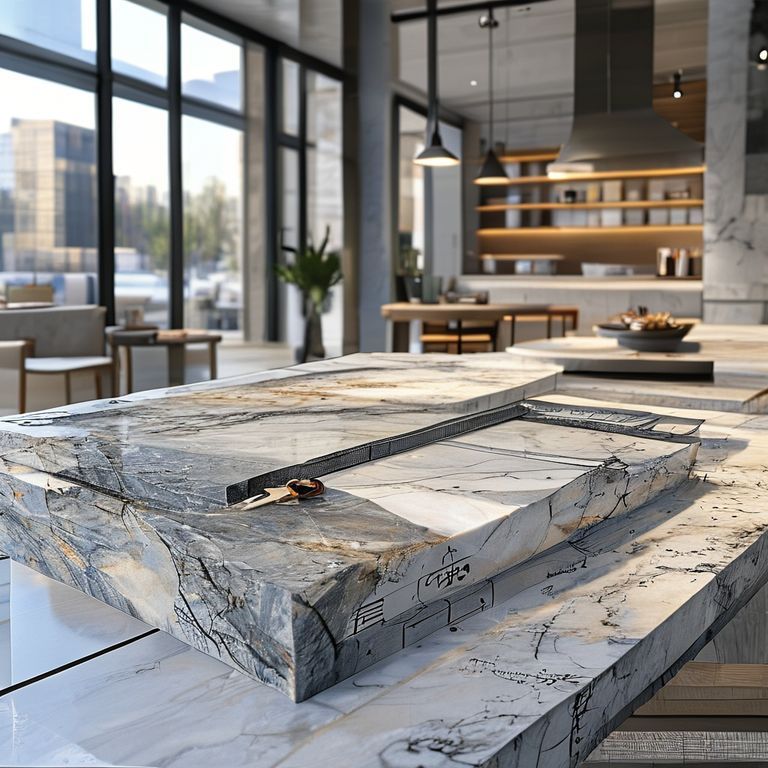
For decades, the industry operated under the constraints of “standard” sizes. If you wanted a kitchen island, you worked with what was available, often resulting in awkward grout lines or visible joins that broke the “vein-matching” illusion. Today, the conversation has shifted. When we discuss engineered stone slab sizes, we are talking about the “Jumbo” and “Super Jumbo” formats that have redefined what is possible. Typically, a standard quartz slab might sit around 3000mm by 1400mm (roughly 118 by 55 inches). However, the luxury market has pushed these boundaries to 3200mm by 1600mm and even larger. Why does this matter? Because the average modern kitchen island has grown. Homeowners no longer want a functional workspace; they want a social hub. A 3.2-meter slab allows for a seamless waterfall island—where the stone flows from the top down to the floor without a single break in the pattern. That is the difference between a renovation and a masterpiece.
But let’s talk about the nuance of these dimensions. It isn’t a “one size fits all” game. The thickness of the slab is the third dimension that dictates the entire vibe of the space. You’ll see slabs ranging from ultra-thin 6mm sheets to the robust 20mm and 30mm standards. The 6mm and 12mm formats, often found in sintered stone, are the darlings of contemporary minimalism. These large-format, thin slabs are being used to clad entire walls, from floor to ceiling. Imagine a bathroom where every wall is a single piece of book-matched stone. There are no grout lines to scrub, no visual noise to distract the eye. This is where dimension meets utility. By selecting a slab that matches the height of your room, you eliminate the “chopped up” look that plagues traditional tiling.
The physics of these larger slabs is also a marvel of modern engineering. Natural stone, like marble or granite, is riddled with internal fissures and unpredictable weak spots. This makes cutting massive, thin sheets a risky endeavor—they are prone to snapping. Engineered stone, however, is a composite of high-purity quartz or mineral blends bound with resins and subjected to intense vacuum and vibration. This process creates a structural integrity that allows for these massive surface areas. When you opt for a “Jumbo” slab, you aren’t just buying more material; you’re buying the confidence that the material can handle the span of a breakfast bar or a massive dining table without the need for cumbersome support structures.
Furthermore, the “size” of a slab influences the “yield.” This is the intellectual side of design that often goes unmentioned. A savvy designer looks at the dimensions of the engineered stone and maps out the kitchen layout to minimize waste. If your slab is 3200mm long and your counter run is 3300mm, you’ve hit a logistical snag that requires a second slab. However, if you understand the dimensions from the start, you can tweak the cabinetry or the overhang to fit perfectly within the footprint of a single piece. This isn’t just about saving money; it’s about the elegance of efficiency.
Then there is the texture. As the slab size increases, the impact of the finish becomes more pronounced. A polished 3200mm slab of “Calacatta-style” quartz reflects light across a vast, uninterrupted plane, making a room feel twice its actual size. On the other hand, a “honed” or “leathered” finish on a massive scale provides a tactile, organic warmth that grounds a high-tech kitchen. The dimensions allow the pattern—whether it’s a bold, dramatic vein or a subtle, sandy speckle—to breathe. In smaller formats, a heavy vein can feel cluttered. On a grand slab, it looks like a piece of art. We are seeing a move toward these “monolithic” designs where the stone is the focal point, and the furniture is merely an accessory. The size of the slab is what makes that hierarchy possible.
Continuing our journey into the architectural impact of slab sizing, we have to address the “Sintered Stone” phenomenon, which has pushed dimensions into a whole new stratosphere. While quartz slabs are limited by the size of the molds and the curing ovens, sintered stone—essentially a man-made version of metamorphic rock created through extreme heat and pressure—can be produced in staggering sizes. We are seeing slabs that reach 3600mm or even 4000mm in length. This is a game-changer for commercial spaces, luxury hotel lobbies, and high-end residential exteriors. When you have four meters of continuous material, the concept of a “wall” changes from a structural necessity to a decorative canvas.
The logistics of these massive dimensions are where the professionals really show their worth. Handling a 1600mm x 3200mm slab that weighs several hundred pounds requires precision. It’s a dance of suction cups, A-frames, and reinforced transport. But the result justifies the effort. In modern open-plan living, where the kitchen, dining, and lounge areas merge, the stone surfaces act as the visual anchor. Large-format slabs allow designers to “wrap” elements. You don’t just put a slab on top of a cabinet; you wrap the sides, the drawers, and even the sinks in the same material. This “integrated” look is only possible because the slab dimensions are large enough to provide the “skin” for these architectural features.
Let’s dive into the mathematics of the “Super Jumbo” slab. For a fabricator, a larger slab offers a higher degree of flexibility during the “nesting” phase. Nesting is the process of laying out the various pieces of a project—the main countertop, the backsplash, the island, and the bathroom vanity—onto the slab surface before cutting. With a larger dimension, there is more room to maneuver around the “movement” or patterns in the stone. If there is a particular vein that you want to highlight on the edge of the sink, a larger slab gives you the real estate to shift the cut lines without running out of material. This level of customization is what separates a high-end installation from a generic one. You aren’t just getting a countertop; you’re getting a piece of the stone that was specifically chosen for its visual flow.
Beyond the kitchen, the dimensions of engineered stone are revolutionizing furniture design. We are seeing a surge in demand for bespoke dining tables made from a single slab of sintered stone or quartz. A table that seats twelve people requires a length of at least 3000mm. In the past, such a table would have to be made of wood or a heavy, fragile piece of natural marble. Now, with engineered stone, you can have a table that is incredibly thin (thanks to the 12mm slabs), extremely durable (resistant to wine stains and scratches), and perfectly sized. The dimension becomes the defining characteristic of the furniture.
Then there is the ecological and sustainable angle. While it might seem counterintuitive, larger slabs can actually lead to less waste. When a project is designed with the slab’s dimensions in mind, the “offcuts” are minimized. Furthermore, the longevity of these materials means they won’t need to be replaced for decades. Unlike smaller tiles that might crack or go out of style, a massive, seamless stone surface is a timeless architectural statement. It transcends trends. By choosing a slab that fits the space perfectly, you are investing in a permanent fixture of the home’s value.
For those planning a renovation, the advice is simple: don’t treat the slab size as an afterthought. It should be one of the first things you discuss with your architect or designer. Ask about the “usable area” of the slab. Some slabs have “untrimmed” edges that can’t be used in the final product, so a 3200mm slab might actually give you 3150mm of pristine surface. Knowing these specifics prevents heartbreaks during the installation phase. Also, consider the access to your home. A “Super Jumbo” slab is a marvel, but it needs to fit through your front door or up your staircase!
In the end, the evolution of engineered stone slab dimensions is a testament to our desire for beauty without compromise. We want the look of the natural world but with the performance of modern technology. We want the drama of a massive, sweeping stone surface without the headache of maintenance. Whether it’s a 20mm quartz slab for a rugged kitchen or a 6mm sintered stone sheet for a sophisticated feature wall, the dimensions are the key. They provide the scale, the seamlessness, and the sheer “wow factor” that defines contemporary luxury. When you choose your stone, you aren’t just choosing a color or a pattern; you are choosing the scale of your ambition. Let your surfaces be big, bold, and entirely without limits. After all, in the world of design, size isn’t just a measurement—it’s a feeling.









