
part 1:
The world of interior design is currently undergoing a silent revolution, one that doesn’t just happen on the drafting boards of architects, but in the heart of high-tech manufacturing facilities. We are witnessing the era of the “engineered marvel.” While natural stone has held the crown of luxury for millennia, a new protagonist has emerged: Artificial Stone. This isn’t a mere imitation; it is a sophisticated evolution. The process of turning crushed minerals and high-performance resins into monolithic slabs is a feat of modern alchemy, blending the raw power of geology with the precision of aerospace engineering.
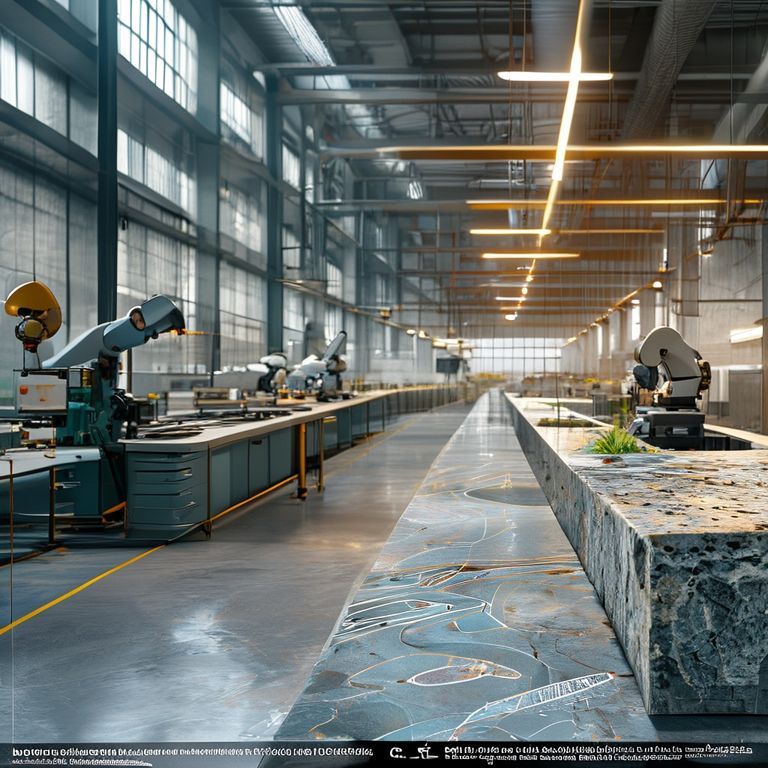
To understand the allure of artificial stone—whether it be quartz, solid surface, or the cutting-edge sintered stone—one must first appreciate the meticulous “recipe” that begins the journey. The process starts not with a block of stone, but with a selection of raw materials so precise it would make a jeweler blush. High-purity silica sand, crushed quartz, or marble chips are the bones of the operation. These are not simply shoveled into a vat; they are graded by grain size. This granulometry is the secret sauce. By mixing various sizes of particles, manufacturers ensure that the smaller grains fill the voids between the larger ones, creating a structural density that natural stone can rarely match.
But what holds this mineral skeleton together? The “flesh” of the artificial stone is a specialized binder, typically a high-quality polyester or acrylic resin. In this stage, the material is more like a high-tech dough than a rock. This is where the magic of aesthetics begins. Pigments are introduced—not just dumped in, but often swirled or injected using automated systems that mimic the chaotic, beautiful veining found in Calacatta marble or the deep, brooding shadows of basalt. The result is a material that possesses the soul of natural stone but the reliability of a manufactured product.
The transition from a viscous mixture to a solid slab is where the heavy machinery takes center stage. Enter the “Vacuum Vibration Compression” technology. This is perhaps the most critical stage in the processing of artificial stone slabs. The mixture is poured into massive molds and subjected to a simultaneous assault of intense vibration and a powerful vacuum. The vacuum sucks out every microscopic air bubble, while the vibration settles the particles into a perfect, interlocking grid. Under hundreds of tons of pressure, the mixture is compacted into a dense, non-porous slab. This lack of porosity is the defining characteristic of high-end artificial stone; it is what makes a countertop resistant to the red wine spills of a dinner party or the harsh chemicals of a laboratory.
Once the slab is formed, it enters the curing kiln. This isn’t just a big oven; it’s a controlled environment where temperature and timing are managed by sophisticated algorithms. As the slabs travel through the kiln, the resin undergoes polymerization—a chemical reaction that permanently bonds the minerals into a rigid, rock-hard matrix. It is here that the “artificial” becomes “stone.” The slabs emerge from the kiln glowing with residual heat, structurally sound and ready for the final, most transformative phase of their journey.
At this point, the slab is “raw.” It is thick, dull, and slightly uneven. The next step is calibration. Massive, diamond-tipped grinding heads move across the surface with surgical precision, shaving away millimeters of material until the slab is perfectly uniform in thickness. This level of consistency is a luxury that installers dream of. Unlike natural stone, which can vary in thickness across a single piece, an engineered slab is a mathematical constant. This precision allows for the seamless transitions and “waterfall” edges that have become the hallmark of contemporary kitchen design.
Following calibration, we move into the realm of the senses: polishing. This is a multi-stage process where the slab passes under a series of polishing heads, each finer than the last. We move from coarse abrasives that level the surface to ultra-fine pads that coax out a mirror-like reflection. However, the beauty of modern artificial stone processing is its versatility. If a high-gloss finish isn’t the goal, the process can be adjusted to create “honed” (matte), “leathered” (textured), or “brushed” finishes. Each texture offers a different tactile experience, allowing designers to play with the way light interacts with the space.
In this first half of the production cycle, we see a bridge being built between the earth’s raw resources and the refined needs of human habitation. The processing of artificial stone isn’t about faking nature; it’s about perfecting it. It takes the best qualities of the earth—hardness, longevity, and beauty—and strips away the flaws—porosity, fragility, and unpredictability. As we move from the factory floor toward the final fabrication and installation, the story shifts from industrial might to the delicate touch of the artisan.
part 2:
While the birth of a slab happens in the thunderous environment of the press and the kiln, its “soul” is refined in the fabrication shop. If the first part of the process is about creating a canvas, the second part is the masterpiece itself. The transition from a standard 126-inch by 63-inch slab into a custom-fitted piece of architectural art requires a blend of digital intelligence and manual craftsmanship that is truly a sight to behold.
The modern fabrication process begins with a digital “twin.” Before a single blade touches the stone, the installation site is mapped using laser scanners. This data is fed into CAD (Computer-Aided Design) software, where the slab is virtually laid out. This is a crucial step for aesthetic continuity. If a designer wants the veins of a backsplash to line up perfectly with the countertop, the “Bookmatching” or “Vein-matching” is done here in the digital realm. The software allows the fabricator to move the template over a high-resolution photograph of the actual slab, ensuring that the most beautiful features of the stone are highlighted in the final installation.
Once the layout is perfected, the CNC (Computer Numerical Control) machines take over. These are the titans of the fabrication world. Using a combination of high-speed diamond saws and waterjets—which use water pressurized to 60,000 PSI mixed with garnet abrasive to cut through stone like a hot knife through butter—the machine follows the digital path with sub-millimeter accuracy. The waterjet, in particular, has revolutionized artificial stone processing. It allows for intricate curves, delicate cutouts for under-mount sinks, and complex geometric patterns that were once considered impossible or prohibitively expensive.
However, despite the dominance of the machines, the human element remains irreplaceable. Edge profiling is a perfect example. While a CNC machine can grind a basic “bullnose” or “mitered” edge, the final hand-polishing of those edges is what gives the stone its “expensive” feel. A master fabricator runs their hands along the rim, feeling for the slightest imperfection that the eye might miss. They use hand-held pneumatic polishers to ensure that the edge has the exact same luster as the face of the slab.
One of the most impressive feats in artificial stone processing is the “Invisibeam” or seamless joint. Because these slabs are engineered with specific resins, fabricators can use color-matched adhesives that are chemically identical to the stone itself. When two pieces are joined, the adhesive slightly melts the edges together, and once polished, the seam becomes virtually invisible. This allows for massive, seemingly monolithic structures—islands that look like they were carved from a single giant block of marble, or reception desks that flow around corners without a break in the pattern.
The “Artificial Stone” category has also expanded into the realm of “Sintered Stone” or “Ultra-compact Surfaces,” which represents the pinnacle of current processing technology. In this variation, the “binder” is removed entirely. Instead, the minerals are subjected to even higher pressure and “fired” at temperatures that mimic the conditions deep within the earth’s crust. This process, known as sintering, causes the particles to fuse at a molecular level. The resulting slab is practically indestructible—it is heat-proof, scratch-proof, and UV-stable. Processing these slabs requires even more specialized equipment, as their extreme hardness makes them a challenge to cut, pushing the boundaries of what diamond tools can achieve.
As we look toward the future, the processing of artificial stone is increasingly leaning into sustainability. The industry is moving toward a “circular economy” model. Many high-end slabs now incorporate recycled glass, mirrors, or even “upcycled” stone waste from marble quarries. The resins are being replaced with bio-based alternatives derived from corn or soy. The processing plants themselves are becoming closed-loop systems, recycling 95% of the water used in the cutting and polishing phases. This evolution ensures that the beauty we bring into our homes doesn’t come at the cost of the planet.
Ultimately, the craft of artificial stone slab processing is a testament to human ingenuity. It is a field where we take the chaos of the natural world and organize it into something functional, durable, and breathtakingly beautiful. It’s about more than just “fake stone”; it’s about the pursuit of the perfect surface. Whether it’s a sleek, white quartz island in a minimalist kitchen or a dramatic, textured wall in a luxury hotel lobby, these slabs are the result of a complex dance between chemistry and art.
When you run your hand across a finished artificial stone surface, you aren’t just feeling a product; you’re feeling the end result of intense heat, massive pressure, digital precision, and the steady hand of a craftsman. It is a material designed to withstand the rigors of life while maintaining the elegance of a museum piece. In the world of modern construction, artificial stone has moved from a secondary option to the primary choice, proving that when science and aesthetics collaborate, the results are written in stone.









