
The kitchen is the undisputed heart of the home, but it’s also a battlefield. It’s where heavy cast iron pans are slammed down during a frantic Tuesday night dinner, where citrus juices are spilled in the quest for the perfect cocktail, and where hot trays are occasionally set down in a moment of distraction. When you’re standing in a showroom, surrounded by shimmering slabs of stone, one question inevitably crops up: “Is 1.5cm quartz enough?” In the Chinese market and increasingly in international design circles, the debate between the 1.5cm and 2cm thickness is heated. Choosing 1.5cm feels like a bold move—it’s sleek, it’s modern, and it’s often more budget-friendly. But does that missing half-centimeter mean you’re sacrificing the structural integrity of your dream kitchen?
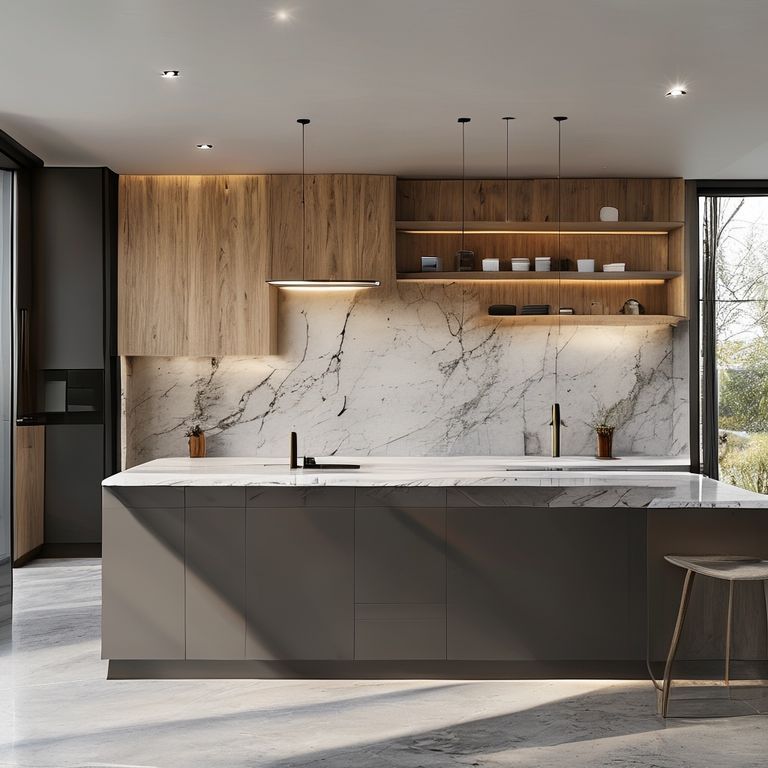
To understand the 1.5cm quartz phenomenon, we have to look at the shift in global design aesthetics. For decades, the “chunky” look was synonymous with luxury. We wanted our countertops to look like massive blocks of stone carved straight from a mountain. However, as the minimalist movement took over, spearheaded by Italian and Scandinavian designers, the silhouette of the kitchen began to slim down. The “ultra-thin” profile became the new hallmark of high-end design. In this context, 1.5cm quartz isn’t a compromise; it’s an intentional choice for a refined, contemporary look. It allows for a kitchen island that looks like a singular, sharp-edged piece of art rather than a heavy piece of furniture.
But let’s talk about the elephant in the room: durability. Quartz is an engineered stone, a composite of ground quartz, resins, and pigments. This manufacturing process makes it incredibly dense and non-porous. When people ask if 1.5cm is “enough,” they are usually worried about cracking—specifically under the weight of a heavy pot or the vibration of a powerful blender. Here’s the reality: quartz is inherently strong. In fact, a 1.5cm slab of high-quality quartz is significantly more resilient than a 3cm slab of many natural marbles or granites. The “strength” of a countertop isn’t just about thickness; it’s about the quality of the resin and the pressure used during the manufacturing process. If you’re buying from a reputable brand, a 1.5cm slab has undergone rigorous stress testing to ensure it can handle the daily grind.
Another factor that makes 1.5cm quartz an attractive option is the weight. If you’re renovating an older home or designing a kitchen with custom, minimalist cabinetry, the load-bearing capacity of your units matters. A 2cm or 3cm slab puts immense pressure on your cabinet carcasses. 1.5cm quartz offers a “Goldilocks” solution—it’s heavy enough to feel premium and stay in place, but light enough to allow for more creative cabinet designs, including floating islands or handle-less systems that might struggle with the sheer mass of thicker stone.
The financial aspect is also hard to ignore. In the world of home renovation, costs have a way of spiraling. Opting for 1.5cm quartz can often save you a significant percentage on material costs compared to 2cm or 3cm slabs. In a large kitchen with expansive counter space and a waterfall island, those savings can be the difference between settling for a basic backsplash and being able to afford that designer tile you’ve been eyeing. However, the “soft” part of this article is reminding you that these savings only matter if the result looks and performs as expected.
So, why does the 2cm standard still haunt our decision-making? It’s largely psychological. We are conditioned to believe that “more is more.” We think a thicker steak is better, a thicker mattress is more comfortable, and a thicker countertop must be stronger. But in the world of engineering, “optimal” is the goal, not “maximum.” When you see a 1.5cm countertop properly installed with a clean, mitered edge, it doesn’t look “thin” in a cheap way; it looks “slim” in an expensive way. It creates a profile that is architectural rather than just functional.
As we move into the technicalities of installation in the next section, keep this in mind: 1.5cm quartz is a tool in your design kit. It’s not just a way to save money, and it’s certainly not a “weak” version of a real countertop. It’s a specific material choice for a specific aesthetic. Whether it’s “enough” for you depends entirely on how you plan to build the support system underneath it. Because, as any veteran contractor will tell you, a countertop is only as good as the cabinets it sits on.
If Part 1 convinced you that 1.5cm quartz can hold its own in the style department, Part 2 is about the “how.” How do we make sure that “enough” actually feels like “plenty”? The secret to a successful 1.5cm installation lies not in the stone itself, but in the substructure. This is where the amateurs are separated from the pros. When a 1.5cm slab fails, it’s almost never because the stone was too thin; it’s because the support was inadequate.
When you install a 1.5cm countertop, you must ensure that your cabinetry is perfectly level. Any slight dip or peak in the cabinet line creates a stress point. When you then place a heavy object—like a 10-quart stand mixer or a full stockpot—over that gap, you’re asking the stone to flex. Quartz doesn’t like to flex. To combat this, high-quality installations of 1.5cm quartz often utilize a full underlayment, typically made of high-grade plywood or a specialized aluminum support frame. This distributes the weight evenly across the entire surface area of the cabinets. With this support, a 1.5cm slab becomes functionally indestructible for normal household use.
Let’s address the “edge” of the conversation. One of the most common reasons homeowners hesitate with 1.5cm is the fear that the edge will look too spindly. This is where the “mitered edge” technique saves the day. Your fabricator can take a 1.5cm slab and create a mitered apron that makes the countertop appear to be 4cm, 6cm, or even 10cm thick at the edges. You get the lightweight benefits and the cost savings of the 1.5cm material, but with the visual “heft” of a much thicker piece of stone. Conversely, if you embrace the thinness and go with a simple eased edge, you achieve that “paper-thin” ultra-modern look that is currently dominating high-end Italian kitchen magazines. It’s a look that says, “My kitchen is so well-engineered it doesn’t need to be bulky.”
What about heat and impact? Regardless of thickness, quartz is heat-resistant but not heat-proof. The resin in the stone can discolor if you take a pan directly from a 200°C oven and set it down. This is true for 1.5cm and 3cm alike. Similarly, while quartz is incredibly hard, the edges can chip if struck with a heavy object at just the right angle. Choosing a 1.5cm slab doesn’t make your edges twice as likely to chip as a 3cm slab; the “chip-ability” is more about the edge profile (rounded edges chip less than sharp, 90-degree corners) than the thickness of the material itself.
In the context of the modern “smart kitchen,” 1.5cm quartz is actually a superior choice. Many people are now opting for hidden induction burners that sit beneath the countertop, or integrated wireless charging pads. Thinner stone allows for better thermal and magnetic conductivity, making these futuristic features easier to implement. If you’re looking to build a “kitchen of the future,” the 1.5cm slab isn’t just enough—it’s actually the preferred medium.
There is also the environmental perspective to consider. A 1.5cm slab uses 25% less raw material than a 2cm slab and significantly less than a 3cm one. It requires less energy to transport and less manpower to install. In an era where we are all trying to reduce our carbon footprint, choosing the thinner option is a quiet way to be more sustainable without sacrificing the beauty of your home.
So, back to the original question: Is 厨房石英石1.5够用吗? (Is 1.5cm kitchen quartz enough?) The answer is a resounding “Yes,” with a few small caveats. It is enough if you are working with a skilled fabricator who understands the importance of a level sub-base. It is enough if you are looking for a sleek, modern aesthetic that prioritizes clean lines over bulky mass. It is enough if you want to save a bit of budget for other luxury finishes without compromising on the quality of your prep surface.
When you walk into your kitchen five years from now, you won’t be thinking about that 0.5cm difference. You’ll be looking at the way the light hits the polished surface, the way the stone resists the stains of a spilled glass of red wine, and how much more open and airy your kitchen feels because you didn’t clutter it with heavy, oversized slabs. The 1.5cm quartz countertop isn’t a “budget” choice; it’s a “smart” choice. It’s the realization that in modern design, elegance is often found in the leanest forms. So, take the leap. Go slim. Your kitchen—and your sense of style—will thank you for it. High-performance, high-style, and high-efficiency are all packed into that 1.5cm profile. It’s not just enough; it’s exactly what a modern home needs.









