
When you walk into a high-end kitchen showroom, there is a specific kind of magnetism that draws you toward the countertops. It’s that cool, polished surface that promises both the endurance of a mountain and the elegance of a gallery. But as you start flipping through the sample swatches and looking at the spec sheets, you’ll encounter a technical fork in the road that leaves many homeowners scratching their heads: the choice between 1.5cm and 2.0cm thickness.

On the surface—quite literally—the difference is a mere 0.5 centimeters. That’s about the thickness of a pencil or a few stacked credit cards. In the grand scheme of a massive kitchen island, it feels negligible. However, in the world of interior architecture and long-term durability, those five millimeters represent a world of difference in engineering, aesthetics, and, most importantly, your bank account. If you’re caught in the “1.5 vs 2.0” debate, you aren’t just choosing a slab of stone; you’re choosing the structural integrity and the visual “weight” of your home’s most-used room.
Let’s start with the visual profile. In the modern design landscape, we are seeing two divergent trends. On one hand, there is the “ultra-sleek” movement, inspired by European minimalist aesthetics. This style favors thin lines, hidden handles, and surfaces that look almost like a thin sheet of paper floating over the cabinetry. For this look, the 1.5cm slab is the undisputed king. It offers a contemporary, lightweight feel that works beautifully in smaller apartments or “scandi-chic” kitchens where you want to avoid a bulky appearance.
On the other hand, there is the “timeless luxury” trend. This is the look of the grand suburban kitchen, the professional chef’s station, and the “statement” island. Here, mass matters. A 2.0cm slab (often referred to as 3/4 inch in some regions) provides a sense of permanence and gravitas. It looks substantial. It feels like it could survive a century of heavy use. When you look at the edge of a 2.0cm countertop, the pattern of the quartz—whether it’s a subtle grain or a bold Calacatta vein—has more room to breathe. It creates a more immersive visual experience.
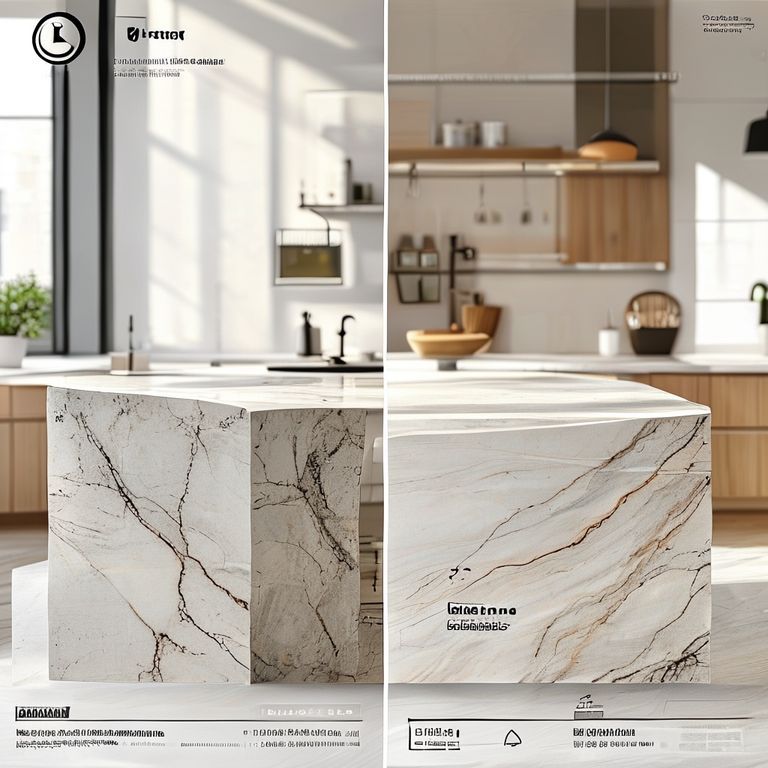
But design isn’t just about what meets the eye; it’s about what the eye tells the brain about quality. When a guest leans against a 2.0cm countertop, there is a subconscious perception of strength. The 1.5cm counterpart, while equally beautiful, can sometimes feel “economical” if not styled correctly. However, the 1.5cm slab has a secret weapon: the mitered edge. Many designers take a 1.5cm slab and “build up” the edge to make it look like 4cm or even 6cm thick. This gives you the look of a massive block of stone while saving on the material cost of the entire slab. But this brings us to the first major price differentiator: labor.
In terms of raw material, 2.0cm quartz is naturally more expensive than 1.5cm. You are quite literally paying for more stone, more resin, and more weight. Generally, the price of a 2.0cm slab can be 20% to 35% higher than its 1.5cm sibling. If a 1.5cm slab costs you $1,000, you can expect the 2.0cm version of the same brand and pattern to land somewhere between $1,250 and $1,350. But don’t let that sticker price fool you into thinking the 1.5cm option is always the “budget” choice.
Because 1.5cm quartz is thinner, it is more fragile during transport and installation. It also often requires a plywood sub-top for support, especially over large spans like a dishwasher or a seating overhang. This means you might save $300 on the stone but spend $200 on extra labor and materials to ensure it doesn’t crack the first time someone sits on the counter to reach a high cabinet.
The 2.0cm slab, by contrast, is often strong enough to be installed directly onto the cabinet frames without a full plywood sub-base (depending on local building codes and the specific brand of quartz). This inherent strength is one of the primary reasons why the 2.0cm thickness has become the industry standard for premium builds. It’s the “Goldilocks” of thickness—not too heavy to crush your cabinets, but strong enough to handle the chaotic reality of a busy kitchen.
In the next section, we’ll dive deeper into the physical durability—how they handle heat, impact, and heavy appliances—and break down the specific “hidden costs” that can make a “cheaper” 1.5cm countertop end up costing more than a 2.0cm masterpiece.
Continuing our deep dive into the quartz thickness debate, we have to talk about the “lifestyle” factor. A kitchen isn’t a museum; it’s a high-traffic workspace. This is where the physical properties of the 2.0cm slab really start to shine over the 1.5cm alternative.
Think about the impact. Maybe it’s a heavy cast-iron skillet that slips from your hand, or a grocery bag full of canned goods dropped a bit too forcefully. The sheer density of a 2.0cm slab provides a much higher “impact resistance.” While quartz is incredibly hard, the thinner a material is, the more prone it is to flex. Under extreme pressure or sudden impact, a 1.5cm slab has a slightly higher risk of developing a stress crack, particularly around “weak points” like the sink cutout or the cooktop area. If you have a busy household with kids, pets, and a lot of home cooking, that extra 0.5cm acts as a form of insurance for your investment.
Then there’s the issue of heat. No quartz is truly “heat-proof”—the resins used to bind the stone can scorch if you put a pan straight from the oven onto the surface. However, a thicker slab (2.0cm) has more thermal mass. It can dissipate heat slightly more effectively than a thin sheet. While you should always use a trivet, the 2.0cm slab offers a bit more leeway for those “oops” moments.
Now, let’s talk about the money—the real “price gap” you’ll see on your quote. As we established, the raw material cost usually sees a 20-30% jump. However, the total project cost often tells a different story. In the stone fabrication world, labor is a massive variable.
If you choose a 1.5cm slab but want it to look thick and luxurious, you will ask for a “mitered edge.” This involves the fabricator cutting the edge at a 45-degree angle and gluing a vertical strip of stone to the front. This is a highly skilled, time-consuming process. By the time you pay for the extra labor to make a 1.5cm slab look like a 4.0cm slab, you might find that your total bill is actually higher than if you had just bought a 2.0cm slab with a simple eased edge.
Conversely, if you are looking for the absolute lowest entry price for a rental property or a laundry room, 1.5cm with a basic flat edge is the winner. In these scenarios, the price gap remains wide. In the current market, for a standard-sized kitchen, choosing 1.5cm over 2.0cm can save you anywhere from $500 to $1,500 depending on the square footage. For some, that’s the cost of a new dishwasher or a fancy faucet.
Another hidden factor is the overhang. Do you dream of a kitchen island where your family can sit on barstools and eat breakfast? If so, the 2.0cm slab is your best friend. A 1.5cm slab usually cannot overhang more than 6 to 8 inches without requiring unsightly metal support brackets. A 2.0cm slab can often extend up to 10 or 12 inches (depending on the brand’s specific guidelines) without extra support, maintaining that clean, floating look that everyone craves in a modern island.
So, how do you decide? Let’s look at the “Final Verdict” logic.
Choose 1.5cm if:
You are on a strict budget and are okay with a thinner, more “efficient” look. You are designing a ultra-modern, “thin-line” kitchen where sleekness is the primary goal. You are doing a bathroom vanity or a backsplash where heavy impact and weight aren’t concerns. You are planning to do a deep mitered edge anyway, and the core thickness doesn’t matter for the visual.
Choose 2.0cm if:
This is your “forever home” and you want the maximum durability and resale value. You want a substantial overhang for a breakfast bar without heavy bracing. You prefer the classic, hefty look of natural stone. You want peace of mind knowing the slab has a higher resistance to cracking and stress.
In the end, the “price difference” is more than just a line item on a receipt. It’s a trade-off between upfront savings and long-term resilience. While 1.5cm is a fantastic, versatile material that has its place in modern design, the 2.0cm slab remains the “standard” for a reason. It bridges the gap between the budget-friendly and the indestructible.
When you’re standing in your finished kitchen six months from now, running your hand across the surface, you won’t be thinking about the few hundred dollars you saved or spent. You’ll be noticing the way the light hits the edge of the stone and how solid it feels when you set down your morning coffee. In the battle of the 1.5 and the 2.0, the “best” choice is the one that lets you enjoy your kitchen without a second thought. If your budget allows for the leap to 2.0cm, it is almost always the smarter investment for the heart of your home.









