
Standing in a stone gallery, surrounded by towering slabs of engineered quartz, you’re likely to be seduced by the patterns first. The swirling Calacatta veins, the moody charcoals, or the pristine sparkles of “Stellar White” usually steal the spotlight. But once you move past the aesthetics, your fabricator or designer is going to drop a technical question that often catches homeowners off guard: “Do you want 1.5 or 2.0?”
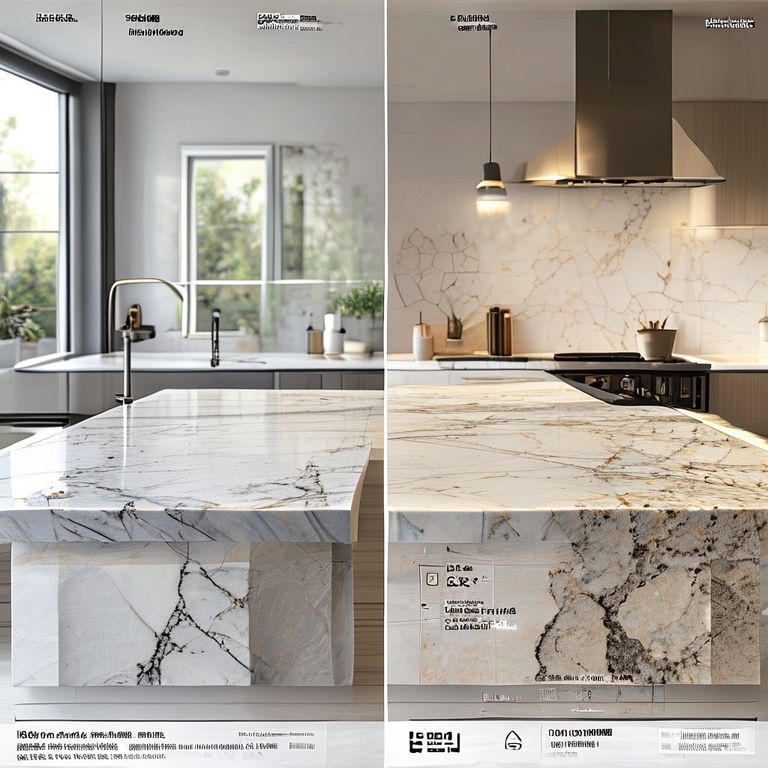
To the uninitiated, five millimeters sounds like a negligible difference—the width of a few stacked credit cards. However, in the world of interior architecture, those five millimeters represent a fundamental shift in structural integrity, visual weight, and, perhaps most impactfully, your final invoice. The debate between 1.5cm (15mm) and 2.0cm (20mm) quartz isn’t just about thickness; it’s about the soul of your kitchen’s workspace and the longevity of your investment.
Let’s start with the visual gravitas. There is a specific psychological profile associated with the thickness of a countertop. A 2.0cm slab is widely considered the “standard” in high-end residential design. It offers a sense of permanence and “heft” that feels substantial under your palms. When you lean against a 20mm edge, there is an unspoken assurance of strength. It looks traditional, grounded, and expensive. On the other hand, the 1.5cm slab is the darling of the minimalist, modern movement. It’s sleek, slim, and understated. In a contemporary kitchen where “less is more,” a 15mm profile can make a space feel lighter and more agile. However, the catch is that 15mm can sometimes look “thin” or “budget” if not handled with the right edge profile—a nuance we’ll explore in depth.
Beyond the look, we have to talk about the physics of the material. Quartz is an engineered stone, typically composed of roughly 90-93% crushed natural quartz and 7-10% polymer resins. This composition makes it incredibly dense and non-porous. However, density doesn’t always equate to invincibility against torque or impact. A 2.0cm slab possesses significantly more flexural strength than its 1.5cm counterpart. If you have a large island with a significant overhang for seating—say, a 10-inch to 12-inch breakfast bar—a 2.0cm slab is much more capable of supporting its own weight without the immediate need for unsightly steel brackets or plywood sub-tops.
The 1.5cm slab, while still incredibly tough compared to laminate or wood, is more brittle under stress. In the fabrication shop, 15mm slabs require more delicate handling. During transportation and installation, the risk of a “snap” at the sink cutout—the most vulnerable point of any countertop—is statistically higher with 1.5cm material. This isn’t to scare you away from the thinner option, but rather to highlight why professional installers often breathe a sigh of relief when they see a 2.0cm slab on the order sheet. It’s simply more forgiving.
Now, let’s touch on the “Price Gap” mystery. Many consumers assume that because 1.5cm uses 25% less raw material than 2.0cm, it should be 25% cheaper. If only the world of global logistics and manufacturing were that linear. In reality, the price difference at the wholesale level usually sits between 10% and 15%. Why the discrepancy? Because the cost of quartz isn’t just the stone itself; it’s the overhead of the factory, the energy required to vibrate and vacuum-press the slabs, the diamond tools used to polish them, and the shipping containers that bring them from overseas. A shipping container has a weight limit. While you can fit more 1.5cm slabs into a container than 2.0cm ones, the labor and energy to produce each slab remain relatively constant.
Furthermore, the “savings” you find in the raw material of a 1.5cm slab often vanish during the fabrication process. Because 1.5cm is thinner, many homeowners don’t like the “thin” look of the edge. To fix this, fabricators often perform a “mitered drop edge,” where they cut a strip of stone and glue it to the perimeter to make the countertop look 4cm or 5cm thick. This process is labor-intensive and requires high-precision machinery and skilled hand-polishing. By the time you’ve paid for the extra labor to make a 1.5cm slab look thick, you might find yourself paying more than if you had just started with a 2.0cm slab and left the edge as is.
There is also the regional factor to consider. In many parts of the world, 2.0cm is the baseline. This means distributors stock it in higher volumes, leading to better economies of scale. 1.5cm is often treated as a specialty item or a “project” grade material (commonly used in massive apartment complexes to shave off costs across 500 units). If you’re a retail customer looking for a one-off slab for your dream kitchen, you might find that the color selection in 1.5cm is narrower, or that the lead times are longer because it’s not the “stock” thickness.
In this first half of our exploration, we’ve established that while 1.5cm offers a sleek, modern aesthetic and a slightly lower entry price for the material itself, it brings structural challenges and hidden fabrication costs to the table. The 2.0cm slab remains the “Goldilocks” thickness—sturdy enough for most designs, visually balanced, and widely available. But the story doesn’t end at the slab’s edge. In the next part, we will dive into the installation nuances, the long-term resale value, and the specific scenarios where 1.5cm actually outperforms the 2.0cm heavyweights.
Continuing our journey into the world of quartz thickness, we need to address the practicalities of how these slabs actually live in your home. While we’ve established the structural benefits of 2.0cm, there is a specific architectural niche where 1.5cm isn’t just a budget choice—it’s the superior choice.
Think about vertical applications. If you are planning a full-height backsplash—where the quartz continues from the countertop all the way up to the bottom of your cabinets or the ceiling—weight becomes your primary enemy. A 2.0cm slab is heavy. Hanging that much weight on a vertical drywall surface requires significant mechanical fastening and a very sturdy wall structure. 1.5cm quartz is the “sweet spot” for backsplashes. It provides that seamless, luxury look without the excessive weight, making the installation faster, safer, and less likely to put undue stress on your wall studs.
The same logic applies to bathroom vanities and furniture toppers. If you’re putting a quartz top on a delicate, vintage-style vanity or a custom-built nightstand, 2.0cm can look “clunky” and overbearing. The 1.5cm thickness maintains the elegance of the furniture’s proportions. It’s also a favorite for “waterfall” edges on smaller islands where a 2cm or 3cm profile might overwhelm the room’s scale.
Now, let’s talk about the “Feel Factor.” There is a tactile difference in how these materials dissipate heat and sound. Because 2.0cm quartz has more mass, it tends to feel “colder” to the touch for longer and has a deeper, more muted sound when you set down a ceramic mug or a glass. 1.5cm quartz can have a slightly higher-pitched “clack” and warms up to room temperature faster. It sounds like a minor detail until you’re living with it every day in a quiet house. The perceived quality of a home is often found in these sensory details—the weight of a door, the sound of a drawer closing, and yes, the resonance of a countertop.
Returning to the “Price Gap,” we need to look at the long-term ROI (Return on Investment). If you are flipping a house or preparing a rental property, 1.5cm is a strategic move. It allows you to market the home as having “luxury quartz countertops” while keeping your capital expenditure low. Most buyers or renters won’t bring a ruler to the open house; they see the stone, they see the sparkle, and they’re sold. However, if this is your “forever home,” the 2.0cm slab is usually the wiser investment. The added durability against chips—especially around the dishwasher where pots and pans are frequently knocked against the edge—is significantly higher with the 20mm thickness. A chip in a 1.5cm edge is much harder to repair invisibly because there is less “meat” in the stone to work with.
When discussing price with your contractor, always ask for the “all-in” installed price. This is where the 1.5cm vs 2.0cm debate gets interesting. In some markets, the labor for 1.5cm is actually higher because the material is more fragile to cut. Fabricators might add a “risk premium” to the quote. Conversely, because 2.0cm is the industry workhorse, many shops have their CNC machines calibrated specifically for that thickness, making the production line move faster and more efficiently. You might find a scenario where a 2.0cm slab of “Grade A” quartz actually costs the same as a 1.5cm slab once you factor in the labor and the support structures needed for the thinner stone.
Let’s address the “Sub-top” issue. In many installations, particularly with 1.5cm quartz, a plywood sub-top is required to bring the countertop up to the standard height and to provide the necessary support to prevent cracking. This adds another layer of material and labor cost. With 2.0cm quartz, you can often skip the plywood entirely and mount the stone directly onto the cabinet frames (depending on the cabinet’s construction and the stone’s span). This creates a cleaner look from the underside—something you’ll appreciate every time you open a drawer and look up.
So, where does that leave you, the decision-maker?
The 1.5cm quartz is your choice if:
You are doing a vertical backsplash or wall cladding. You are designing a modern, ultra-slim minimalist kitchen. You are working on a high-volume commercial or rental project where every dollar per square foot is scrutinized. You are planning a complex mitered edge (e.g., a 6cm thick-look edge), where the starting thickness of the slab matters less than the skill of the joinery.
The 2.0cm quartz is your choice if:
You want the best balance of price, durability, and availability. You have large spans or overhangs without extra bracing. You prefer a classic, substantial aesthetic. You want the peace of mind that comes with the industry-standard thickness.
The price difference, while real, is often a secondary consideration to the “total system” of your kitchen design. A 1.5cm slab might save you $300 on the raw material, but if it requires $400 in extra labor or support, you’ve actually lost ground. The smartest approach is to select the thickness that aligns with your design’s structural needs first, then work backward to the budget.
In the end, whether you choose the nimble 1.5cm or the sturdy 2.0cm, quartz remains one of the best investments you can make in a home. It’s a marriage of nature’s beauty and human engineering. Just remember: that 5mm gap is small in measurement, but it’s the difference between a surface that merely looks good and one that’s engineered to perform for a lifetime. Choose based on how you cook, how you live, and the “weight” you want your home to carry.









