
When you walk into a kitchen that feels “expensive,” your eyes don’t just land on the high-end appliances or the custom cabinetry. They inevitably drift toward the horizontal planes—the countertops. In the modern era of interior design, quartz has claimed its throne as the undisputed king of surfaces. It’s hard, non-porous, and can mimic everything from Calacatta marble to industrial concrete. But once you decide on quartz, you’re immediately hit with a technical fork in the road: do you go with 1.5cm or 2.0cm thickness? And in a market flooded with names, does the “Haiguai Xinyuan” brand actually live up to the whispers of its growing popularity?
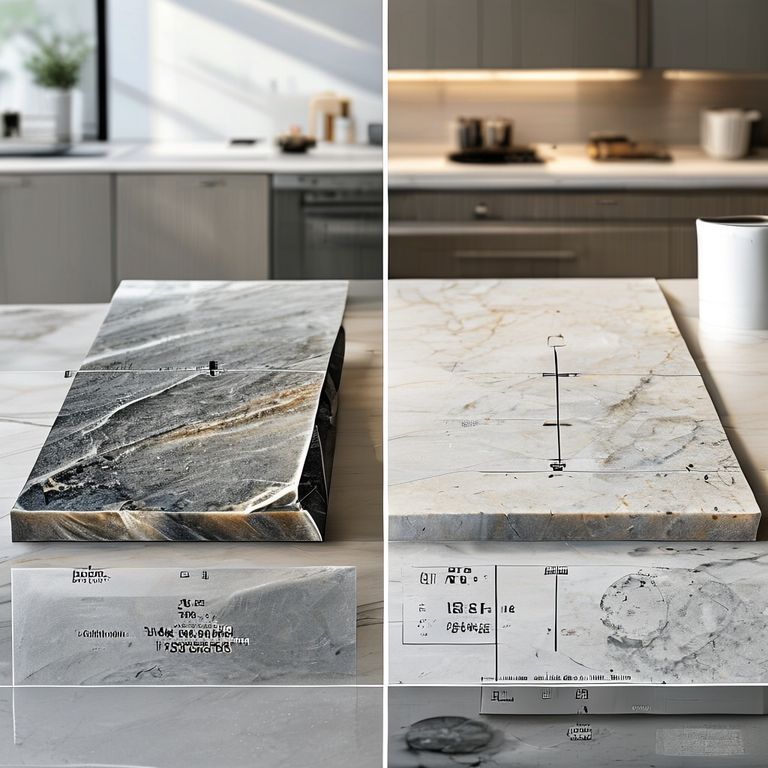
Let’s start with the basics of the “Thickness War.” In the stone industry, we often speak in centimeters, and while a 0.5cm difference sounds negligible on paper, in the world of structural integrity and visual weight, it is a chasm. The 1.5cm quartz slab is the lean, agile cousin of the family. It’s often preferred in modern, minimalist designs where a “slim-line” aesthetic is desired. Think of those sleek, European-style kitchens where the countertop looks almost like a thin sheet of silk draped over the cabinets.
However, 1.5cm isn’t just about the look; it’s about weight and cost. If you are renovating a space where the sub-structure—the cabinets themselves—isn’t built like a fortress, 1.5cm exerts significantly less pressure. It’s also a favorite for vertical applications. If you want a seamless look where your countertop climbs up the wall to become a full-height backsplash, 1.5cm is much easier to install and less prone to pulling away from the drywall due to gravity. But there’s a trade-off. Because it’s thinner, it has a lower threshold for impact. If a heavy cast-iron skillet slips from your hand, a 1.5cm slab is statistically more likely to suffer a hairline crack compared to its thicker counterpart. Furthermore, to make a 1.5cm slab look substantial, fabricators often have to use “mitred edges”—gluing a vertical strip to the front to fake a thicker appearance. While beautiful, this creates a seam that, if poorly executed, can become a point of failure or an eyesore.
Now, let’s pivot to the 2.0cm slab. This is the global gold standard for a reason. When you run your hand across a 2.0cm quartz surface, there is an inherent sense of permanence. It feels grounded. Structurally, 2.0cm quartz offers superior flexural strength. You can often achieve longer “overhangs” for breakfast bars without needing as many unsightly support brackets. It’s the workhorse thickness. If your kitchen is a high-traffic zone where kids drop backpacks, chefs pound out dough, and the occasional heavy grocery bag is slammed down, 2.0cm provides that extra layer of “insurance.”
The visual impact of 2.0cm is also distinct. It allows for more intricate edge profiles. While a 1.5cm slab is mostly limited to square or slightly eased edges, the 2.0cm thickness allows for a beautiful bullnose, an ogee curve, or a deep bevel that catches the light and highlights the crystalline structure of the stone. In terms of market value, homes featuring 2.0cm countertops often command a higher perceived value because the material itself is physically more substantial.
But thickness is only half the battle. You could have a 3.0cm slab of low-quality resin, and it would still fail you in six months. This brings us to the second part of the equation: the brand. Specifically, Haiguai Xinyuan (海怪新源). In the competitive landscape of Chinese quartz manufacturing, Haiguai Xinyuan has started to emerge as a name synonymous with “industrial-grade resilience meeting domestic elegance.”
The name itself, “Haiguai” (meaning Sea Monster), suggests something formidable and powerful. In the context of quartz, that power translates to the vacuum-vibration-compression process used to create the slabs. High-quality quartz isn’t just poured into a mold; it’s engineered under immense pressure to remove every microscopic air bubble. This is where Haiguai Xinyuan has invested heavily. Their slabs are known for a high density that rivals the top-tier international brands. When you’re choosing between 1.5 and 2.0, you also have to consider the purity of the quartz. Haiguai Xinyuan prides itself on a high ratio of natural quartz aggregates (usually around 93%) to polymer resins. Why does this matter? Because cheaper quartz brands use more resin to save money, resulting in a surface that scratches easily and can actually “scorch” if you put a hot kettle on it.
As we move deeper into the comparison, we must realize that the choice between 1.5 and 2.0 isn’t just a “good vs. better” scenario. It’s about matching the material to the mission. If you’re a designer working on a high-end apartment with weight restrictions, the 1.5cm Haiguai Xinyuan slab offers the perfect blend of lightness and high-density durability. But if you’re building your “forever home” kitchen, the 2.0cm slab from the same brand offers a level of ruggedness that can survive a generation of family dinners.
Continuing our deep dive into the Haiguai Xinyuan brand, we have to look past the technical specs and into the soul of the stone: the aesthetics. One of the most common complaints about “budget” or “off-brand” quartz is that it looks “printed” or “plastic.” You’ve seen it—those slabs where the marble veining looks like it was drawn on by a shaky hand with a gray marker. This is where Haiguai Xinyuan separates itself from the pack.
The brand has mastered the art of through-body patterning. Whether you are looking at a 1.5cm or a 2.0cm slab, the “movement” in the stone isn’t just skin deep. If you choose a 2.0cm slab with a deep bevel, the pattern continues through the edge. This is a hallmark of high-quality quartz engineering. Haiguai Xinyuan’s palette ranges from the ultra-clean “Arctic Whites” that remain bright even under yellow kitchen lighting, to the sophisticated “Galactic Grays” that feature subtle shimmering particulates. These particulates aren’t just for show; they are carefully graded quartz crystals that provide the Mohs hardness (usually around 6 to 7) that makes the surface nearly impossible to scratch with a standard kitchen knife.
So, is Haiguai Xinyuan “good”? To answer that, you have to look at the three pillars of quartz quality: Porosity, Pigment Stability, and Slab Flatness. First, porosity. A “Sea Monster” brand should, ironically, be completely impervious to liquids. Haiguai Xinyuan slabs have a water absorption rate that is near zero. This means that if you spill red wine, turmeric, or balsamic vinegar on your 1.5cm or 2.0cm countertop and don’t notice it until the next morning, it won’t leave a permanent ghost stain. Second, pigment stability. Many homeowners find that their quartz yellows over time when exposed to UV light from a nearby window. Haiguai Xinyuan utilizes high-grade, UV-stable pigments that maintain their “day one” color for years. Finally, slab flatness. When you are installing 1.5cm quartz, any slight “bowing” or “warping” in the slab can cause it to crack during the leveling process. Haiguai Xinyuan’s manufacturing precision ensures that their slabs arrive perfectly flat, making the installer’s job easier and the final result more professional.
But let’s get down to the practicalities of the 1.5 vs 2.0 choice within the Haiguai Xinyuan catalog. If you are leaning toward the 1.5cm thickness, you should be aware that while the stone is tough, the thinner profile means you have less “meat” for the sink cutout. If you’re planning an under-mount sink—the kind that hangs below the stone—a 2.0cm slab offers a much more secure “bite” for the clips and adhesive. If you insist on 1.5cm for the sleek look, ensure your fabricator is experienced with reinforcing the sink area with fiberglass rods or extra bracing.
On the flip side, the 2.0cm Haiguai Xinyuan slab is a dream for “waterfall” islands. This is the design trend where the countertop continues down the side of the cabinet all the way to the floor. The extra thickness of the 2.0cm slab allows for a much stronger 45-degree miter joint at the corner. It feels solid, it looks monolithic, and it creates a focal point in the home that screams luxury.
Cost is often the elephant in the room. Usually, a 2.0cm slab costs about 20% to 30% more than a 1.5cm slab of the same material. With Haiguai Xinyuan, the price-to-performance ratio is one of their strongest selling points. You are getting a slab that performs like a premium Italian or Spanish brand but at a price point that reflects efficient Chinese manufacturing and supply chain logistics. For many homeowners, this “middle ground” is the sweet spot. You aren’t paying for a massive marketing budget or a celebrity designer’s name; you’re paying for the resin quality and the quartz density.
When people ask, “Is Haiguai Xinyuan good?” they are usually asking two things: “Will it last?” and “Will it look cheap?” Based on the current market feedback and the structural properties of their 1.5 and 2.0 lines, the answer to the first is a resounding yes—provided it is installed correctly. As for looking cheap? The brand has moved significantly into the “luxury-affordable” space. Their newer collections, particularly the ones that mimic natural quartzite and Calacatta gold, are indistinguishable from natural stone to the untrained eye.
In conclusion, the choice between 1.5 and 2.0 quartz isn’t just a measurement; it’s a lifestyle decision. If you prioritize a sharp, modern, lightweight aesthetic and you’re careful with your surfaces, the 1.5cm Haiguai Xinyuan is an elegant, cost-effective choice. However, if your kitchen is the “combat zone” of a busy family, or if you want the most luxurious edge profiles and structural peace of mind, the 2.0cm slab is the undisputed winner.
Whichever thickness you choose, the Haiguai Xinyuan brand provides a reliable foundation for your home. It’s a brand that understands that a countertop isn’t just a work surface; it’s a piece of furniture you interact with every single day. By selecting the right thickness and a brand that doesn’t cut corners on resin quality, you’re not just renovating a kitchen—you’re upgrading your quality of life. In the end, the “Sea Monster” might just be the best guardian your kitchen ever had.









