
The kitchen is no longer just a place where meals are prepared; it has evolved into the atmospheric soul of the modern home. It’s where coffee-fueled morning epiphanies happen, where wine-soaked late-night conversations linger, and where the physical manifestations of our culinary ambitions take shape. At the center of this universe lies the countertop—the silent workhorse that bears the brunt of our knives, the heat of our pans, and the spills of our celebrations. When you find yourself standing in a showroom, surrounded by shimmering slabs of engineered stone, you are inevitably confronted with a technical choice that feels surprisingly existential: Should you go with the 1.5cm or the 2.0cm thickness? And more importantly, in a market flooded with names, does the “Haiguai Xinyuan” (Sea Monster New Source) brand actually deliver the reliability its evocative name suggests?
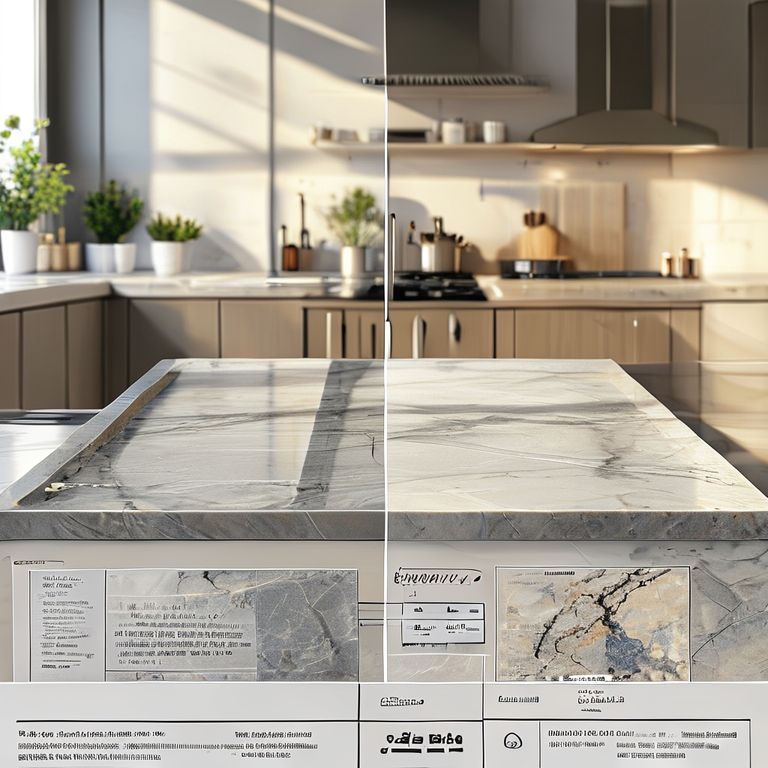
Let’s peel back the layers of the thickness debate first. In the world of quartz, those five millimeters represent more than just a measurement; they represent a philosophy of design and a commitment to structural integrity. For a long time, the industry standard hovered around the 1.5cm mark. It was the “safe” bet—light enough to transport without a crane, thick enough to handle a rolling pin. However, as our kitchens have grown more ambitious and our aesthetic tastes more refined, the 2.0cm slab has emerged as the premium heavyweight contender.
Choosing between 1.5cm and 2.0cm isn’t a simple case of “bigger is better.” It’s about the synergy between your cabinetry and your lifestyle. The 1.5cm quartz stone is the sleek, agile athlete of the surfacing world. It offers a contemporary, minimalist profile that looks stunning in modern, “handleless” kitchen designs. Because it is lighter, it places less stress on your base cabinets, which can be a significant factor if you are retrofitting an older kitchen with delicate or vintage cabinetry. However, because it is thinner, it often requires a “built-up” edge—a process where a second strip of stone is mitered to the edge to give it a thicker appearance. While skilled fabricators make this seam invisible, it is still a point of intervention.
On the flip side, the 2.0cm quartz stone is the bedrock of luxury. It is solid, through and through. When you run your hand along the edge of a 2.0cm slab, you are feeling the raw, unadulterated mass of the material. There is no need for mitered edges here; the stone speaks for itself. This thickness is particularly well-suited for heavy-duty kitchens. If you are the type of cook who slams down heavy cast-iron Dutch ovens or hosts massive family gatherings where the countertop becomes a buffet station for forty people, that extra 0.5cm provides a psychological and physical sense of security. It absorbs vibration better and has a higher threshold for impact resistance.
But thickness is only half the battle. You could have a three-centimeter slab of low-grade resin and sand, and it would still fail you within a year. This brings us to the brand factor. In the vast landscape of Chinese manufacturing, “Haiguai Xinyuan” (海怪新源) has started popping up in conversations among contractors and savvy homeowners alike. The name itself is intriguing—”Haiguai” translates to Sea Monster, suggesting something formidable and powerful emerging from the depths, while “Xinyuan” implies a new source or a fresh beginning.
Is Haiguai Xinyuan good? To answer that, we have to look at what makes quartz “good” in the first place. Quality quartz isn’t just dug out of the ground; it’s an engineered marvel. It typically consists of about 90-93% crushed natural quartz aggregates bound together with high-quality polymer resins and pigments. The magic happens in the vacuum vibration compression molding process. Haiguai Xinyuan has positioned itself as a brand that focuses heavily on the density of this compression.
When you examine a slab of Haiguai Xinyuan, the first thing you notice is the “tightness” of the grain. Low-quality quartz often has microscopic pores that you can’t see with the naked eye but will certainly notice when a drop of red wine turns into a permanent purple tattoo on your white “marble-look” surface. Haiguai Xinyuan’s manufacturing process aims for a near-zero porosity. This means that whether you choose their 1.5cm or 2.0cm variant, the liquid resistance remains top-tier.
Furthermore, the brand seems to have mastered the art of “the bleed.” In the early days of quartz, the patterns (the veins and swirls) were often just printed on the surface, looking like a cheap 1990s screensaver. Haiguai Xinyuan utilizes advanced 3D inkjet and through-body veining technology. This means that if you chip the edge or decide to do a fancy recessed drainboard, the pattern continues through the thickness of the stone. This is where the difference between 1.5 and 2.0 becomes an aesthetic playground. With a 2.0cm Haiguai Xinyuan slab, a “shark nose” or a “bullnose” edge profile looks incredibly premium because the internal structure of the stone is as beautiful as the surface.
In this first part of our exploration, we’ve established that 1.5cm is the choice for the modern minimalist and the budget-conscious renovator, while 2.0cm is the choice for the traditionalist and the high-intensity chef. But as we move forward, we need to dive deeper into the technical specs of Haiguai Xinyuan. How does it handle a 200-degree pan? Does it scratch when you’re slicing sourdough? And how does the price-to-performance ratio stack up against the global giants of the industry?
Continuing our deep dive into the world of premium surfaces, let’s talk about the “torture test.” A countertop isn’t a museum piece; it’s a battlefield. When evaluating Haiguai Xinyuan against the industry standards, we have to look at the Mohs scale of mineral hardness. Natural quartz sits at a 7, which is incredibly hard (diamonds are a 10). Haiguai Xinyuan maintains this integrity, ensuring that their slabs are effectively scratch-resistant under normal culinary conditions. You can’t exactly use it as a sharpening stone for your Japanese steel knives, but the accidental slip of a blade isn’t going to leave a permanent scar.
One of the most common questions regarding the 1.5cm versus 2.0cm debate involves heat resistance. There is a common misconception that a thicker stone can handle more heat. In reality, quartz is a “thermal shock” sensitive material regardless of its thickness. The resins used to bind the quartz can discolor or even crack if exposed to extreme, localized heat (like a pot straight from the stove). While a 2.0cm slab has more mass to dissipate heat, the difference is marginal. Haiguai Xinyuan uses high-polymer resins with a higher-than-average thermal threshold, but the advice remains the same: always use a trivet. The “goodness” of the brand here lies in its transparency and the quality of those resins, which are less likely to yellow over time when exposed to UV light from a kitchen window.
Now, let’s talk about the “Sea Monster” in the room: the price and accessibility of Haiguai Xinyuan. In the premium quartz market, you often pay a “brand tax” for names like Caesarstone or Silestone. These are fantastic products, but for many homeowners, the cost can be prohibitive. Haiguai Xinyuan occupies a “sweet spot” in the market. It offers the aesthetic sophistication of European designs—mimicking the subtle greys of Pietra Grey or the dramatic gold veins of Calacatta—at a price point that makes a full-height backsplash actually affordable.
If you are choosing the 1.5cm Haiguai Xinyuan, you are essentially getting a high-fashion look on a pragmatic budget. It’s perfect for apartments, rental properties, or secondary kitchens. However, if you are building your “forever home,” the 2.0cm slab is the investment that pays off in tactile satisfaction. There is a specific sound—a deep, muted “thud”—when you set a glass down on a 2.0cm Haiguai Xinyuan countertop that you just don’t get with thinner materials. It feels permanent. It feels like a part of the architecture rather than an appliance.
What about the installation? This is where the 1.5 vs. 2.0 distinction becomes vital for your contractor. A 1.5cm slab requires more meticulous support. If your cabinets aren’t perfectly level, a 1.5cm slab is more prone to cracking under stress because it lacks the longitudinal stiffness of its 2.0cm sibling. Haiguai Xinyuan’s 2.0cm slabs are favored by installers because they are more “forgiving.” They can bridge slight gaps in the cabinetry leveling with much higher safety margins. When you’re spending thousands on a renovation, that peace of mind is worth the extra weight.
Aesthetics-wise, Haiguai Xinyuan has been making waves (pun intended) with its “Industrial Series.” They’ve managed to capture the raw, gritty look of poured concrete but with the non-porous, easy-clean benefits of quartz. In the 1.5cm thickness, this looks incredibly sharp in a loft-style kitchen. In the 2.0cm thickness, it takes on a more brutalist, monolithic vibe that can anchor a large open-plan living space.
Is Haiguai Xinyuan “good”? If we define “good” as a balance of durability, aesthetic variety, and value for money, then the answer is a resounding yes. They haven’t just copied the patterns of their competitors; they’ve invested in the vibration technology that eliminates internal air bubbles—the secret enemy of quartz longevity.
So, how do you make the final call? Choose 1.5cm Haiguai Xinyuan if:
You have a strict budget but refuse to compromise on the “look.” You are aiming for a ultra-modern, slimline aesthetic. Your cabinetry is lightweight or you are worried about floor loading.
Choose 2.0cm Haiguai Xinyuan if:
You want the most durable, impact-resistant surface available. You prefer the look of a solid, natural stone edge without seams. You do a lot of heavy prep work and want a surface that feels indestructible.
Ultimately, the choice between 1.5 and 2.0 is a balance of “form vs. function,” but with a brand like Haiguai Xinyuan, you are starting from a high baseline of quality. Their stones don’t just sit there; they transform the light in the room, they provide a cool touch on a hot day, and they withstand the chaotic beauty of daily life.
When you walk into your kitchen five years from now, you won’t be thinking about the 0.5-centimeter difference. You’ll be looking at a surface that hasn’t stained, hasn’t dulled, and still looks as vibrant as the day it was installed. Whether it’s the slender 1.5 or the robust 2.0, the “Sea Monster” has proven that it can handle the tides of kitchen trends and the rigors of real-world use. In the end, the best countertop is the one that lets you stop worrying about the surface and start focusing on the memories you’re creating on top of it. Haiguai Xinyuan offers exactly that: a foundation of strength hidden beneath a veneer of absolute beauty.









