
The modern kitchen has evolved from a mere utility room into a high-stakes arena of design, where the thickness of a countertop or the lip of a sink can spark intense architectural debate. In recent years, the trend has leaned heavily toward the “slim-line” aesthetic. Homeowners and designers are increasingly ditching the bulky, chunky slabs of the past in favor of something more refined, more ethereal. This is where the 15mm quartz slab enters the conversation. It is sleek, it is modern, and it promises a minimalist profile that makes a kitchen feel larger and more sophisticated. However, when you pair this slender material with the technical demands of a “Taizhong” sink—known in international circles as a flush-mount installation—you hit a crossroads of physics and fashion.

The “Taizhong” or flush-mount sink is the holy grail of kitchen seamlessness. Unlike an overmount sink that sits on top of the counter like a lid, or an undermount sink that hides beneath a stone edge, the flush-mount sits perfectly level with the countertop surface. There is no lip to catch crumbs, no silicone bead to mold over time, and no jarring transition between stone and steel. It is a singular, continuous plane. But achieving this look requires precision. A ledge must be routed into the quartz to allow the sink to sit flush. When you are working with a standard 20mm or 30mm slab, you have plenty of “meat” left on the bone. But with 15mm quartz? You are dancing on a razor’s edge.
The immediate question isn’t just “can” it be done, but “should” it be done? To understand the feasibility, we have to look at the anatomy of quartz itself. Quartz is an engineered stone, a composite of crushed natural stone and polymer resins. This composition gives it incredible flexural strength—much higher than natural granite or marble. This strength is exactly why we can even consider 15mm as a viable countertop thickness. In a 15mm slab, the resin acts as a high-tech binding agent that allows the material to withstand pressures that would snap a natural stone of the same thickness. However, the process of creating a flush-mount sink involves “rebating” or “routing” a step into the stone. Typically, the rim of a high-quality stainless steel or granite composite sink is about 6mm to 8mm thick. If you carve out 8mm from a 15mm slab, you are left with only 7mm of material supporting the entire weight of the sink, the water within it, and the dishes piled inside.
This is the point where many fabricators get nervous. A 7mm strip of quartz is remarkably strong, but it isn’t invincible. The physics of weight distribution become the primary concern. When a sink is filled to the brim, it can weigh upwards of 40 to 60 kilograms. That weight is concentrated right on the narrow ledge you’ve just carved out. If the fabrication isn’t handled with surgical precision, or if the material quality is sub-par, the risk of “stress cracking” at the corners becomes a very real shadow hanging over your beautiful new kitchen.

However, the appeal of the 15mm profile is often too great to ignore. It aligns perfectly with the European minimalist movement—brands like Bulthaup or Boffi have long championed the look of thin worktops that seem to float over the cabinetry. In these high-end designs, the 15mm quartz isn’t just a cost-saving measure; it’s a deliberate stylistic choice. It creates a silhouette that feels more like furniture and less like a heavy industrial fixture. To make this work with a flush-mount sink, one must move beyond basic installation techniques and enter the realm of advanced structural reinforcement. The conversation shifts from the thickness of the stone to the integrity of the support system underneath.
When we discuss the “Taizhong” sink in the context of 15mm quartz, we are also talking about the evolution of the fabricator’s craft. Ten years ago, most shops would have flatly refused the job. Today, with the advent of high-precision CNC (Computer Numerical Control) machinery, the margin of error has shrunk. A CNC machine can mill that 8mm ledge with a tolerance of less than a millimeter, ensuring that the sink sits perfectly flat. This prevents “point loading,” where the weight of the sink is unevenly distributed, which is the leading cause of cracks in thin stone. If the ledge is perfectly level, the weight is spread across the entire circumference of the cutout, significantly reducing the strain on the 15mm slab.
But even with a perfect cut, the material’s inherent properties must be scrutinized. Not all 15mm quartz is created equal. The ratio of quartz to resin is vital. Higher-quality slabs with a 90-93% quartz content offer better rigidity, while cheaper slabs with more filler can be more brittle or prone to warping. If you’re eyeing that ultra-thin look for your flush-mount dream, the brand and the technical specs of the slab are your first line of defense. You aren’t just buying a color; you’re buying a structural component that needs to defy the traditional expectations of stone.
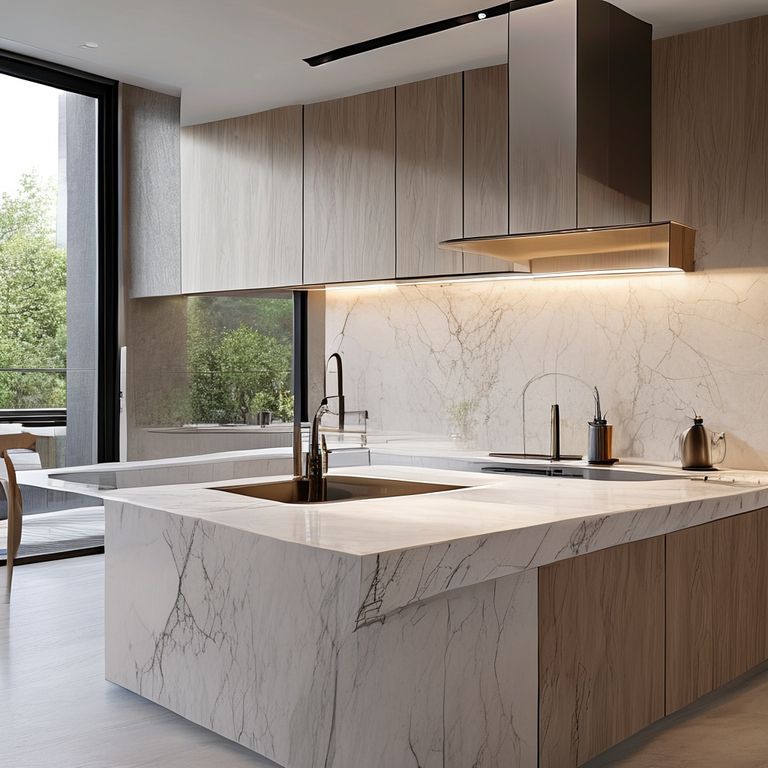
The transition from theory to practice is where the 15mm quartz flush-mount installation truly proves its worth. If you have decided that the slim aesthetic is non-negotiable, the secret to success lies in what you cannot see. While the top of the counter looks like a delicate 15mm sliver of stone, the underside must be a fortress. In professional installations involving thin-profile quartz, we often employ “sub-top” reinforcement or strategic bracing. By lining the perimeter of the sink cutout with moisture-resistant plywood or, better yet, steel support bars integrated into the cabinetry, the weight of the sink is transferred away from the stone ledge and onto the cabinets themselves.
This hidden engineering is what makes the “impossible” possible. Instead of the 7mm of remaining quartz carrying the load, the sink is essentially “cradled” from below. This allows the 15mm quartz to act as a beautiful, seamless skin rather than a primary load-bearing structure. Furthermore, the use of high-elasticity epoxy resins during the mounting process can provide a buffer. These adhesives allow for a tiny amount of movement—essential because quartz and stainless steel expand and contract at different rates when exposed to hot and cold water. Without this “give,” the rigid 15mm ledge could eventually succumb to thermal shock.
Another critical factor to consider is the geometry of the sink itself. Sharp, 90-degree corners are the enemies of thin stone. Stress naturally accumulates at the points of a square. If you are dead set on a 15mm quartz countertop with a flush-mount sink, choosing a sink with “R10” or “R15” (radiused) corners can be a lifesaver. These slight curves allow the CNC machine to create a smoother path, distributing stress more evenly through the stone. It’s a small design compromise that drastically increases the longevity of the installation.
Let’s talk about the daily reality of a 15mm flush-mount setup. Users often worry about the “clatter” or the vibration of a heavy-duty garbage disposal unit attached to a thin stone surface. It’s a valid concern. A high-torque disposal unit can send micro-vibrations through the countertop. In a 30mm slab, the mass of the stone absorbs these vibrations easily. In a 15mm slab, you might feel it in your bones—or worse, it could loosen the bond between the sink and the stone. To mitigate this, sound-dampening pads on the sink and a flexible mounting gasket are essential. It’s about creating a system that manages energy as much as it manages weight.
So, why go through all this trouble? Why not just use 20mm and be done with it? The answer lies in the “edge profile.” A 15mm edge has a certain sharpness and “bite” to its visual impact that 20mm simply cannot replicate. It feels more digital, more precise. In a world where kitchen design is increasingly moving toward integrated living spaces, the kitchen needs to look less like a laboratory and more like a curated gallery. The 15mm quartz flush-mount sink is the pinnacle of this “gallery” look. It’s for the homeowner who values the process and the craft as much as the end result.
However, a word of caution for those looking to DIY this or hire a budget contractor: the 15mm flush-mount is not a “standard” job. It requires a level of communication between the cabinet maker, the stone fabricator, and the plumber that goes beyond the norm. The cabinet tops must be perfectly level—if there is even a 2mm dip across the span of the sink base, the 15mm quartz will be under constant tension, just waiting for a heavy pot to be dropped to finally snap. The cabinets provide the foundation that the thin stone lacks.
From a maintenance perspective, the flush-mount on 15mm quartz is actually a dream, provided it’s installed correctly. Because there is no “hump” or “recess” at the sink edge, water doesn’t pool in places you can’t reach. Wiping down the counters becomes a single, fluid motion. The lack of exposed silicone edges means there is nowhere for black mold to take root. You are trading a bit of complexity during the installation phase for a lifetime of effortless cleaning.
In conclusion, can 15mm quartz stone do a “Taizhong” or flush-mount sink? The answer is a resounding yes—but with conditions. It is a marriage of high-quality material, precision machining, and clever structural support. It is not the “safe” choice, nor is it the “easy” choice. It is the designer’s choice. It’s for those who want to push the boundaries of what stone can do, transforming a heavy, earth-bound material into something that looks light, airy, and perfectly integrated into a modern home. If you ensure your fabricator is experienced with thin-gauge porcelain or quartz, and if you invest in the necessary sub-surface reinforcements, the 15mm flush-mount sink will be the undisputed star of your kitchen. It is a testament to the fact that in modern design, “less” really is “more,” provided you have the engineering to back it up.









