
Resurrecting Your Surfaces: The Art and Science of Artificial Marble Countertop Repair
The gleam of artificial marble countertops can be a cornerstone of a kitchen’s aesthetic appeal. Their durability and versatility have made them a popular choice for homeowners seeking both style and practicality. However, even the most resilient materials are not entirely immune to the rigors of daily life. Daily use, accidental impacts, and the passage of time can leave their mark in the form of unsightly scratches, chips, and a general dullness that detracts from their original splendor. But before you resign yourself to a costly replacement, understand that a vibrant second life for your countertops is often within reach through the art and science of artificial marble countertop repair.

Artificial marble, often referred to as solid surface or engineered stone, is typically composed of acrylic polymers or polyester resins combined with mineral fillers, pigments, and binders. This composite nature lends it remarkable uniformity and a non-porous surface, which is a significant advantage in terms of hygiene and stain resistance. However, this very composition also dictates the methods best suited for its repair. Unlike natural stone, which can be polished or filled with epoxies that mimic its crystalline structure, artificial marble requires a more nuanced approach that respects its homogeneous makeup.
The journey to revitalizing your artificial marble countertops begins with a thorough assessment of the damage. Is it a superficial scratch that merely grazes the surface layer, or a deeper gouge that penetrates the material? Is it a small chip that has broken off a piece, or a larger area of wear and tear? Identifying the nature and extent of the damage is paramount to selecting the appropriate repair strategy.
For minor surface scratches, the process often involves a multi-stage sanding and polishing technique. This is where the precision of the repair professional, or the diligent DIY enthusiast, truly shines. The principle is to gently abrade the damaged area, effectively leveling the surface. This starts with fine-grit sandpaper, progressing to progressively finer grits. The goal is to remove the scratch without creating new, wider ones. It’s a delicate dance between abrasion and finesse. After the sanding is complete, the surface will appear somewhat hazy. This is where the polishing compounds come into play. Using specialized abrasive pastes and buffing machines, the surface is gradually brought back to its original sheen. This isn’t simply about making it shiny again; it’s about restoring the optical clarity of the material, ensuring that light reflects off the surface uniformly, just as it did when it was new.

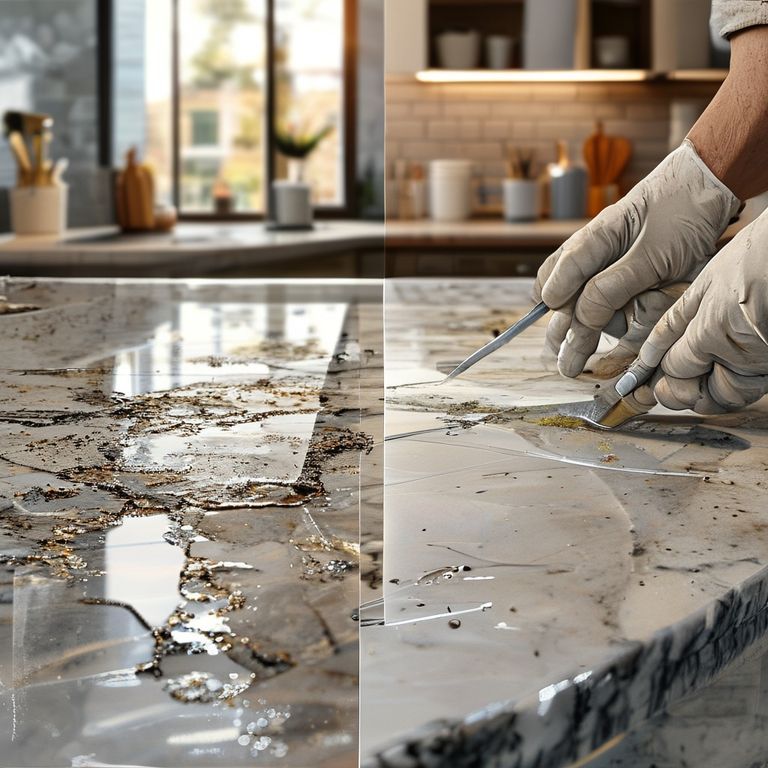
When it comes to chips, the challenge escalates. A chip means that a piece of the material is missing. The repair here involves filling the void with a specially formulated resin that closely matches the color and composition of the original countertop. This is where the term “color matching” becomes incredibly important. Artificial marble comes in a vast array of colors and patterns, from solid whites and blacks to intricate veining and speckles. Professionals often have access to a wide spectrum of pigments that can be mixed to achieve a near-perfect match. The filling process itself requires careful application, ensuring that the resin adheres well and that the filled area is flush with the surrounding surface. Once the resin has cured, it will likely need to be sanded and polished, much like in the case of scratch repair, to seamlessly integrate the repaired area with the rest of the countertop.
The repair of larger areas of wear, such as those found on frequently used work surfaces or around sinks, can be more complex. These areas might exhibit a dulled finish, subtle pitting, or even minor delamination in some older or lower-quality products. Restoration in these cases might involve a more aggressive sanding to remove the compromised top layer, followed by the application of a new topcoat or resin layer. This is akin to refinishing a piece of wood furniture, but with materials specifically designed for solid surfaces. The aim is to create a uniform, durable, and aesthetically pleasing finish that revitalizes the entire affected section.
The materials used in artificial marble countertop repair are as crucial as the techniques employed. High-quality, two-part epoxy resins are often the go-to for filling chips and cracks. These resins offer excellent adhesion, durability, and can be tinted to match virtually any color. For larger surface repairs, specialized acrylic-based fillers or solid surface repair kits are available. These kits often contain a combination of resins, hardeners, colorants, and application tools, empowering homeowners with the ability to tackle minor issues themselves. However, for significant damage, professional intervention is highly recommended. Professionals possess the expertise, specialized equipment, and access to a broader range of materials and color matching systems that are essential for achieving seamless, long-lasting results.
The decision to repair your artificial marble countertops is not just about aesthetics; it’s also a sound economic choice. Replacing a kitchen countertop can be a significant investment, involving not only the cost of the new material but also installation fees, and potentially the disruption of your kitchen’s functionality for an extended period. Repair, on the other hand, is typically a fraction of the cost of replacement. It’s a sustainable solution that extends the lifespan of your existing surfaces, reduces waste, and preserves the overall aesthetic you’ve come to love.
Furthermore, understanding the composition of your artificial marble is key. If your countertops are made from a specific brand or type of solid surface, consulting the manufacturer’s guidelines for care and repair can provide invaluable information. Some manufacturers offer proprietary repair kits or recommend specific products for maintaining their materials. This knowledge empowers you to make informed decisions and ensures that the repair process is compatible with the original material.
The realm of artificial marble countertop repair is a testament to how innovation and skilled craftsmanship can breathe new life into our living spaces. It’s about more than just fixing a flaw; it’s about preserving the beauty, functionality, and value of our homes. As we delve deeper into the specific techniques and considerations, it becomes clear that with the right approach, the battle against wear and tear on these beloved surfaces is not only winnable but can result in a stunning transformation.

The art of artificial marble countertop repair extends beyond merely filling gaps or buffing out scratches; it involves a deep understanding of material science and a commitment to meticulous execution. While the initial assessment and selection of repair methods form the foundation, the true magic lies in the execution of these techniques. This is where the subtle nuances of working with composite materials come into play, transforming what might appear to be irreversible damage into a virtually invisible mend.
Let’s delve deeper into the granular process of scratch removal. For shallow surface scratches, the technique often starts with a dry sanding process using very fine-grit sandpaper, typically starting around 400 grit and progressing up to 1500 or even 2000 grit. The sanding should be done in a consistent direction, or in a controlled circular motion, depending on the specific recommendation for the material. The key is to apply even pressure and to avoid oversanding any single area, which could create a depression or an uneven finish. The progression through finer grits is critical. Each finer grit effectively removes the microscopic scratches left by the previous one, gradually restoring a smoother surface. After the final sanding stage, the surface will look dull and uniformly hazy. This is the stage where patience and the right polishing compounds become indispensable.
The polishing phase is where the countertop truly begins to regain its luster. This is typically achieved using a specialized polishing compound designed for solid surfaces or acrylics. These compounds contain very fine abrasive particles that further refine the surface, removing the microscopic abrasions left by the sandpaper and bringing back the original shine. This can be done by hand with a soft cloth or, more effectively, with a low-speed buffer or polishing machine. When using a machine, it’s crucial to maintain a consistent speed and to avoid overheating the surface, as excessive heat can damage the resin. The polishing process is iterative; you may need to apply the compound multiple times, working it into the surface until the desired level of gloss is achieved. The goal is to match the original sheen of the surrounding countertop. This often requires a keen eye and the ability to discern subtle differences in reflectivity.
Chip repair, as mentioned, involves filling a void. The success of this repair hinges on several factors: the quality of the filler material, the precision of color matching, and the technique of application. When selecting a filler, it’s important to opt for a two-part epoxy or a high-grade acrylic resin that is specifically designed for solid surfaces. These materials offer superior adhesion and durability compared to standard household glues. Color matching is arguably the most critical, and often the most challenging, aspect of chip repair. Professionals will use a carefully curated palette of pigments to create a custom blend that precisely matches the surrounding countertop. This involves mixing small amounts of pigment into the clear resin until the color is indistinguishable from the original. Once the color is matched, the resin is mixed with its hardener and carefully applied to the chipped area. It’s often applied slightly proud of the surface, allowing for a small amount of shrinkage as it cures. Once fully cured – a process that can take several hours – the excess resin is carefully sanded down flush with the countertop surface. This is followed by the same multi-stage sanding and polishing process used for scratch repair to ensure the filled area is seamlessly integrated and indistinguishable from the original material.
For larger areas of damage, such as those exhibiting significant wear, staining, or dullness across a broader section, a more comprehensive restoration might be required. This could involve a complete refinishing of the affected area. The process often begins with a more aggressive sanding, using coarser grits of sandpaper (e.g., 180-220 grit) to remove the damaged top layer. The goal here is to remove all imperfections and create a clean, uniform surface ready for a new topcoat. Following this initial aggressive sanding, the area is then progressively sanded with finer grits, as described for scratch repair, to achieve a smooth base. Once the surface is prepared, a new topcoat of clear acrylic or resin can be applied. This layer acts as a protective and aesthetic sealant, restoring the countertop’s original appearance and durability. The application of this topcoat requires a clean environment and precise application techniques to avoid drips, runs, or uneven coverage. Once the topcoat has cured, it is then polished to a high sheen, bringing the entire repaired section back to its former glory.
It is important to differentiate between artificial marble and other composite countertop materials, such as quartz. While both are engineered, quartz countertops are made from a much higher percentage of natural quartz crystals bound with resin. Repair techniques for quartz are often different, as the material itself is harder and has a different crystalline structure. Artificial marble, with its higher resin content, is generally more susceptible to heat and scratches but also more amenable to certain types of chemical and abrasive repairs that might not be suitable for quartz. Understanding what material you have is the first step to choosing the correct repair methodology.
The choice between a DIY repair and professional intervention is often dictated by the severity of the damage and the homeowner’s comfort level with detailed work. For minor scratches and superficial dullness, a well-equipped and patient DIYer can achieve satisfactory results using specialized kits and following instructions meticulously. However, for chips, deep gouges, cracks, or extensive surface wear, the expertise of a professional solid surface fabricator or repair specialist is highly recommended. They possess the specialized tools, knowledge of material formulations, and advanced color-matching capabilities that are often beyond the reach of the average homeowner. Investing in professional repair for significant damage ensures a more durable, seamless, and aesthetically pleasing outcome, ultimately saving you from potential frustration and further damage.
Ultimately, artificial marble countertop repair is a fascinating blend of science and art. It’s about understanding the chemical and physical properties of these composite materials and applying precise techniques to restore them to their pristine condition. It’s a process that requires patience, attention to detail, and the right tools and materials. By embracing these principles, homeowners can effectively extend the life and beauty of their artificial marble countertops, preserving the heart of their kitchens and bathrooms for years to come. It’s a testament to the fact that even the most cherished surfaces can be revived, offering a sustainable and cost-effective alternative to full replacement.









