
The allure of quartzite countertops is undeniable. They boast the sophisticated veining and natural character of marble, yet offer the robust durability and low maintenance of granite. For those seeking a statement piece in their kitchen or bathroom, a substantial slab of quartzite, particularly one stretching to a generous 2.4 meters, presents an unparalleled option. This impressive length allows for a dramatic, sweeping surface, minimizing seams and creating a truly monolithic feel. It’s a choice that speaks of luxury, of enduring style, and of a commitment to quality that transcends fleeting trends. But as with any substantial element in home design, there’s a fundamental question that lurks beneath the polished surface: “2米4的石英石台面多重?” or, more precisely, “How much does a 2.4-meter quartzite countertop weigh?” This isn’t just a trivial curiosity; it’s a question that underpins the entire journey of this magnificent material, from quarry to kitchen.
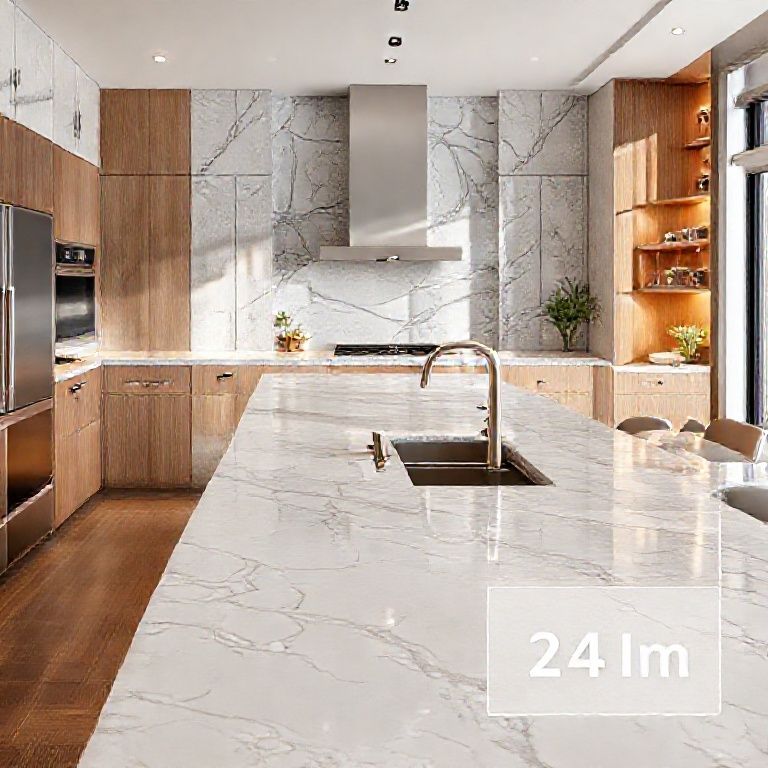
To even begin to answer this, we need to understand the nature of quartzite itself. Unlike engineered quartz (which is a composite material), natural quartzite is a metamorphic rock formed deep within the earth under immense heat and pressure. It’s essentially sandstone that has been recrystallized and transformed into a dense, hard, and visually striking stone. This geological process imbues quartzite with a remarkable density, and it’s this density that is the primary driver of its weight.
The density of natural quartzite can vary, but a commonly cited range is between 2.65 and 2.75 grams per cubic centimeter (g/cm³). For practical purposes in the world of countertops, we often convert this to pounds per cubic foot (lbs/ft³). This translates to roughly 165 to 172 lbs/ft³. Now, let’s bring in the dimensions. A standard countertop thickness is typically around 2 centimeters (approximately 0.79 inches) or 3 centimeters (approximately 1.18 inches). For our 2.4-meter (which is about 94.5 inches or 7.87 feet) slab, we’ll consider both thicknesses to get a clearer picture.
Let’s do some quick calculations. Assuming a uniform thickness of 3 cm (0.0984 feet) and using an average density of 170 lbs/ft³, a 2.4-meter (7.87 feet) long, 0.6-meter (2 feet) wide (a common countertop depth), and 0.0984-foot thick slab would weigh approximately:
Weight = Length × Width × Thickness × Density Weight = 7.87 ft × 2 ft × 0.0984 ft × 170 lbs/ft³ Weight ≈ 261.6 lbs
Now, if we consider a 2 cm thickness (0.0656 feet):
Weight = 7.87 ft × 2 ft × 0.0656 ft × 170 lbs/ft³ Weight ≈ 174.4 lbs
These figures are approximations, of course. The exact weight will depend on the specific density of the chosen quartzite slab, its precise dimensions (which can vary slightly during fabrication), and any edge profiling that might be applied. However, these calculations provide a crucial baseline understanding: we are dealing with a significant weight. A 2.4-meter quartzite countertop is not a flimsy addition; it’s a substantial, weighty piece of natural art.
This weight has profound implications that extend far beyond the showroom floor. For fabricators and installers, the weight is a paramount consideration. Handling a slab of this magnitude requires specialized equipment – think heavy-duty trolleys, suction cups, and often, multiple strong individuals. The risk of injury during transport and installation is real, necessitating careful planning and adherence to safety protocols. It’s a testament to the sheer material presence of the stone.
Beyond the physical strain, the weight also dictates structural considerations for the cabinetry that will support it. Standard cabinets might buckle or warp under the immense load of a thick, heavy quartzite slab, especially over a span of 2.4 meters. Reinforced cabinetry, often featuring thicker plywood or even additional support beams, is frequently a necessity. This is particularly true for islands or peninsulas where the countertop might be cantilevered, meaning it extends beyond the supporting structure. The weight distribution becomes critical to prevent sagging or, in the worst-case scenario, collapse.
Furthermore, the weight influences the delivery process. Will the slab fit through doorways and hallways? Are there tight corners or staircases to navigate? These logistical challenges, all stemming from the inherent weight, need to be meticulously assessed before the material even leaves the stone yard. It’s a multi-faceted consideration that transforms the simple act of choosing a countertop into a complex logistical and engineering puzzle. The beauty of the stone is inextricably linked to its physical presence, and in the case of a 2.4-meter quartzite countertop, that presence is undeniably substantial. This initial exploration into the “how much does it weigh” question reveals that the answer is not merely a number, but a gateway to understanding the material’s character, the demands it places on its surroundings, and the expertise required to bring it into our homes.
Continuing our exploration into the weight of a 2.4-meter quartzite countertop, we’ve established that it’s a substantial entity, demanding respect for its physical presence. We’ve touched upon the density of the stone and the initial weight calculations, revealing that these impressive slabs can easily weigh over 250 pounds, and sometimes significantly more, depending on thickness and specific density. But the story doesn’t end with a number on a scale. The weight of a quartzite countertop is intrinsically linked to its performance, its aesthetic impact, and the very foundation upon which it rests.
One of the most compelling reasons for choosing quartzite, despite its heft, is its remarkable durability and resistance to heat, scratches, and stains. This resilience is a direct consequence of its dense, crystalline structure – the same structure that contributes to its considerable weight. Unlike softer stones or even some engineered materials, quartzite can withstand the rigors of a busy kitchen environment. Dropped pans are less likely to cause chips, hot pots can often be placed directly on the surface without fear of scorching (though using trivets is always recommended for longevity), and spills, when wiped up promptly, typically don’t leave permanent marks. This robust nature means that while the initial installation might be more demanding due to the weight, the long-term payoff in terms of low maintenance and enduring beauty is substantial. You’re investing in a material that can truly stand the test of time, gracefully bearing the weight of daily life.
The aesthetic implications of a 2.4-meter slab are also amplified by its weight. Imagine a long, unbroken expanse of Calacatta Viola quartzite, with its dramatic purple veins against a creamy background, or a stark, icy white Supreme Everest with its subtle grey striations. A single, expansive countertop of this length creates a powerful visual statement. It elongates the space, imparts a sense of grandeur, and minimizes the visual disruption that seams can introduce. The weight, in this context, translates to a feeling of solidity and permanence. It’s not just a surface; it’s a foundational element of the kitchen’s design, anchoring the entire room with its imposing yet elegant presence. The substantiality of the material contributes to the perceived value and luxury of the space. It conveys a sense of permanence and groundedness that lighter materials simply cannot replicate.
The installation process, as previously mentioned, is where the weight truly becomes a tangible factor. For a 2.4-meter slab, this isn’t a DIY job. Professional fabricators and installers are essential. They possess the specialized tools, such as heavy-duty suction lifters, that are crucial for safely maneuvering these heavy slabs. They understand the mechanics of lifting, the importance of proper support, and the techniques for avoiding stress fractures or damage during transport and placement. The weight necessitates a team of skilled individuals who can work in unison, communicating effectively to ensure a smooth and safe installation. This is an investment in expertise, a recognition that the beauty of the stone comes with inherent challenges that require specialized knowledge to overcome.
Furthermore, the weight of the countertop impacts the design of the cabinetry beneath it. As mentioned, robust cabinetry is often required. This means opting for thicker plywood, reinforced joints, and potentially even additional structural supports. For island countertops, especially those with overhangs, the weight becomes a critical factor in determining the necessary support system to prevent sagging over time. A professional kitchen designer will account for this, ensuring that the cabinetry is not only aesthetically pleasing but also structurally sound enough to bear the considerable load of the quartzite. This integration of structural integrity with design is a hallmark of a well-executed kitchen renovation.
The transportation of such a heavy item also presents logistical challenges. Getting a 2.4-meter slab into a residential property can involve navigating narrow hallways, tight turns, and staircases. The stone yard must have the appropriate equipment to load it onto a specialized truck, and the installation crew must have the manpower and tools to unload and maneuver it into its final position without damaging the stone or the property. This careful choreography, driven by the material’s weight, is an often-unseen but critical part of the process.
In essence, the question “2米4的石英石台面多重?” opens a dialogue about the multifaceted nature of quartzite countertops. Their weight is not a drawback but a characteristic that speaks to their origin, their durability, their aesthetic impact, and the skilled craftsmanship required to bring them into our homes. It’s a weight that signifies strength, permanence, and a luxurious presence. While the numerical answer to their weight might vary, the understanding of what that weight represents is universal: a commitment to enduring beauty, superior performance, and a sophisticated statement in any living space. The gravity of elegance, indeed.









