
The kitchen. It’s the heart of the home, isn’t it? A place where culinary creations come to life, where family gathers to share stories, and where that first cup of coffee tastes just a little bit better. And at the center of it all, quite literally, lies the kitchen countertop. This is where the magic happens – the chopping, the mixing, the kneading, and yes, sometimes even the impromptu dance parties while waiting for something to bake. So, when it comes to choosing a countertop material, it’s not just a functional decision; it’s an aesthetic one, a lifestyle one, and for many, a significant investment.
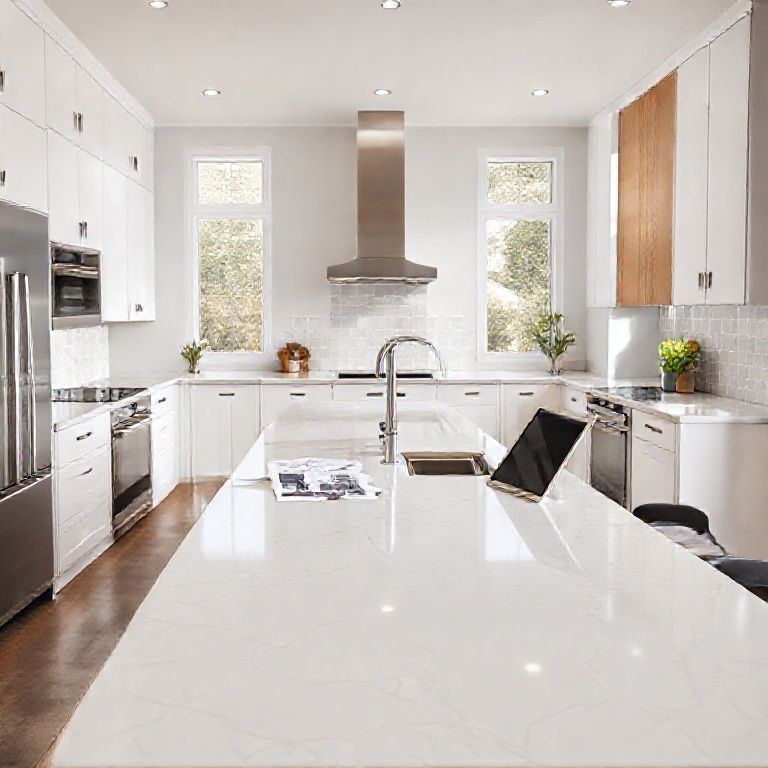
Enter “人造石” (rén zào shí), which translates beautifully to “man-made stone.” In the realm of kitchen countertops, this term most commonly refers to engineered quartz. Now, you might be thinking, “Man-made? Doesn’t that imply less… authentic? Less natural beauty?” And it’s a valid question. For years, natural stones like granite and marble reigned supreme, their unique patterns and earthy origins a draw for many. But engineered quartz has steadily, and impressively, carved out its own niche, proving that sometimes, the best innovations are born from enhancing nature’s brilliance.
So, let’s dive into this captivating material. What exactly is engineered quartz? Imagine taking the raw beauty of quartz crystals, a naturally occurring mineral known for its incredible hardness and striking appearance, and blending them with resins, polymers, and pigments. This meticulous process results in a solid surface that not only mimics the elegance of natural stone but often surpasses it in terms of practicality and consistency. Unlike its quarried counterparts, which can have variations in color and pattern, engineered quartz offers a predictable and uniform look. This means if you fall in love with a particular shade of white with subtle grey veining, you can be confident that every slab will be a close match. This consistency is a boon for designers and homeowners alike, allowing for seamless integration into various kitchen styles, from the ultra-modern minimalist to the warmly traditional.
The visual appeal of quartz is truly remarkable. The manufacturing process allows for an astonishing range of colors and patterns. Want a pure, unadulterated white that rivals the brightest snow? Quartz can do that. Dreaming of a deep, dramatic black that exudes sophistication? Quartz has you covered. Perhaps you’re after the timeless allure of marble, complete with swirling veining, but without the inherent maintenance headaches? Engineered quartz can beautifully replicate this look, offering a stunning visual doppelgänger. Beyond solid colors and marble imitations, you can find quartz that mimics granite, concrete, and even unique abstract designs. This versatility means that quartz isn’t just a countertop; it’s a design element that can truly elevate your kitchen’s aesthetic, acting as a canvas for your culinary endeavors and a statement piece in your home.
But beauty, as they say, is only skin deep. And while quartz is undeniably beautiful, its true strength lies in its performance. Let’s talk durability. Quartz is exceptionally hard, ranking a 7 on the Mohs scale of hardness, just below granite. What does this mean in practical terms? It means your countertops will be remarkably resistant to scratches, chips, and cracks. Imagine confidently placing hot pots and pans directly from the oven onto your quartz surface – no need for trivets every single time! While it’s always good practice to use trivets to protect any surface from extreme heat, quartz can handle it far better than many other materials. This resilience is a game-changer for busy kitchens, where life happens, and accidents can occur.
Another significant advantage of engineered quartz is its non-porous nature. This is a crucial distinction when comparing it to natural stones like granite or marble, which, even when sealed, can have microscopic pores that absorb liquids. For a kitchen, where spills are a daily occurrence – think red wine, coffee, olive oil – this non-porous quality is a blessing. It means that stains are far less likely to penetrate the surface. A quick wipe with a damp cloth is usually all it takes to clean up any mess, making quartz incredibly hygienic. This is particularly important in a food preparation area, where cleanliness is paramount. The lack of porosity also means that quartz is resistant to bacteria and mold growth, contributing to a healthier kitchen environment.
Maintenance is often a major consideration when choosing a countertop. And here, quartz truly shines. Because it’s non-porous and highly resistant to stains, it requires very little ongoing care. Unlike granite or marble, which need periodic sealing to maintain their protective barrier, quartz countertops typically do not require any sealing. A simple routine of wiping them down with mild soap and water or a non-abrasive cleaner is usually sufficient to keep them looking pristine. This low-maintenance aspect is a huge draw for homeowners who want a beautiful kitchen that doesn’t demand constant, intensive upkeep. It’s about enjoying your space, not laboring over it.
Furthermore, the manufacturing process of engineered quartz allows for large slabs to be produced. This means that in many cases, you can have countertops with fewer seams, or even no visible seams at all. Seams can be points of weakness, potential areas for dirt to accumulate, and visually disruptive. The ability to create expansive, seamless surfaces adds to the sleek, modern aesthetic that quartz is so well-suited for, and contributes to its overall ease of cleaning and maintenance.
Considering all these factors – the stunning aesthetic versatility, the exceptional durability, the stain resistance, the hygienic properties, and the low-maintenance appeal – it’s easy to see why engineered quartz has become such a popular choice. It offers a compelling blend of natural stone’s beauty with enhanced performance and convenience. But as with any significant home improvement decision, it’s always wise to look at the complete picture. What are the potential downsides? Are there situations where quartz might not be the ideal fit? Let’s delve deeper into that in the next part.
Continuing our exploration of engineered quartz, we’ve established its impressive strengths: a dazzling array of design options, formidable durability, stain and scratch resistance, hygienic properties, and remarkably easy maintenance. It truly sounds like a countertop dream come true, doesn’t it? However, like any material, quartz has its own unique characteristics that are worth understanding thoroughly before making your final decision. It’s all about finding the perfect fit for your specific needs, lifestyle, and kitchen environment.
While quartz is incredibly resilient, it’s not entirely invincible. One area where it requires a bit more consideration is its resistance to extreme heat. Unlike natural stone, which generally handles high temperatures very well, the resins used in engineered quartz can be susceptible to thermal shock. This means that exposing a quartz countertop to sudden and extreme temperature changes, such as placing a scorching hot pan directly from a broiler onto a cold countertop, can potentially cause discoloration or even cracking. It’s not an everyday occurrence, mind you, but it is a possibility. The good news is that this can be easily mitigated. By consistently using trivets or hot pads under any hot cookware, you can effectively protect your quartz surface and ensure its longevity. So, while you might not need them every single time, it’s still a very good habit to cultivate.
Another aspect to consider is the cost. Engineered quartz generally falls into the mid-to-high price range for countertop materials. It’s typically more expensive than laminate or solid surface materials, and often comparable to, or even more expensive than, mid-range granite. However, when you compare it to high-end natural stones like exotic granites or premium marbles, quartz can offer a more budget-friendly option while still delivering a luxurious look. The price can also vary significantly depending on the brand, the complexity of the design, and the specific finish. For instance, quartz with intricate veining patterns or a unique color may command a higher price than a solid, more uniform color. It’s an investment, certainly, but one that offers excellent long-term value due to its durability and low maintenance. When budgeting for your kitchen renovation, it’s essential to factor in not just the material cost but also the fabrication and installation, which can add a significant portion to the overall price.
The “man-made” aspect of quartz, while offering consistency and control over design, might be a point of contention for those who deeply value the inherent uniqueness and “soul” of natural materials. Natural stones, by their very nature, are one-of-a-kind. Each slab tells a story of geological time, with its own individual mineral inclusions, subtle color variations, and unique veining patterns. Some homeowners find this perfectly imperfect beauty to be irreplaceable. Engineered quartz, on the other hand, is designed for uniformity. While this is a strength for achieving a consistent look, it might feel less organic or less “natural” to certain individuals. It’s a matter of personal preference, and if the idea of a truly unique, “you-won’t-find-another-like-it” surface is paramount, then exploring natural stones might be a more compelling path.
UV sensitivity is another factor to be aware of, though it’s often less of a concern for indoor kitchen countertops. The resins in quartz can be susceptible to fading or discoloration if exposed to prolonged, direct sunlight. If your kitchen has a large window that receives intense, direct sun for many hours a day, and you plan to place lighter-colored quartz directly in its path, it’s something to keep in mind. However, for most typical kitchen environments, this is not a significant issue.
When it comes to the installation, engineered quartz is a heavy material. This means it requires a sturdy support structure beneath it. For standard cabinet configurations, this is rarely a problem, but it’s worth noting that professional installation is crucial. Skilled fabricators and installers will ensure the quartz is cut, transported, and fitted correctly, paying close attention to support and leveling. This is not a DIY project for most homeowners. The precision required in cutting and fitting, especially around sinks and cooktops, is best left to the experts.
Finally, let’s consider the environmental impact. The production of engineered quartz involves mining quartz crystals and using resins, which are petroleum-based. However, many manufacturers are increasingly focusing on sustainable practices. Some use recycled materials in their formulations, and others have implemented energy-efficient production processes. When researching brands, you might find that some offer more environmentally conscious options. It’s a complex equation, as quarrying natural stone also has its own environmental footprint. The choice often comes down to comparing the lifecycle impacts of different materials.
So, to circle back to our initial question: “人造石做厨房台面好吗” – Is man-made stone (engineered quartz) good for kitchen countertops? The resounding answer is a strong, resounding “yes,” for many people. It offers an exceptional balance of beauty, durability, and ease of use that is hard to beat. Its resistance to stains, scratches, and its hygienic qualities make it a practical choice for the demanding environment of a kitchen. The vast array of design possibilities means you can achieve almost any aesthetic you desire.
However, it’s not a one-size-fits-all solution. If your heart is set on the absolute uniqueness of natural stone, or if you’re consistently working with extreme heat without using protective measures, you might want to explore other options. But for the vast majority of homeowners looking for a stunning, low-maintenance, and highly functional countertop that can withstand the rigors of daily life while looking fabulous, engineered quartz is a truly excellent choice. It’s a material that blends innovation with elegance, proving that sometimes, the best things are indeed “made,” not just found.









