
The Unseen Weight of Elegance: Unpacking the Mystery of Quartz Countertop Mass
The allure of a quartz kitchen countertop is undeniable. It’s a symphony of durability, aesthetic versatility, and a sleek, modern finish that can transform a kitchen from mundane to magnificent. We admire its seamless surfaces, the way it catches the light, and the promise of a low-maintenance workhorse. But have you ever paused, perhaps while admiring a particularly substantial-looking slab, to consider its weight? The question, “How much does a typical 2.4-meter artificial stone kitchen countertop weigh?” might seem niche, a bit like pondering the gravitational pull of a particularly dense cheese, but it’s a question brimming with practical implications and a touch of scientific curiosity.
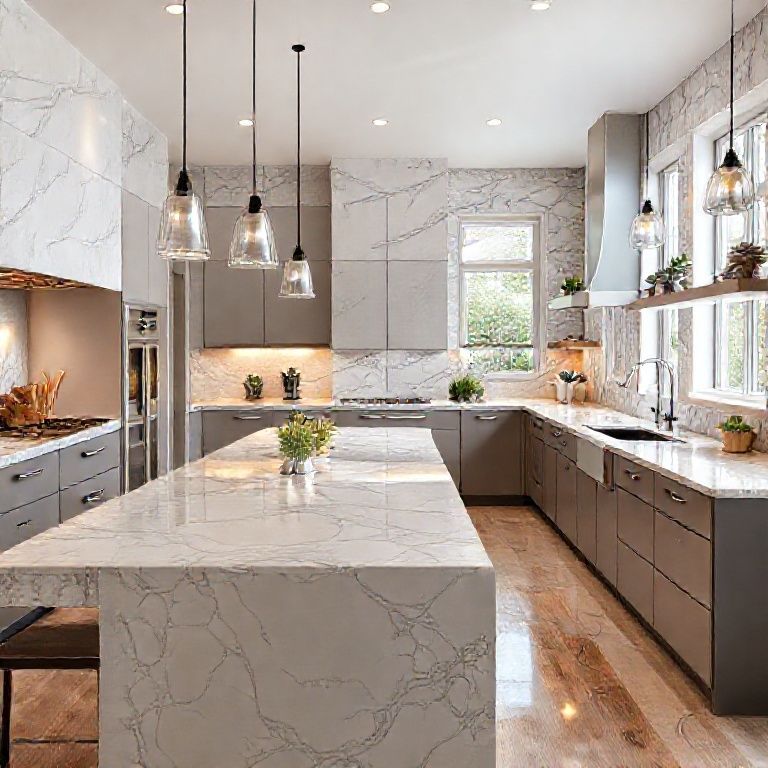
Let’s start by demystifying “artificial stone.” While the term can sometimes conjure images of cheap imitations, in the context of countertops, it most commonly refers to engineered quartz. This isn’t just simply “stone” that’s been manufactured; it’s a sophisticated composite material. The star ingredient is natural quartz, which makes up around 90-95% of the material. This is then combined with resins (polymers) and pigments. The quartz provides the unparalleled hardness and durability, while the resins bind it all together, offering flexibility and the ability to create a vast array of colors and patterns. Pigments, of course, are what give it that captivating visual appeal, from stark whites and deep blacks to intricate veining that mimics natural marble or granite.
So, when we talk about the weight of a 2.4-meter (approximately 8-foot) quartz countertop, we’re really talking about the combined mass of these components, compressed and cured into a solid slab. The density of engineered quartz is a key determinant. Generally, engineered quartz has a density ranging from approximately 2.5 to 2.7 grams per cubic centimeter (g/cm³). This might sound like a dry scientific fact, but it’s the bedrock of our weight calculation. Think of it as how much “stuff” is packed into a given volume. Denser materials feel heavier because more mass is present in the same space.
To calculate the weight, we need to consider not just density but also the dimensions of the countertop. Our specified length is 2.4 meters. However, a countertop isn’t just a flat plane; it has thickness and width. Standard countertop thickness typically ranges from 20mm (about 3/4 inch) to 30mm (about 1 1/4 inches). For our calculation, let’s assume a common thickness of 20mm (0.02 meters) and a standard width of 600mm (0.6 meters). These are typical dimensions for a kitchen island or a standard cabinet run.
Now, let’s do some math. First, we need to convert all our units to be consistent, preferably meters. Length: 2.4 m Width: 0.6 m Thickness: 0.02 m
The volume of our countertop slab would be: Volume = Length × Width × Thickness Volume = 2.4 m × 0.6 m × 0.02 m Volume = 0.0288 cubic meters (m³)
Next, we need to relate this volume to the density. Our density is typically given in g/cm³. To use it with our volume in cubic meters, we need to convert the density. 1 meter = 100 centimeters 1 cubic meter (m³) = (100 cm)³ = 1,000,000 cubic centimeters (cm³)
So, if the density is, say, 2.6 g/cm³, in kilograms per cubic meter (kg/m³), it would be: Density (kg/m³) = Density (g/cm³) × 1,000,000 cm³/m³ ÷ 1000 g/kg Density (kg/m³) = 2.6 g/cm³ × 1,000,000 cm³/m³ ÷ 1000 g/kg Density (kg/m³) = 2600 kg/m³
Now we can calculate the mass (weight): Mass = Volume × Density Mass = 0.0288 m³ × 2600 kg/m³ Mass = 74.88 kg
So, a 2.4-meter long, 600mm wide, and 20mm thick engineered quartz countertop would weigh approximately 75 kilograms, or about 165 pounds. That’s roughly the weight of a large dog, or a significant stack of textbooks!
However, this is just one scenario. What if the countertop is thicker? Let’s consider a more substantial 30mm (0.03 meters) thickness: Volume = 2.4 m × 0.6 m × 0.03 m Volume = 0.0432 m³
Mass = 0.0432 m³ × 2600 kg/m³ Mass = 112.32 kg
This brings our 2.4-meter slab up to nearly 112.5 kg, or about 248 pounds! This is getting into the territory of a very large, very strong individual, or perhaps a small piano.
It’s important to remember that these are estimates. Several factors can influence the actual weight:
Brand and Manufacturer: Different manufacturers might use slightly different formulations, with varying proportions of quartz aggregate and resin. Some might use finer quartz particles, while others use larger ones, which can subtly affect density. Specific Design: While solid slabs are common, some countertops might incorporate features like integrated sinks or specially carved edges, which could add or remove small amounts of material, though typically the bulk of the weight comes from the slab itself. Edge Profiles: While the main slab determines the vast majority of the weight, decorative edge profiles, especially thicker ones like a mitered edge or a waterfall edge, can add a little extra mass. Thickness Variations: While we’ve used standard thicknesses, custom projects might deviate. A thicker slab will always be heavier. Substrate (if applicable): Sometimes, for very long spans or specific designs, a substrate like plywood or MDF might be used for added support. This would increase the overall weight of the installed unit, but it’s usually considered separately from the quartz material itself.
The practical implications of this weight are significant, especially during the installation phase. A 75kg slab can be managed by a team of two reasonably strong individuals, but a 112kg slab starts demanding more careful planning and potentially specialized lifting equipment. This is why countertop installation is almost always a professional job. It’s not just about precise cutting and fitting; it’s about safely maneuvering heavy, often brittle, materials. Dropping or mishandling a quartz slab can lead to chips, cracks, or even complete breakage, rendering it useless.
Beyond the installation, the weight of the countertop also has implications for the cabinetry that supports it. Standard kitchen cabinets are designed to bear a certain load. A heavy quartz countertop adds a significant, constant dead load. This is why it’s crucial that cabinets are well-constructed, properly anchored, and capable of supporting the substantial weight. In kitchens with standard plywood or particleboard cabinets, especially older ones, the additional stress from a thick, heavy quartz slab is something to consider. More robust cabinet construction, or even reinforcing existing structures, might be necessary to ensure long-term stability and safety.
So, the next time you’re marveling at the beauty of your quartz kitchen countertop, take a moment to appreciate not just its visual appeal, but also its substantial, grounding presence. That elegant surface is, quite literally, a heavy achievement of modern material science and manufacturing. It’s a testament to how we can engineer beauty that is also built to last, a beautiful, and substantial, foundation for all your culinary adventures.
Continuing our exploration into the fascinating world of kitchen countertops, we’ve established that a 2.4-meter (8-foot) artificial stone (engineered quartz) countertop, depending on its thickness and specific composition, can weigh anywhere from around 75 kg (165 lbs) for a 20mm slab to over 112 kg (248 lbs) for a 30mm slab. This substantial heft isn’t just a number on a scale; it translates into several critical considerations for homeowners, designers, and installers alike. The unseen weight of elegance is a force to be reckoned with in kitchen design and renovation.
Let’s delve deeper into the practical implications of this weight. For starters, the sheer mass of quartz slabs means that transportation and handling require meticulous planning. Imagine a slab weighing over 100 kg. It’s not something you can easily lift into the back of a standard car or maneuver up a narrow staircase without proper equipment and a trained team. This is why quartz is typically delivered directly to the installation site by specialized fabricators. They utilize dollies, suction cups designed for stone, and often forklifts or cranes for larger pieces or difficult access points. Even within the home, from the delivery point to its final resting place on the cabinets, every movement needs to be calculated to avoid damage to the material, the surrounding walls, floors, and, of course, the people involved.
The installation process itself is where the weight becomes most apparent. Quartz slabs, while incredibly durable in their cured state, are also brittle. They can crack or chip if subjected to uneven stress or sharp impacts. Installing a heavy slab means ensuring that the supporting structure (the kitchen cabinets) is perfectly level and stable before the countertop is placed. Any slight settling or unevenness in the cabinets can create stress points on the quartz, leading to potential failure down the line. This is why professional installers are indispensable. They have the expertise to assess the cabinet base, shim where necessary, and carefully lower the slab into place. They also manage the seams – where two or more slabs meet – ensuring they are precise, clean, and durable, often using specialized adhesives that cure to become nearly as strong as the quartz itself.
Furthermore, the weight of the countertop directly impacts the structural integrity of the kitchen itself. Standard kitchen cabinets are designed to hold the weight of typical kitchen items, appliances, and a countertop. However, a dense quartz slab adds a significant and constant load. This is particularly important when considering the lifespan of the cabinetry. Over time, excessive weight can cause cabinets to sag, doors to misalign, or even the underlying structure to weaken. This is why, when opting for thicker, heavier quartz slabs, it’s often recommended to ensure that the cabinets are of a high quality, robust construction. Solid wood frames, strong shelving, and secure mounting to the wall studs are all crucial elements that contribute to the overall stability of a kitchen fitted with a substantial quartz countertop.
Consider the trend of waterfall countertops, where the material flows down the sides of an island or cabinet run, creating a seamless, modern look. This design element significantly increases the amount of quartz used and, consequently, its weight. A waterfall edge on both sides of a kitchen island, for example, can add the weight of an entire additional slab section to the island’s load. This demands even more attention to the structural support of the island base, ensuring it can handle this increased, downward force without compromising its stability or the integrity of the quartz itself.
The type of edge profile chosen also plays a minor, but noticeable, role. While the bulk of the weight comes from the slab’s thickness and surface area, elaborate edge profiles that add significant thickness or material – such as a mitered edge, a chiseled edge, or a very thick bullnose – will contribute to the overall mass. A simple eased or square edge will be lighter than a more decorative, multi-layered profile.
Beyond the immediate installation and structural concerns, the weight of quartz countertops can also influence future renovations or modifications. If a homeowner decides to change their kitchen layout years down the line, removing heavy quartz slabs becomes a significant undertaking. It requires the same level of professional care as installation, ensuring the removal process doesn’t damage surrounding structures or pose a safety risk.
It’s also worth considering the environmental aspect of moving such heavy materials. While quartz is renowned for its durability and longevity, which minimizes the need for frequent replacement, the energy expended in transporting and installing these dense slabs is a factor in their overall environmental footprint. This is why choosing a local fabricator and installer can help reduce transportation emissions.
Finally, let’s touch on cost. While not directly related to weight, the handling and installation challenges associated with heavy slabs can sometimes translate into higher labor costs for fabrication and installation. The need for specialized equipment, more installers, and the increased time required for careful maneuvering all contribute to the overall investment.
In conclusion, the question of “how much does a 2.4-meter artificial stone kitchen countertop weigh” opens a window into a world of practical engineering and design. It’s a reminder that beauty often comes with substance. The dense, resilient nature of engineered quartz, while providing unparalleled performance in the kitchen, also demands respect for its physical presence. From the careful selection of cabinets to the skilled hands of the installers, understanding and accounting for the weight of your chosen countertop is fundamental to creating a kitchen that is not only stunning but also safe, stable, and built to last. The elegance you see is underpinned by a formidable, grounding weight, a testament to its quality and enduring appeal.









