
When you step into a kitchen that feels truly “expensive,” it isn’t just the lighting or the designer appliances that catch your eye. It is the sweep of the countertops—the way they hold the light, the way they invite your touch, and the quiet confidence they lend to the entire room. In the modern quest for the perfect interior, two titans of the surface world constantly go head-to-head: Acrylic and Artificial Stone.
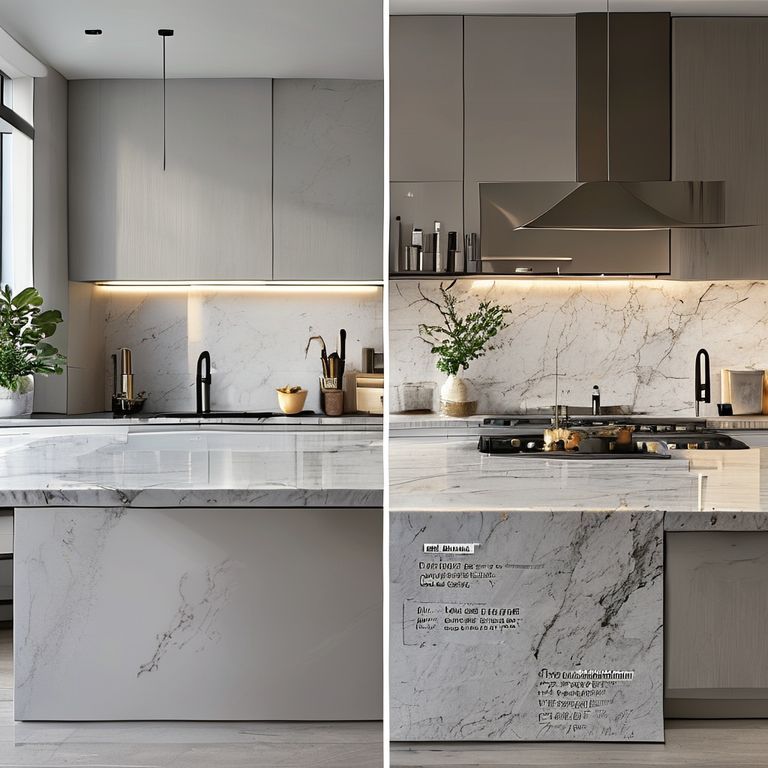
Choosing between them is rarely about finding a “winner” in an objective sense; it is about finding a soulmate for your lifestyle. If you are currently staring at samples, wondering why one feels like silk and the other like a mountain range, you aren’t alone. Let’s peel back the layers of these materials to see what they actually bring to your home’s narrative.
The Ethereal Fluidity of Acrylic (Solid Surface)
Acrylic, often referred to in the industry as “Solid Surface” (pioneered by brands like Corian), is essentially the chameleon of interior design. It is composed of acrylic resins, polyester resins, and mineral fillers. When people talk about high-end “Pure Acrylic,” they are talking about a material that is almost poetic in its versatility.
The primary charm of acrylic lies in its seamlessness. Imagine a kitchen island that is six meters long, flowing effortlessly into a built-in sink without a single visible line. This isn’t just an aesthetic flex; it’s a lifestyle upgrade. Without seams, there is nowhere for bacteria to hide, nowhere for moisture to seep, and no visual “noise” to interrupt the flow of your design. If your aesthetic leanings are minimalist, futuristic, or organic, acrylic is your best friend. Because it is thermoplastic, it can be heated and molded into curves that would be impossible for any stone. It can wrap around pillars, become a winding staircase railing, or even be backlit for a glow that feels straight out of a high-end lounge.
But it’s not just about the looks. Acrylic is “warm” to the touch. Unlike natural stone, which can feel icy on a winter morning, acrylic maintains a room-temperature feel. This makes it a favorite for bathroom vanities and dining surfaces where human skin frequently meets the material.
However, every protagonist has a flaw. Acrylic’s Achilles’ heel is its hardness—or lack thereof. It is a “softer” material compared to its stone counterparts. This means if you decide to chop vegetables directly on the surface or drag a heavy cast-iron skillet across it, you will see scratches. But here is the silver lining: acrylic is entirely renewable. Because the color and pattern go all the way through the slab, a professional can simply sand down the scratches and buff the surface back to its original glory. It’s a material that allows for mistakes, making it surprisingly forgiving for a high-traffic home.
The Evolution of the “Solid Surface” Persona
Historically, artificial stone was a catch-all term that often felt “cheap” or plastic-like. But the industry has undergone a renaissance. Modern acrylics now mimic the veining of Calacatta marble or the depth of volcanic rock with startling accuracy. The difference is that while marble is porous and prone to staining from a spilled glass of Cabernet, acrylic is non-porous. You can leave a spill overnight, and it will wipe away as if nothing happened.
This brings us to the environmental and health aspect. High-quality acrylics are often GREENGUARD certified, meaning they contribute to better indoor air quality by having low VOC emissions. In an era where we are increasingly conscious of the “health” of our homes, the hygienic, non-porous nature of acrylic makes it a top-tier choice for families.
Yet, as we transition from the fluid world of acrylic, we must acknowledge the sheer, unyielding power of the challenger: Artificial Stone. While acrylic is the artist of the family, Artificial Stone (particularly Quartz) is the athlete.
While acrylic prides itself on being a master of form and hygiene, Artificial Stone—specifically Quartz and its composite cousins—rules the world of durability and “heft.” If acrylic is the fluid silk of the design world, artificial stone is the tailored suit. It is rugged, commanding, and built to withstand the chaos of a busy life without flinching.
The Rugged Elegance of Quartz and Composites
When we talk about Artificial Stone in a modern context, we are usually referring to Quartz surfaces. These are engineered stones made of roughly 90-93% crushed natural quartz crystals bound together by high-quality resins. This composition creates a surface that is incredibly hard—ranking just below diamonds and rubies on the Mohs scale.
The biggest “pro” of artificial stone is its invincibility. In a kitchen where heat, knives, and heavy pots are the norm, quartz is a fortress. It is significantly more heat-resistant than acrylic (though you should still use a trivet!) and almost impossible to scratch under normal circumstances. For the homeowner who wants a “set it and forget it” kitchen, this is the Holy Grail. You don’t need to worry about the kids doing their science experiments on the counter or a guest accidentally dragging a heavy centerpiece across the island.
Visually, artificial stone offers a sense of “depth” that acrylic sometimes struggles to match. Because it contains real stone fragments, it captures the crystalline shimmer and the heavy, cold-to-the-touch feel of granite or marble. It feels substantial. When you knock on a quartz countertop, it sounds solid, echoing the permanence of the earth itself.
The Trade-offs: The Reality of the Seam
However, the “stone” nature of the material brings its own set of limitations. Unlike the thermoformable acrylic, artificial stone is rigid. It cannot be bent or molded into complex curves. If you have an L-shaped kitchen or a very long run, you will have seams. While modern installers are wizards at color-matching epoxy to hide these joints, they will never be truly invisible. If you are a perfectionist who cannot stand the sight of a hairline fracture in visual continuity, this might be a dealbreaker.
Furthermore, while it is incredibly durable, it is not “repairable” in the same way acrylic is. If you manage to chip a piece of quartz—say, by dropping a heavy Dutch oven on the edge—fixing it is a complex job that often leaves a visible scar. Unlike acrylic, you cannot simply sand the chip away.
The Financial and Practical Verdict: Which One Wins Your Heart?
When we look at the “Difference in Pros and Cons,” it often boils down to a few key pillars:
Aesthetics vs. Durability: Acrylic wins on aesthetics if you want a seamless, sculptural, and integrated look (like integrated sinks). Artificial stone wins on durability if you want a surface that can survive a hurricane. Maintenance Rituals: Acrylic requires a bit more mindfulness regarding scratches but offers 100% repairability. Artificial stone requires almost zero daily caution but is difficult to fix if a rare catastrophe occurs. The “Feel”: Acrylic is warm, soft, and inviting. Artificial Stone is cool, hard, and prestigious. Cost Dynamics: Generally, high-end “Pure Acrylic” and premium Quartz sit in a similar price bracket. However, “Modified Acrylic” (a blend of acrylic and polyester) is often the most budget-friendly option, while exotic, slab-matching quartz can reach astronomical prices.
Making the Choice
So, where do you belong?
You are an Acrylic Person if you view your home as a piece of art. You value the tactile sensation of your surfaces, you love the idea of a sink that grows out of the countertop without a single edge, and you don’t mind a few “patina” scratches that can be buffed out once a year. It’s for the designer, the minimalist, and the hygiene-conscious.
You are an Artificial Stone Person if your kitchen is the “command center.” You want the look of luxury marble without the high-maintenance drama. You want a surface that looks as good in ten years as it does today, despite the heavy cooking, the spills, and the general wear and tear of a bustling household. It’s for the pragmatist, the chef, and the traditionalist.
In the end, the “difference” isn’t about quality—both materials are leaps and bounds ahead of the laminates of the past. The difference lies in how you move through your space. Whether you choose the seamless, flowing grace of acrylic or the steadfast, crystalline strength of artificial stone, you are choosing a foundation for memories. Choose the one that makes you want to run your hand across the surface every time you walk into the room. After all, your home isn’t just a building; it’s a feeling.









