
The story of stone is as old as the earth itself, a narrative written in tectonic shifts and the slow, crushing weight of eons. For centuries, we were beholden to what we could find—the luck of the quarry. If the mountain gave us a fractured vein or a muddy hue, we simply lived with it. But we live in an era of alchemy. The modern designer is no longer a mere harvester of the earth; they are a creator. This is the world of artificial stone—a material that has shed its “imitation” label to become the most sought-after medium in contemporary architecture and interior design.
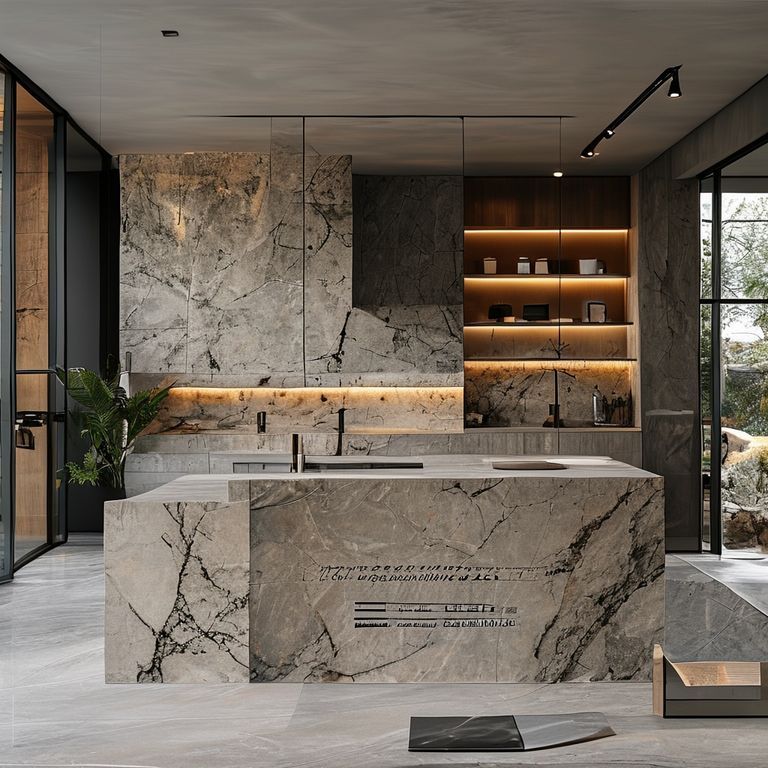
To understand the allure of artificial stone, one must first dismantle the prejudice of the word “artificial.” In this context, artificial doesn’t mean “fake.” It means “perfected.” Think of it as the difference between a wild-grown fruit and a culinary masterpiece prepared by a Michelin-starred chef. One is a raw occurrence; the other is a deliberate expression of human intent. Artificial stone, whether it manifests as engineered quartz, sintered stone, or sophisticated solid surfaces, represents the marriage of geological raw materials with high-octane technology.
The journey began in the mid-20th century, but the leap into the stratosphere of luxury happened only recently. Early iterations were utilitarian—tough, yes, but lacking the soul and depth of Carrara or Calacatta marble. However, the last decade has seen a revolution in digital printing and molecular bonding. Today’s engineered stones are indistinguishable from their mountain-born cousins to the naked eye, yet they possess a structural integrity that Mother Nature often forgets to provide.
When you walk into a kitchen anchored by a sprawling island of engineered stone, you aren’t just looking at a surface; you’re looking at a curated aesthetic. Designers now have the power to “program” the veins. They can ensure that the dramatic charcoal lines of a slab flow seamlessly across a mitered edge, creating a waterfall effect that is mathematically impossible to achieve with unpredictable natural slabs. This level of control is the ultimate luxury. It allows for a symmetry and a narrative flow in a room that feels intentional, grounded, and deeply sophisticated.
Beyond the visuals, there is the tactile poetry of the material. Modern manufacturing techniques allow for finishes that range from “volcanic” textures that mimic raw basalt to “honed” surfaces that feel like soft silk under the fingertips. Unlike natural stone, which can feel cold and clinical, many high-end artificial stones have a thermal consistency that makes them feel more integrated into the living environment. They absorb the warmth of the room, inviting touch rather than just demanding admiration from a distance.
Furthermore, the rise of artificial stone is a response to a global shift in values. We are entering an age of “Quiet Luxury,” where the ostentatious display of rare, depleted natural resources is beginning to lose its luster. There is a burgeoning pride in choosing a material that is engineered for longevity. When a homeowner chooses a sintered stone—made from minerals refined under intense pressure and heat—they are choosing a product that is essentially indestructible. It is a rebellion against the “disposable” culture. This stone won’t stain from a spilled glass of Bordeaux; it won’t etch from the acidity of a sliced lemon. It preserves its “day one” beauty for decades.
This reliability is the silent hero of the artificial stone movement. Natural marble is a diva; it requires constant sealing, cautious cleaning, and a hovering sense of anxiety. Artificial stone, by contrast, is the reliable partner. It offers the high-drama aesthetics of a palace in Italy with the workhorse durability of a laboratory. This transition from “precious and fragile” to “precious and powerful” is exactly why artificial stone has become the darling of the world’s most prestigious design firms. It allows for a life lived fully, without the fear of ruining the art that surrounds you.
As we look at the skyscrapers of Dubai, the penthouses of New York, and the minimalist villas of Scandinavia, the presence of artificial stone is ubiquitous. It has become the canvas upon which modern life is painted. In the first half of this century, we were obsessed with the “real.” In this second half, we are obsessed with the “optimized.” Artificial stone is the physical manifestation of that optimization—a testament to the fact that when human ingenuity takes the raw ingredients of the earth and refines them through the lens of art and science, the result is something far more extraordinary than anything we could simply dig out of the ground.
While the aesthetic evolution of artificial stone has captured the hearts of stylists, its technical superiority is what has won over the architects and engineers. If Part 1 of the artificial stone story is about beauty, Part 2 is about the sheer, unadulterated performance that makes it a cornerstone of the future. We are no longer just building houses; we are building high-performance environments. In this context, the material requirements have shifted from “looking good” to “performing under pressure.”
The magic lies in the porosity—or rather, the lack thereof. Natural stone is a sponge at a microscopic level. It breathes, which means it also absorbs. Bacteria, oils, and pigments find sanctuary in the tiny fissures of granite and marble. Artificial stone, particularly engineered quartz and sintered surfaces, is non-porous. The vacuum-vibro-compression process used in manufacturing eliminates the voids. This results in a surface that is naturally hygienic. In a post-pandemic world, where the sanctity of the home as a clean sanctuary is paramount, the “health” of a material has become a primary selling point. You can knead bread dough directly on an engineered stone counter without a second thought. It is a surface that supports life without harboring its shadows.
Then there is the matter of scale and versatility. One of the greatest limitations of natural stone is its weight and its brittleness. Try to clad a ceiling or a high-rise facade in thick, heavy marble, and you face a nightmare of structural engineering. Artificial stone has broken these chains. We now see ultra-thin sintered slabs, some as thin as 3mm or 6mm, that possess the strength of a much thicker traditional tile. These “large format” slabs allow for a seamless look—imagine a bathroom where the walls, floors, and vanity are all carved from what appears to be a single, continuous block of stone. No grout lines to clean, no visual interruptions. It is an architectural sleight of hand that creates a sense of infinite space.
Sustainability is the other pillar of the artificial stone revolution. The traditional stone industry is notoriously invasive. For every perfect slab of marble extracted, a staggering amount of waste is produced, and the environmental scar left by open-pit mining is permanent. Artificial stone offers a more circular path. Many leading manufacturers now use recycled glass, mirrors, and stone scraps as the primary aggregate in their slabs. By diverting these materials from landfills and binding them with bio-resins, they create a product that is as “green” as it is gorgeous. It is a way to enjoy the tectonic aesthetic without the tectonic cost to the planet.
The creative freedom afforded by this material also means we are seeing colors and patterns that don’t exist in nature. While the “marble look” remains a bestseller, a new generation of designers is pushing into the avant-garde. We are seeing artificial stones with metallic flecks that shimmer like a nebula, or deep, matte blacks that swallow light like a black hole. We are seeing translucent stones that can be back-lit, turning a kitchen island or a bar top into a glowing lantern at night. This isn’t just stone; it’s a medium for light and shadow.
As we move deeper into the 21st century, the boundary between our digital dreams and our physical reality continues to blur. Artificial stone is the perfect material for this transition. It can be CNC-machined with surgical precision, allowing for integrated sinks, hidden wireless charging ports built directly into the countertop, and induction hobs that sit invisibly beneath the stone surface. The kitchen of the future doesn’t look like a kitchen; it looks like a sleek, monolithic sculpture. This is only possible because of the predictable, uniform strength of engineered stone.
Ultimately, the rise of artificial stone is a celebration of human potential. It represents our ability to take the chaos of the natural world and organize it into something that serves our needs, matches our ethics, and fulfills our deepest desires for beauty. It is a material that doesn’t ask you to choose between form and function. It insists that you have both.
Whether you are a developer looking for a material that will stand the test of a thousand tenants, or a homeowner wanting to create a sanctuary that reflects your personal style, artificial stone provides the answer. It is durable, it is sustainable, and it is breathtakingly beautiful. The “Alchemist’s Quarry” is open, and the treasures it produces are not just replacements for the past—they are the blueprints for a more resilient, more elegant future. The stone age didn’t end because we ran out of stones; it ended because we learned how to build better ones. Artificial stone is that “better,” and it is here to stay.









