
The question “人工石是什么字?” (What character is artificial stone?) sounds like a riddle posed by a Zen master or a challenge hidden within a dusty archive of ancient linguistics. At first glance, it seems literal—a search for a name. But for those who dance in the spaces between architecture, history, and the written word, the answer reveals a fascinating piece of mid-century ingenuity that bridges the gap between raw nature and human ambition.

In the world of Chinese characters, “artificial stone” isn’t just a phrase; it is a singular, powerful glyph: 砼 (pronounced tóng).
To look at this character is to witness a masterpiece of logical construction. On the left, you have 石 (shí), the radical for stone—the symbol of the earth’s primordial bones. On the right, you find a vertical stack: 人 (rén) for man, and 工 (gōng) for work or labor. Together, they form a visual equation: Man + Work + Stone = Concrete. This character didn’t emerge from the mists of the Han Dynasty; it was born in 1953, birthed by the visionary structural engineer Cai Fangyin. He sought a shorthand for “reinforced concrete,” a way to condense a complex engineering concept into a single, elegant stroke. In doing so, he didn’t just invent a word; he captured the essence of the Anthropocene—the era where humanity began to craft its own geology.
But “artificial stone” as a concept has outgrown the grey, industrial confines of 1950s concrete. Today, when we ask what “artificial stone” is, we aren’t just talking about the sidewalks of Beijing or the pillars of a highway overpass. We are talking about an aesthetic revolution that has swept through the galleries of Milan and the penthouses of Manhattan. We are talking about engineered quartz, sintered stone, and sophisticated composites that defy the limitations of the natural world.
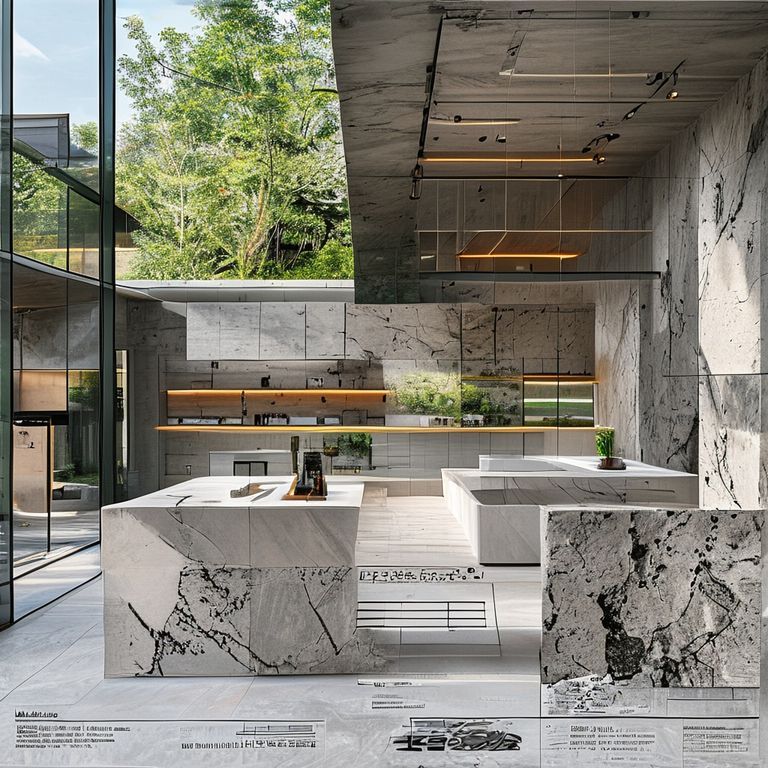
The allure of the “artificial” lies in its perfection. Natural marble is a temperamental beauty—prone to staining, fragile under acidic touch, and riddled with unpredictable fissures. Artificial stone, however, is stone with a human soul and a scientist’s precision. It is the result of crushing natural minerals and binding them with high-performance resins or through intense heat and pressure (sintering), creating a surface that is non-porous, incredibly durable, and visually breathtaking. It is the “砼” philosophy updated for the 21st century: taking the best of the earth and refining it through the crucible of human intellect.
Imagine walking into a kitchen where the island is a monolithic slab of deep, midnight emerald, veined with gold. In nature, such a stone might be impossible to find in a size large enough to cover a counter without a seam, or it might be too soft to survive a dinner party. In the realm of artificial stone, it is a reality. This is the “character” of the material—not just a mark on a page, but a personality defined by resilience and bespoke beauty.
The rise of these materials marks a shift in our relationship with luxury. Luxury used to be defined by rarity—the hardest-to-reach quarry, the most exotic imported slab. Now, luxury is defined by performance and intentionality. We choose artificial stone because it represents the pinnacle of what we can achieve when we stop merely taking from the earth and start collaborating with it. It is the architectural equivalent of a diamond grown in a lab: chemically identical or superior, ethically clearer, and physically flawless.
As we delve deeper into this world, we realize that the character “砼” is more than a technical term. It is a symbol of transition. It marks the moment we stopped being at the mercy of the mountain and started building our own peaks. Whether it’s the high-gloss sheen of a quartz countertop or the brutalist elegance of a polished concrete floor, the “man-made stone” is the foundation of our modern identity. It is the physical manifestation of our desire to leave a mark—not just by carving into stone, but by inventing a stone that reflects who we are: innovative, resilient, and endlessly creative.
Continuing our journey into the soul of “artificial stone,” we must look beyond the chemical bonds and the linguistic shorthand to the sensory experience of the material itself. If Part 1 was about the “what” and the “how,” Part 2 is about the “why.” Why has this “artificial” character become the protagonist of modern design? Why do the world’s leading architects now favor the engineered over the excavated?
The answer lies in the concept of unlimited expression. Natural stone is a finished story—a narrative written by tectonic plates millions of years ago. You get what the earth gives you. Artificial stone, conversely, is a blank page. Designers can manipulate the pigment, the translucency, and the texture to create “stones” that have never existed in nature. We are seeing slabs that mimic the iridescent glow of the Northern Lights, or surfaces that feel like soft silk but possess the hardness of granite. This is the true “work” of the “man” in the character 砼. It is the artistry of the impossible.
Furthermore, we are living in an era of conscience. The environmental cost of traditional quarrying—the scars left on the landscape, the massive carbon footprint of transporting heavy slabs across oceans—has led a new generation to seek alternatives. Many modern artificial stones are pioneers of sustainability. They utilize recycled glass, crushed stone scraps that would otherwise be waste, and bio-resins. In this context, the “man-work-stone” character takes on a new meaning: it represents a responsible stewardship of resources. It is the stone of the future because it doesn’t require us to tear down the past.
In the high-stakes world of commercial architecture, artificial stone is the unsung hero of longevity. Think of the Burj Khalifa or the sleek airports of Singapore and Dubai. These structures require materials that can withstand the footfall of millions without losing their luster. Natural limestone would crumble; marble would dull. But engineered composites, with their uniform density and resistance to the elements, stand defiant. They allow for a “monolithic” aesthetic—vast, seamless expanses of stone that create a sense of infinite space. This is where the character of artificial stone meets the character of the city: bold, enduring, and meticulously planned.
But let’s bring it back to the intimate scale of the home. The modern obsession with the “minimalist sanctuary” owes much to these materials. The ability to have a bathroom entirely clad in a single, seamless texture of warm, matte grey stone—from the floors to the walls to the integrated sink—creates a sense of calm that is difficult to achieve with the chaotic patterns of natural rock. Artificial stone provides a visual “hush.” It allows the architecture to speak without the distraction of imperfections.
Interestingly, the word “artificial” is also undergoing a linguistic rebrand. In the past, it was a synonym for “fake” or “cheap.” Today, in the circles of high design, it is becoming synonymous with “technological.” We see this in the rise of Sintered Stone, a category of man-made material that uses extreme heat to mimic the natural metamorphic process in a fraction of the time. The result is a slab that is virtually indestructible—UV resistant, scratch-proof, and heat-proof. It is the “superhero” version of stone.
So, when we return to the question, “人工石是什么字?” we find that the answer is multifaceted. It is the character 砼, a tribute to the engineers of the 20th century. It is the quartz in your kitchen, a tribute to the interior designers of the 21st century. It is the sintered slab on a skyscraper’s facade, a tribute to the scientists of the future.
Ultimately, artificial stone is the “character” of human progress. It represents our unique ability to take the raw, chaotic elements of our planet—the silica, the calcium, the resin—and organize them into something of profound utility and grace. It is a reminder that beauty isn’t only found in the wild; it is also crafted in the lab, polished in the factory, and envisioned in the mind.
The next time you run your hand over a cool, perfectly smooth stone surface, don’t ask if it came from a mountain or a mold. Instead, appreciate the “砼” within it. Appreciate the “Man” and the “Work” that transformed the “Stone” into a masterpiece. In the end, the most attractive thing about artificial stone isn’t its durability or its design—it’s the story of us, written in a language of earth and intellect, proving that we have the power to create the very ground we walk on.









