
The allure of natural stone—the swirling veining of marble, the rugged endurance of granite—has captivated architects and homeowners for millennia. However, the modern era has ushered in a new protagonist in the world of interior design: the artificial stone slab. Far from being a mere imitation, these engineered surfaces represent a pinnacle of material science, blending the raw beauty of the earth with the precision of high-tech manufacturing. When we look at “人工石板制作方法图片” (artificial stone production method images), we aren’t just seeing a factory floor; we are witnessing a choreographed dance of pressure, chemistry, and aesthetic intent. To understand the value of these slabs, one must peel back the layers of their creation, starting from the selection of the very atoms that compose them.
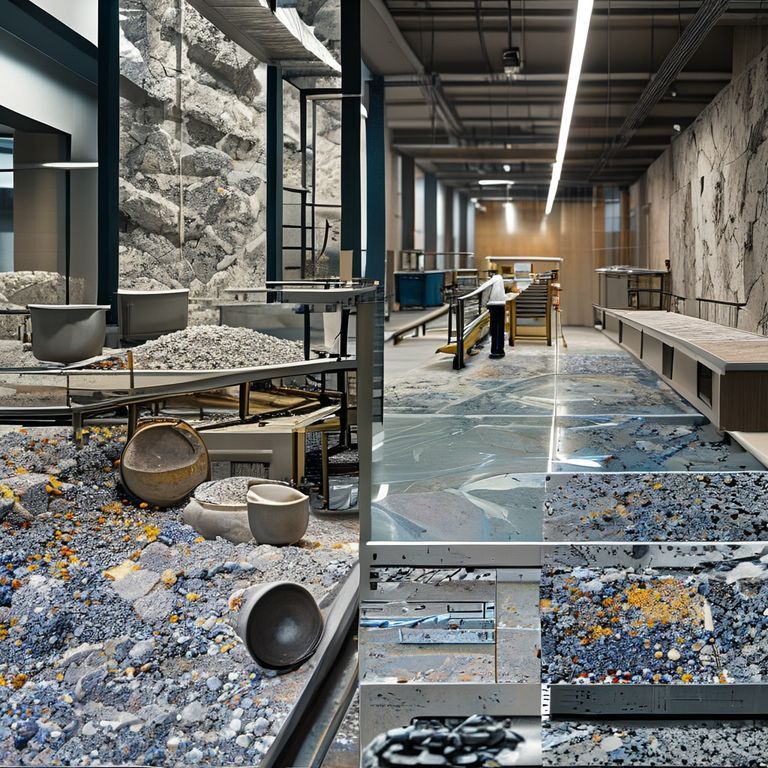
The journey begins in the sorting bays, where the raw “dna” of the stone is gathered. Unlike natural quarries where you take what the earth gives you, artificial stone production allows for total creative control. The primary ingredient is typically crushed quartz or high-grade silica sand, making up roughly 90% to 94% of the final product. The remaining percentage is a proprietary blend of polyester resins, pigments, and functional additives. In the early stages of the method, the visual landscape of the production line is a kaleidoscope of textures. Imagine vast hoppers filled with translucent quartz crystals, ranging from the size of fine flour to coarse pebbles. This variation in “grain” is what determines the final look—fine grains result in a sleek, monochromatic finish, while larger chunks create the classic, speckled look of traditional terrazzo.
Once the recipe is set, the ingredients enter a massive industrial mixer. This is where the “alchemy” happens. The resin acts as a high-performance binder, coating every single grain of quartz. It’s a viscous, honey-like substance that, when mixed with specialized pigments, begins to define the slab’s personality. If the goal is a “calacatta” marble look, the pigments are introduced in a controlled yet chaotic manner to mimic natural veining. Watching this process via “制作方法图片” (production method images) reveals the complexity of “vein-loading” technology, where robotic arms or skilled technicians inject streaks of color into the base mix. It is a moment where the industrial meets the artistic; the machine provides the consistency, but the programming provides the soul.
The next phase is perhaps the most visually striking part of the entire method: the distribution and vacuum-vibro-compression. The wet, sandy mixture is dispensed into a large rubber mold that defines the slab’s dimensions—usually a standard jumbo size of roughly 3200mm by 1600mm. At this point, the mixture looks like nothing more than a tray of colorful, damp sand. However, the transformation occurs within the vacuum press. Here, the mold is subjected to intense pressure (up to 100 tons) while simultaneously being vibrated at high frequencies under a total vacuum.
This step is non-negotiable for quality. The vacuum removes every microscopic air bubble from the mixture, ensuring the final slab is non-porous and incredibly dense. The vibration settles the particles into a perfect, interlocking matrix. This is the secret behind why artificial stone is often more durable and stain-resistant than its natural counterparts. In any visual gallery of the production method, the press is the heart of the operation—a massive, humming titan that compresses raw chaos into a solid, unyielding plate. When the slab emerges from the press, it is no longer a loose collection of minerals; it has gained its structural integrity, though it is still “green” and fragile, requiring a stint in the kiln to achieve its final strength. This transition from liquid-bound aggregate to a solid monolith is the defining bridge between raw material and architectural masterpiece.
After the intense compression of the vacuum press, the “green” slab enters the curing kiln, a phase where time and temperature collaborate to finalize the stone’s molecular structure. This is a critical stage in the artificial stone production method. The slabs are moved on a conveyor system into long, temperature-controlled ovens where the polyester resin undergoes polymerization. As the heat rises, the resin transforms from a viscous liquid into a hard, cross-linked polymer chain that locks the quartz crystals into a permanent embrace. This thermal treatment typically lasts between 30 to 60 minutes, and it is here that the slab gains its legendary hardness—usually reaching a 7 on the Mohs scale, making it nearly as hard as diamond.
When the slabs exit the kiln, they undergo a cooling process. At this stage, looking at “制作方法图片” (production method images), you would see a matte, somewhat dull-looking surface. The true beauty of the artificial stone is still hidden beneath a thin layer of resin “skin” and uneven texture. This leads us to the most labor-intensive part of the finishing line: calibration and polishing. The slab is first fed into a calibration machine equipped with heavy-duty diamond grinding wheels. These wheels shave the slab down to a precise, uniform thickness, ensuring that when the stone is eventually installed on a kitchen island or a bathroom vanity, it is perfectly level.
The polishing line is a sight to behold—a series of 20 to 30 polishing heads, each finer than the last, buffing the surface of the stone under a constant stream of water. The first few heads use coarse diamond abrasives to remove the scratches from calibration, while the final heads use fine powders to bring out a mirror-like luster. This is the moment the “artificial” stone truly begins to shine, quite literally. The colors become more vivid, the veining gains depth, and the quartz crystals start to catch the light. For those who prefer a more contemporary look, the process can be adjusted to produce “honed” (matte) or “leathered” (textured) finishes, proving that the method is as versatile as the designer’s imagination.
Beyond the aesthetics, the latter stages of the production method are dedicated to rigorous quality control. Each slab is moved to an inspection station bathed in high-intensity lighting. Here, technicians—and increasingly, AI-driven optical scanners—examine the slab for any imperfections. They look for “resin pooling,” “pigment spots,” or tiny fissures that might have occurred during the curing process. Because artificial stone is marketed as a premium, “perfected” version of natural stone, the standards are incredibly high. Slabs that don’t meet the grade are recycled back into the aggregate pool, embodying a circularity that modern manufacturing strives for.
The final chapter of the production story involves the back-side treatment. The underside of the slab is often branded with the manufacturer’s logo and batch number, and sometimes a fiberglass mesh is applied for added structural reinforcement during transport. The finished slabs are then moved by giant vacuum suction lifters and stacked into A-frames, ready to be shipped across the globe.
Understanding the “人工石板制作方法” (artificial stone production method) changes how one perceives these surfaces. They are not just “fake” stone; they are a sophisticated composite, a feat of human ingenuity that solves the inherent weaknesses of natural rock. By controlling the ingredients and the environment, manufacturers create a surface that is non-porous, incredibly tough, and aesthetically limitless. Whether it’s a slab that perfectly mimics the white marble of Carrara or a bold, avant-garde design with embedded recycled glass and mirror flecks, the journey from raw quartz to polished slab is a testament to the power of modern fabrication. When you see the images of this process, you are seeing the future of architecture—one where beauty is engineered to last a lifetime.









