
The kitchen is often described as the heart of the home, but if the kitchen is the heart, then the countertop is undoubtedly its soul. It is the stage where culinary masterpieces are born, where morning coffees are savored, and where the frantic energy of a Monday morning meets the slow rhythm of a Sunday brunch. For decades, natural stone was the undisputed king of these surfaces. However, a quiet revolution has taken place in the world of interior design. Artificial stone—specifically engineered quartz and solid surfaces—has ascended the throne. But have you ever paused to wonder how a pile of crushed minerals and liquid resins transforms into a sleek, non-porous, and indestructible slab of beauty? The story of how artificial stone is made is a gripping tale of industrial alchemy, blending the raw power of nature with the precision of cutting-edge engineering.
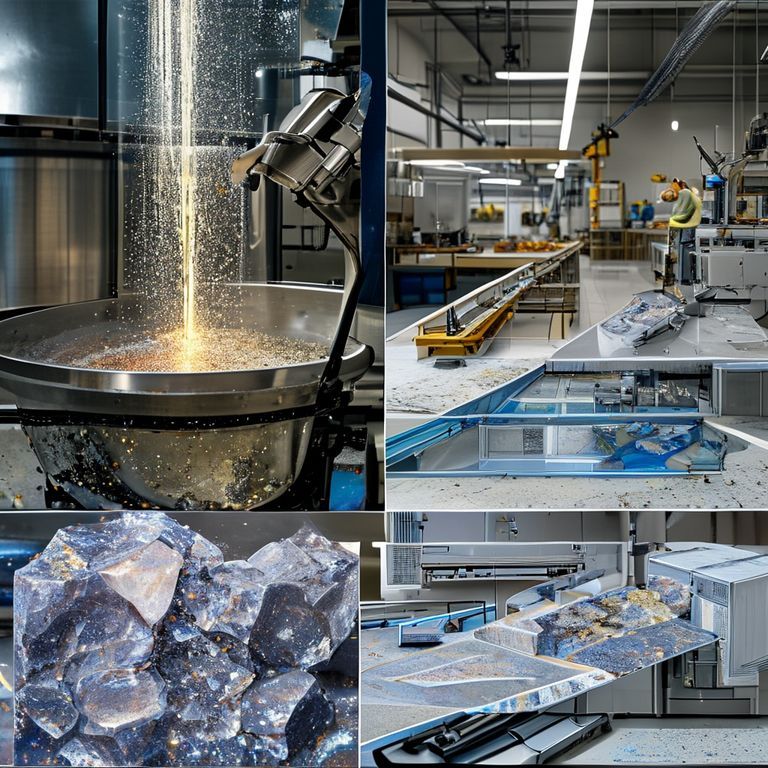
The journey begins far from the showroom floor, in the rugged terrain of quarries where raw minerals are harvested. Unlike natural granite slabs, which are sliced directly from the earth like giant loaves of bread, artificial stone is a composite. The primary ingredient is usually ground quartz—one of the hardest minerals on Earth—making up about 90% to 94% of the final product. The remaining percentage is a proprietary blend of polyester resins, pigments, and sometimes decorative “bits” like recycled glass, metallic flakes, or even pieces of semi-precious stones. This “recipe” is what gives artificial stone its superpower: the ability to be more consistent, more durable, and more versatile than anything found purely in the wild.
The process kicks off in the mixing room, a place of surgical precision. Imagine a giant, high-tech kitchen where every ingredient is weighed to the milligram. Automated systems dispense the crushed quartz—ranging from fine powder to coarse grains depending on the desired texture—into massive industrial mixers. Then comes the resin, the “glue” that will bind the minerals together. This isn’t just any resin; it is a high-performance polymer designed to resist heat, chemicals, and UV light. As the mixers churn, pigments are introduced. This is where the magic happens. Technicians can recreate the delicate veining of Carrara marble or the deep, brooding speckles of volcanic rock. Because the color is mixed throughout the entire mass, the beauty of artificial stone isn’t just skin deep; it runs all the way through.
Once the mixture reaches the perfect consistency—a damp, sandy texture that smells faintly of chemistry and potential—it is transported to a casting station. Here, the “dough” is spread into massive rubber molds that define the dimensions of the future slab. At this stage, it looks nothing like a countertop. It looks like a giant, colorful sandcake. But the next step is where the transformation truly occurs: the vacuum-vibrocompression process.
This is the heartbeat of artificial stone production. The mold enters a massive press where it is subjected to three forces simultaneously: a vacuum, vibration, and immense pressure. The vacuum sucks out every single microscopic bubble of air trapped within the mix. If air remained, the stone would be porous and prone to cracking. The vibration shakes the particles into a dense, interlocking puzzle, while the pressure (often exceeding 100 tons) compacts the material into a solid, void-free mass. This stage is what makes artificial stone virtually non-porous. Unlike natural stone, which has tiny “pores” that can soak up red wine or bacteria, engineered stone is a fortress. Nothing gets in, and nothing gets out.
After the press, the slabs are still somewhat “soft” and must be cured. They move into large industrial kilns, or curing ovens, where they are baked at controlled temperatures. This heat triggers a chemical reaction in the resin, causing it to cross-link and harden. It is a metamorphosis. What went in as a compressed mix of sand and resin emerges as a rock-hard, monolithic slab. It is during this curing phase that the material gains its final structural integrity, becoming a substance that can withstand the bangs of heavy cast-iron pans and the scratches of sharp knives.
The slabs that exit the oven are strong, but they are far from beautiful. They are dull, rough, and slightly uneven. They represent the “raw” state of artificial stone. To the untrained eye, they might look like industrial building blocks, but to the manufacturer, they are diamonds in the rough. The transition from this rugged state to the mirror-like finish you see in high-end kitchen boutiques requires a second act of mechanical mastery. In the next phase, we move from the world of chemistry and pressure into the world of precision grinding and artistic finishing, where the true personality of the stone is revealed.
When the cured slabs emerge from the cooling racks, they are ready for the “calibration” phase. This is a rigorous process where the slabs are passed under a series of heavy-duty grinding heads. These machines use diamond-tipped abrasives to shave the slab down to a perfectly uniform thickness. In the world of high-end cabinetry, a variation of even a millimeter can cause headaches during installation, so calibration is a non-negotiable step. As the slab glides through the calibration line, water flows constantly to keep the friction heat down and to wash away the fine dust, a reminder of the industrial might required to tame such a hard material.
Once the slab is perfectly flat, it moves to the polishing line. This is perhaps the most visually satisfying part of the entire manufacturing journey. A long row of polishing heads—sometimes twenty or more—sequentially buff the surface of the stone. Each head uses a finer grit than the one before it. The first few heads remove the scratches left by the calibration process, while the final heads use pads so fine they feel smooth to the touch. It is here that the colors suddenly pop. The dull greys turn into deep charcoals, and the faint swirls of pigment sharpen into dramatic veins. For those who prefer a different aesthetic, the process can be adjusted to create a “honed” (matte) finish or a “leathered” (textured) finish, providing a tactile experience that appeals to the sense of touch as much as the sense of sight.
The finished slabs are then subjected to a rigorous quality control inspection. Under intense LED lighting, inspectors look for the tiniest imperfections—a stray pigment clump, a microscopic fissure, or an inconsistent polish. Only the perfect slabs are branded and moved to the warehouse. But for the homeowner, the journey is only half over. The slab must now be transformed from a 10-foot piece of stone into a custom-fitted countertop.
This transformation happens at the fabrication shop. Here, the bridge saw—a massive, computer-controlled (CNC) cutting machine—takes center stage. Using the precise measurements or digital templates taken from a customer’s kitchen, the saw slices through the stone with a water-cooled diamond blade. The precision is breathtaking. Complex cutouts for under-mount sinks, holes for faucets, and notches for awkward corners are executed with mathematical perfection. This is where the “artificial” nature of the stone becomes its greatest asset. Because the material is consistent and lacks the hidden “fault lines” often found in natural granite, fabricators can perform intricate cuts that would be impossible or incredibly risky with natural stone.
After cutting, the edges are shaped. Whether it’s a simple “eased” edge for a minimalist modern look or a complex “ogee” edge for a traditional aesthetic, the process involves more diamond routing and hand-polishing. Skilled artisans often step in at this point, using hand-held tools to ensure the seams and edges are as smooth as silk. They treat the stone not as a mass-produced product, but as a custom piece of furniture. The final touch is often a thorough cleaning and, in some cases, the application of a protective sealer (though many high-quality quartz brands are so dense they require no sealing at all).
The final product is a triumph of human ingenuity. It is a material that offers the timeless beauty of the earth’s minerals but corrects the “flaws” of nature. It won’t stain if you spill lemon juice or red wine. It won’t harbor bacteria in hidden pores. It doesn’t require the constant maintenance and resealing that natural stone demands. Instead, it offers a worry-free surface that looks as good on day 3,000 as it did on day one.
As we look toward the future, the manufacturing of artificial stone continues to evolve. New techniques are allowing for even more realistic “natural” patterns, and there is a massive shift toward sustainability. Many manufacturers are now using recycled water in their plants, powering their kilns with renewable energy, and incorporating higher percentages of recycled glass and mirror into their “stone” recipes. The goal is to create beauty without a heavy footprint.
When you finally run your hand over a new artificial stone countertop, you aren’t just feeling a cold surface. You are feeling the culmination of thousands of pounds of pressure, the precision of diamond-edged tools, the chemistry of advanced polymers, and the eye of an artist. It is a product born in a factory but designed for the home, bridging the gap between the rugged outdoors and the refined interior. Understanding how it is made only adds to the allure. It turns a simple piece of home decor into a conversation piece—a testament to the fact that when we combine the best of what nature provides with the best of what humans can imagine, the results are nothing short of extraordinary.









