
There is a specific kind of magic that happens at the intersection of geology and human ingenuity. For decades, we were beholden to the whims of the earth—quarrying massive slabs of granite or marble, hoping the veins aligned and the fissures weren’t too deep. But the narrative has shifted. We have entered the era of the “engineered masterpiece.” When you look at a high-definition “人造石台面效果图” (artificial stone countertop rendering), you aren’t just looking at a digital approximation of a kitchen; you are looking at the future of domestic architecture. These renderings serve as a bridge between a homeowner’s abstract desire for “luxury” and the tactile, high-performance reality of modern materials.
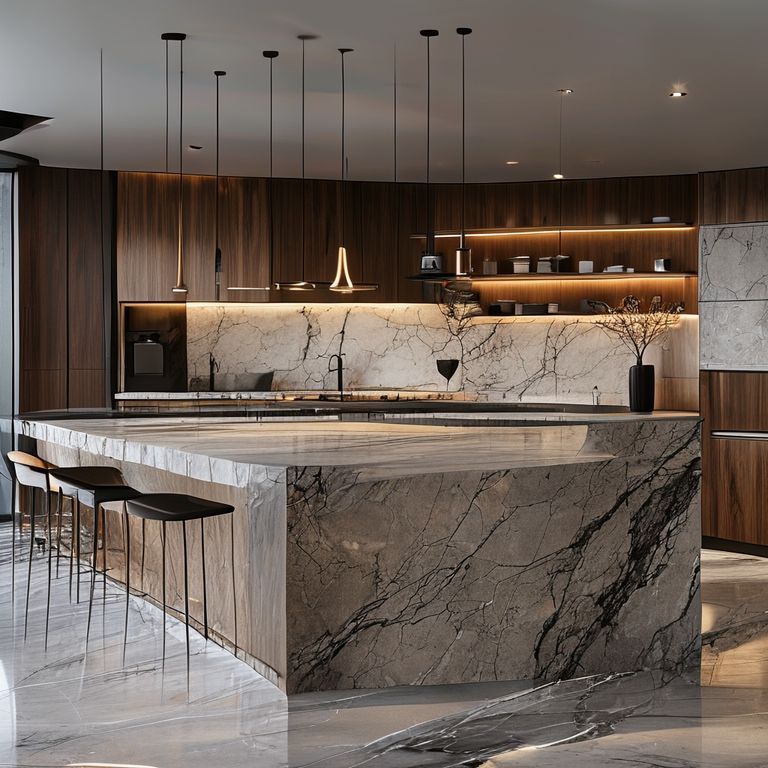
The first thing that strikes you when browsing through professional renderings is the sheer breadth of personality available. In the past, artificial stone was the “safe” alternative—a uniform, perhaps slightly dull, substitute for the wild unpredictability of natural stone. That era is dead. Today’s engineered surfaces, ranging from sophisticated quartz to cutting-edge sintered stone, are chameleons. They can mimic the deep, moody veining of Nero Marquina marble, the industrial grit of poured concrete, or the ethereal translucency of white onyx. A well-executed rendering captures these nuances—the way the morning light catches a polished edge, or how a matte “leathered” finish absorbs the glow of under-cabinet LEDs. It allows a designer to play with light and shadow before a single slab is ever cut.
Why has the “rendering” become such a pivotal part of the design process? Because humans are visual creatures who struggle with scale. Seeing a 2-inch sample in a showroom is a world away from seeing a 3-meter waterfall island anchoring a sprawling open-concept kitchen. A rendering provides the context. It shows you how a charcoal-grey quartz countertop interacts with brushed brass fixtures and walnut cabinetry. It validates the “bold” choices. Perhaps you were afraid that a dark, veined stone would make the room feel small. In a high-quality visualization, you can see that the opposite is true—the dark surface adds a grounding weight, a sense of permanence and gravitas that transforms the kitchen from a mere utility room into a sculptural centerpiece.
Furthermore, the technology behind these stones has outpaced our collective imagination. We are no longer limited by the physical constraints of natural rock. Artificial stone allows for “impossible” designs. Think of ultra-thin profiles that look like a single sheet of paper floating above the cabinets, or massive, seamless backsplashes that climb the wall without a single grout line to break the visual flow. Renderings allow us to experiment with these avant-garde concepts. They give us the confidence to push boundaries. When you see a rendering of a cantilevered breakfast bar made of seamless artificial stone, you realize that your home doesn’t have to follow the rules of 20th-century construction. It can be a reflection of 21st-century precision.
The emotional resonance of these surfaces shouldn’t be underestimated. We spend a significant portion of our lives in our kitchens; they are the “laboratories of the soul” where we nourish our families and host our friends. The countertop is the stage where this life happens. Choosing the right surface is about more than just scratch resistance or heat tolerance—though artificial stone wins those battles handily. It is about the “hand-feel” and the visual rhythm of the room. A rendering helps you find that rhythm. It allows you to swap out a high-gloss finish for a “honed” or “suede” texture in a heartbeat, letting you feel the difference in the atmosphere. A glossy surface reflects the world, making the room feel energetic and bright; a matte surface swallows the light, creating a sanctuary of calm and introspection.
As we look at the latest trends in artificial stone renderings, we see a move toward the “Hyper-Natural.” Designers are no longer satisfied with mere imitation. They are using the controlled environment of stone engineering to create patterns that don’t exist in nature—symmetries that are too perfect, colors that are too pure. These renderings show us a world where we can have the beauty of the rarest Calacatta marble with the indestructible nature of a space-age polymer. It is the ultimate luxury: the ability to have the aesthetic of the sublime without the anxiety of the fragile.
Transitioning from the visual dream of a rendering to the physical reality of a finished home is where the true value of artificial stone reveals itself. While the rendering captures the “soul” of the design, the material itself provides the “body.” If Part 1 was about the artistic potential, Part 2 is about the lifestyle revolution. When you invest in a surface based on a “人造石台面效果图,” you are buying into a promise of longevity that natural stone simply cannot match.
One of the most compelling aspects of modern artificial stone—specifically quartz and sintered stone—is the elimination of the “maintenance tax.” Natural marble is a diva; it demands sealing, it panics at the sight of a lemon wedge, and it “patinas” (a polite word for staining) the moment a glass of red wine is tipped. Artificial stone, however, is a workhorse in a tuxedo. Because these surfaces are non-porous, the rendering you fell in love with on your computer screen is exactly how your kitchen will look ten years from now. The rendering represents a permanent state of perfection. There is a profound psychological peace that comes from knowing your “perfect” kitchen isn’t a ticking clock.
In the realm of bathroom design, artificial stone renderings have opened up a new world of “spa-core” aesthetics. We are seeing a surge in integrated sinks and custom-molded vanities. Imagine a single, monolithic block of stone where the sink isn’t “installed” but is rather a gentle depression in the surface itself. This level of sleekness is a nightmare to achieve with natural stone, which is prone to cracking during such complex fabrication. With artificial stone, it’s a standard feature. Renderings show us these seamless transitions, where the countertop flows into the sink and then up the wall as a full-height backsplash. The result is a visual cleanliness that feels almost clinical in its precision, yet warm and inviting in its materiality.
Let’s talk about the “Bespoke” movement. One of the reasons artificial stone renderings are so popular is that they allow for total color control. If a designer is working on a high-end commercial project or a very specific residential palette, they can specify the exact pigment load and grain size of the stone. You can’t “order” a specific shade of grey from a mountain in Italy, but you can from a high-end engineered stone manufacturer. This predictability is a godsend for interior designers. It ensures that the “effect” promised in the 3D model is the “effect” delivered on-site. There are no surprises, no “oops, this slab has a giant yellow spot in the middle.” The rendering is the contract.
Moreover, we must address the “green” elephant in the room. Modern renderings often highlight the sustainable nature of artificial stone. Many leading brands now use recycled glass, mirrors, and bio-resins in their composition. When you view a rendering of a beautiful, speckled terrazzo-style artificial countertop, you are often looking at a product that has diverted waste from a landfill. For the conscious consumer, the rendering represents a harmony between luxury and responsibility. It shows that you don’t have to strip a mountainside to have a beautiful home. You can have a surface that is smarter, stronger, and more ethical.
The future of these renderings is even more immersive. We are moving toward “Real-Time Visualization,” where you can wear a VR headset and walk through your kitchen, touching the artificial stone countertops in a digital space. You can change the time of day to see how the “veining” of your quartz island looks under the orange glow of a sunset versus the crisp blue of a winter morning. This level of detail ensures that the final result isn’t just “good,” but is a perfect tailored fit for the homeowner’s lifestyle.
In conclusion, the “人造石台面效果图” is much more than a marketing tool; it is a manifesto for modern living. It represents the triumph of human design over the limitations of the natural world. It allows us to dream bigger, design bolder, and live easier. Whether you are drawn to the rugged, tactile feel of a concrete-look quartz or the sophisticated, high-gloss sheen of a porcelain-based sintered stone, the rendering is your first step toward that reality. It is where your vision takes shape, where colors find their partners, and where the house you bought becomes the home you love. The artificial stone countertop is the heart of the modern home, and the rendering is the map that leads you there. In this space, the only limit is the extent of your imagination. So, look at those images, study the light, feel the textures with your eyes, and prepare to transform your living space into a masterpiece of form and function.









