
When you step into the world of high-end kitchen design, you quickly realize that the “devil is in the details” isn’t just a cliché—it’s a lifestyle. You’ve already made the smart choice: Quartz. It’s non-porous, practically indestructible, and carries an elegance that natural stone often struggles to maintain under the duress of a Sunday roast or a spilled glass of Cabernet. But as you stand in the showroom, the consultant drops a question that catches you off guard: “Are we looking at 1.8cm or 2.0cm?”
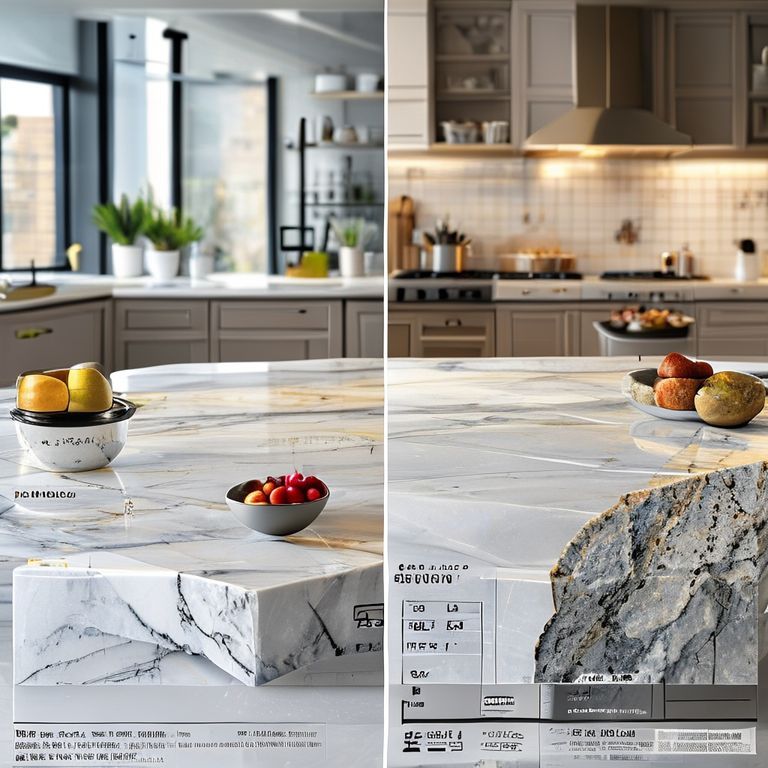
At first glance, you might think, “It’s only two millimeters. Does it really matter?” In the world of precision engineering and interior aesthetics, those two millimeters are the difference between a countertop that merely exists and one that defines the space. The debate between 1.8cm and 2.0cm quartz is one of the most common dilemmas for homeowners today. To make the right call, we need to peel back the layers of marketing speak and look at the structural, financial, and visual implications of this choice.
Let’s start with the basics: why do these two sizes even exist? Historically, the international standard for quartz slabs has hovered around 2.0cm (roughly 3/4 inch) and 3.0cm. The 2.0cm slab is widely considered the “gold standard” for modern cabinetry. However, as the market became more competitive and manufacturing techniques evolved, the 1.8cm slab emerged. Primarily driven by a desire to optimize shipping costs and material usage, 1.8cm became a popular “entry-level” thickness, especially in high-volume residential projects.
The first thing you’ll notice when comparing them is the “heft.” Physics doesn’t lie. A 2.0cm slab is approximately 11% thicker than a 1.8cm slab. While 11% sounds like a small margin, it translates significantly into the slab’s flexural strength. Imagine your kitchen as a high-traffic workspace. You’re kneading heavy dough, perhaps leaning on the edge while chatting with a friend, or placing a heavy cast-iron Dutch oven on the surface. Quartz is remarkably strong, but its strength is a product of its density and thickness.
The 2.0cm slab offers a much higher resistance to cracking under pressure. When a slab is being transported or installed, the risk of “snapping” at narrow points—like the thin strips of stone in front of a sink or a cooktop—is considerably lower with a 2.0cm thickness. For anyone who has ever seen a beautiful countertop ruin a renovation because it cracked during the final hour of installation, the extra 2mm feels like a very cheap insurance policy.
Then there is the issue of load-bearing. Modern kitchen designs often lean towards large, expansive islands with “waterfall” edges or significant overhangs where you can tuck in barstools. If you’re dreaming of that cantilevered look, 2.0cm is almost always the preferred choice. A 1.8cm slab is more prone to sagging over time if not supported by an extensive (and often unsightly) sub-structure of plywood or metal. By choosing 2.0cm, you’re buying structural integrity that allows for cleaner lines and fewer compromises in your cabinetry design.
But strength isn’t just about weight; it’s about heat. While quartz is heat-resistant, it isn’t heat-proof. The resin that binds the ground quartz together can react to extreme thermal shock. A thicker 2.0cm slab has a slightly better thermal mass, meaning it can dissipate heat more effectively than a thinner 1.8cm slab. While you should always use a trivet regardless of thickness, that 2.0cm barrier provides an extra layer of protection for the structural bond of the stone.
From a purely tactile perspective, there’s an psychological element to thickness. We associate weight and thickness with quality. When you run your hand over a 2.0cm edge, it feels substantial. It feels permanent. A 1.8cm slab, while still beautiful, can sometimes feel a bit “thin” or “economical” to the touch. In high-end real estate, savvy buyers often notice these subtle cues. If your goal is to maximize the resale value of your home, sticking to the industry-standard 2.0cm signals to future buyers that you didn’t cut corners on the materials.
However, the 1.8cm slab isn’t without its merits. It’s lighter, which makes it easier for installers to handle, especially in older homes with narrow staircases or tricky layouts. In certain minimalist designs where a “slim” aesthetic is the goal, the 1.8cm profile can actually look quite chic and modern. It’s also generally more budget-friendly. If you are renovating a rental property or a secondary bathroom where the countertop won’t face the daily “warzone” of a family kitchen, 1.8cm might be the perfect place to save a few hundred dollars without sacrificing the look of quartz.
As we move forward, we have to look beyond just the raw slab. The true magic happens during the fabrication process—where the stone is cut, shaped, and edged. This is where the choice between 1.8cm and 2.0cm moves from a structural decision to a purely artistic one.
Continuing our journey into the world of quartz thickness, we must address the “elephant in the room”: the edge profile. This is where the 2mm difference truly transforms from a measurement into a design statement. When a fabricator works with quartz, the thickness of the slab dictates the “menu” of edges available to you.
With a 2.0cm slab, you have a solid foundation for most classic edge profiles—the eased edge, the half-bullnose, or the bevel. Because there is more material to work with, these shapes look more balanced and proportional. If you try to execute a deep bevel or a complex ogee edge on a 1.8cm slab, the result can often look pinched or “sharp.” The 2.0cm thickness provides that extra “meat” on the bone that allows the light to catch the curves and angles of the stone, giving your kitchen that magazine-ready glow.
One of the biggest trends in contemporary kitchen design is the “mitred edge.” This is where two pieces of quartz are cut at a 45-degree angle and joined together to make the countertop look significantly thicker—think 4cm, 6cm, or even 10cm thick. While you can achieve this with both 1.8cm and 2.0cm slabs, the 2.0cm slab provides a larger surface area for the adhesive bond at the seam. This results in a stronger joint and a more seamless look. If you are investing in a massive, chunky island that looks like a single block of stone, the 2.0cm base is the superior choice for longevity and “invisibility” of the seams.
Let’s talk about installation and the “hidden costs.” Many homeowners choose 1.8cm because the quote for the stone itself is lower. However, you have to look at the total project cost. Because 1.8cm is thinner, many fabricators and cabinet makers will insist on installing a plywood sub-top (underlayment) to provide the necessary support and to raise the stone so that the edges don’t interfere with the opening of cabinet drawers.
When you add the cost of the plywood, the extra labor to install it, and the potential need for a wider “apron” or edge to hide that plywood, the price gap between 1.8cm and 2.0cm often disappears. In many cases, 2.0cm quartz can be installed directly onto the cabinet frames (depending on your local building codes and cabinet types), offering a cleaner look from the underside and a faster installation process. When you factor in the “peace of mind” variable, the 2.0cm slab often wins the value-for-money argument.
Now, where does 1.8cm truly shine? It’s all about the “Modern Minimalist” or “Scandi-Chic” aesthetic. In the last few years, there has been a move away from the heavy, chunky look toward ultra-slim, sleek surfaces. In a high-concept kitchen where everything is hidden and the lines are razor-thin, a 1.8cm slab can look incredibly sophisticated. It pairs beautifully with handle-less cabinets and integrated appliances. If you’re going for a look that feels “light” and “airy,” the 1.8cm slab is your best friend. It’s also a fantastic choice for vertical applications. If you want to use the same quartz for your backsplash (a very popular design move), the 1.8cm slab is lighter and easier to mount on the wall than the 2.0cm version, reducing the strain on your wall studs.
Choosing between these two also requires a bit of honesty about how you live. Are you a “gentle” cook who treats the kitchen like a laboratory, or are you the type of person who hosts 20 people for Thanksgiving, with pots banging and kids sitting on the counters? For the “high-impact” household, 2.0cm is the only way to go. It offers the impact resistance that stands up to the chaos of real life. For the solo dweller or the design-focused minimalist who prioritizes a specific “slim” silhouette over heavy-duty utility, 1.8cm is a valid and stylish contender.
It’s also worth noting the regional availability. In some markets, 2.0cm is so ubiquitous that choosing 1.8cm actually becomes more difficult because fabricators don’t stock the matching trim or finishing tools for it. In other markets, 1.8cm is the standard, and 2.0cm is treated as a premium upgrade. Always check what your local fabricator is most comfortable working with. A craftsman who works with 2.0cm every day will likely produce a better finish on that thickness than if they are forced to work with a material they aren’t used to.
So, what’s the final verdict?
If you are looking for the industry standard, the safest investment, and the best structural integrity for a busy family kitchen, 2.0cm is the winner. It’s the “no-regrets” choice. It gives you the freedom of edge design, the strength to handle heavy use, and the classic look that never goes out of style.
If you are working on a tight budget for a low-traffic area, or if you are chasing an ultra-modern, slim-line aesthetic where every millimeter counts toward a minimalist goal, 1.8cm is a fantastic tool in your design arsenal.
At the end of the day, quartz is a remarkable material in any thickness. Whether you go with 1.8 or 2.0, you are choosing a surface that will witness years of morning coffees, midnight snacks, and holiday feasts. Take a moment to feel the slabs in person, talk to your fabricator about the “hidden” installation requirements, and choose the one that makes you feel most confident in your home. After all, the best countertop isn’t just the one that fits the budget—it’s the one that makes you smile every time you walk into the room.









