
石英石2.0厚的好还是1.5厚的好,石英石1.5和2.0价格
Imagine you are standing in the center of your dream kitchen. The lighting is perfect, the cabinetry is a sleek matte finish, and then there is the centerpiece: the countertop. It is the stage where your morning coffee is brewed, where Sunday dinners are prepped, and where late-night conversations happen over a glass of wine. When it comes to selecting the material for this stage, quartz has rightfully claimed the throne. But once you’ve settled on the perfect shade of “Calacatta Gold” or “Midnight Shimmer,” a more technical question arises, one that often leaves homeowners scratching their heads: Do you go with the 1.5cm slab or the 2.0cm slab?

On the surface, a difference of five millimeters—roughly the thickness of a few stacked credit cards—seems negligible. However, in the world of interior architecture and stone fabrication, those five millimeters represent a world of difference in terms of structural integrity, visual weight, and the overall “vibe” of your home. To choose correctly, you have to look beyond the price tag and dive into how these slabs actually live in a space.
Let’s start with the 2.0cm (20mm) slab, which has long been the gold standard for high-end residential design. There is an inherent sense of “gravitas” that comes with a 2.0cm slab. When you walk into a kitchen featuring a 2.0cm quartz surface, your eyes register a sense of permanence and solidity. It doesn’t just sit on the cabinets; it commands the space. This thickness is the sweet spot for those who want a classic, substantial look without the overwhelming bulk of a built-up 4.0cm edge.
One of the primary reasons designers lean toward 2.0cm is the sheer physics of it. Quartz is an engineered stone, a composite of crushed stone and resin, which makes it incredibly hard. But even the hardest materials have their limits when it comes to tension and weight distribution. A 2.0cm slab offers a significantly higher flexural strength than its 1.5cm counterpart. If you are planning an expansive kitchen island with a generous overhang for barstools, the 2.0cm thickness provides the structural confidence you need. It can handle the “lean” of a guest or the weight of a heavy grocery haul with much less risk of stress fractures.
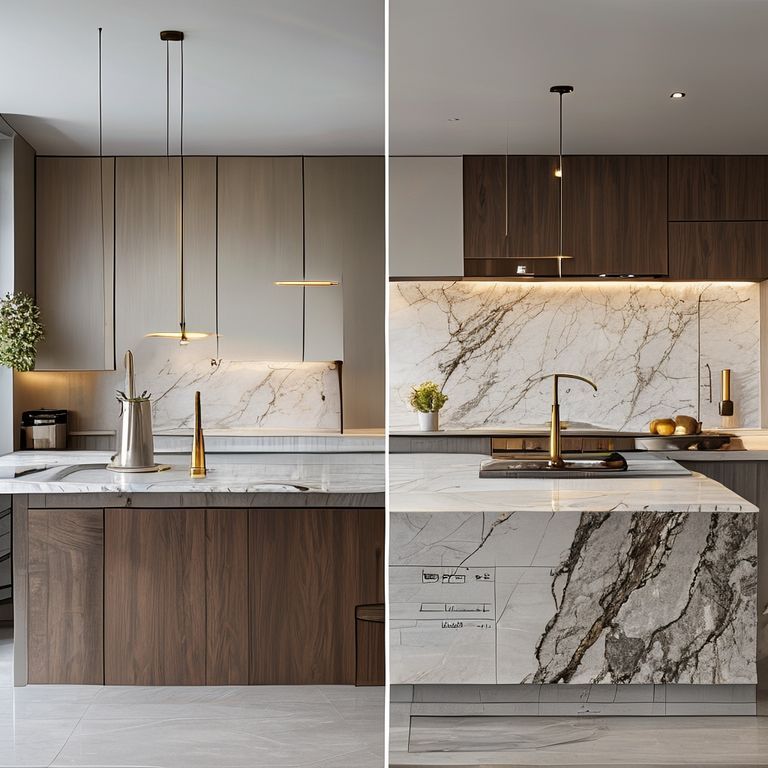
Then there is the matter of the “edge.” The profile of your countertop—whether it’s a simple eased edge, a sophisticated bevel, or a classic bullnose—is carved directly into the thickness of the stone. With a 2.0cm slab, the profile has more room to breathe. The curves are more pronounced, the shadows are deeper, and the tactile experience of running your hand along the edge feels more luxurious. For many, this is the “luxury feel” they are paying for.
However, the 1.5cm (15mm) slab is far from being the “budget basement” option. In fact, in many modern, European-inspired designs, the 1.5cm thickness is a deliberate aesthetic choice. We are currently living in an era of “ultra-thin” design. Think of the latest smartphones, the slimmest OLED TVs, and minimalist furniture. A 1.5cm quartz slab fits perfectly into this design language. It offers a sleek, razor-thin silhouette that makes a kitchen feel airy and light. If you are going for a hyper-modern, minimalist aesthetic where the lines are sharp and the clutter is zero, 1.5cm is often the superior visual choice.
The 1.5cm slab also plays a massive role in “mitered edge” applications. If you’ve ever seen a countertop that looks like a massive, 6cm-thick block of solid stone, you’re likely looking at a clever fabrication trick. Installers take a thinner slab and miter the edges to create a “skirt” or “apron,” giving the illusion of immense thickness without the astronomical weight or cost of a solid 6cm slab. In this scenario, starting with a 1.5cm base is often more practical for the fabricator and lighter for your cabinetry to support.

But before you decide based on looks alone, you have to consider the “skeleton” of your kitchen—the cabinets. A 2.0cm slab is heavy. A standard kitchen full of 2.0cm quartz adds hundreds of pounds of pressure to your floor joists and cabinet boxes. While most modern cabinetry is built to withstand this, older homes or “flat-pack” DIY cabinets might require extra reinforcement to handle the weight of the thicker stone. Conversely, 1.5cm quartz is the lightweight champion. It’s easier to transport, easier to maneuver during installation, and puts significantly less strain on your home’s structure. This makes it a darling for high-rise apartment renovations where moving heavy slabs up an elevator is a logistical nightmare.
In the next part, we will break down the cost implications, the “hidden” fabrication secrets, and how to decide which thickness suits specific areas of your home, from the high-traffic kitchen to the tranquil guest bathroom.
Continuing our journey into the world of quartz, we have to talk about the elephant in the room: the budget. It is a common misconception that 1.5cm quartz is always the cheaper option. While it is true that the raw material cost of a 1.5cm slab is generally lower than a 2.0cm slab—simply because there is less stone and resin involved—the final invoice from your fabricator might tell a different story.

This is where “The Fabrication Paradox” comes in. Because 1.5cm quartz is thinner, it is more delicate during the cutting and polishing phase. It requires a more practiced hand and, often, more reinforcement during the installation process. If you want that thin 1.5cm slab to look like a thick 4cm slab through mitering, the labor costs will skyrocket. You are paying for the artisan’s time to cut 45-degree angles and perfectly match the pattern at the seams. Suddenly, the “cheaper” thin slab becomes more expensive than the “luxury” 2.0cm slab. If you are looking for the most cost-effective way to get a solid, beautiful countertop, choosing 2.0cm with a simple eased edge often provides the best value-to-durability ratio.
Let’s pivot to the functional reality of your home. Where is this quartz going? If you are designing a high-traffic kitchen where pans are being slid across the surface and kids are dragging heavy backpacks over the island, the 2.0cm slab is your best friend. Its thermal mass is slightly higher, and its resistance to impact is naturally superior. It can take the “thump” of daily life with a bit more grace.
However, if you are looking at a bathroom vanity, a laundry room folding station, or even wall cladding, the 1.5cm slab is often the smarter play. In a bathroom, the scale is usually smaller. A 2.0cm slab can sometimes look “clunky” on a small vanity, especially in a compact powder room. The 1.5cm thickness keeps the proportions in check, leaving more room for your backsplash or a dramatic vessel sink. And for wall cladding—such as a seamless quartz backsplash that goes all the way to the ceiling or a feature wall in a walk-in shower—the 1.5cm thickness is the clear winner. You get the waterproof, stain-resistant benefits of quartz without the extreme weight that would require heavy-duty wall anchors and professional-grade adhesives.
There is also the “Overhang Factor.” Many homeowners dream of a breakfast bar where the countertop extends out so guests can tuck their legs under. If you use 1.5cm quartz, the maximum unsupported overhang is quite small—usually around 6 inches depending on the specific brand’s guidelines. Anything beyond that requires unsightly corbels or a hidden steel support system. With 2.0cm quartz, you can often push that overhang to 8 or 10 inches without needing additional support (though checking with your local pro is always a good idea). If you hate the look of brackets and want a floating, clean aesthetic for your seating area, that extra 0.5cm of thickness buys you a lot of architectural freedom.
Now, let’s talk about the “Feel.” This is purely subjective, but it matters. There is a psychological component to stone. When you tap your knuckles on a 2.0cm slab, it sounds deep and solid. It feels like it has been there for a century and will be there for another. A 1.5cm slab has a slightly higher “pitch” and can feel more like a surface treatment than a structural element. For some, the 2.0cm slab offers a sense of security and “homeyness.” For others, the 1.5cm slab feels high-tech, precise, and sophisticated.
So, how do you make the final call?
Ask yourself these three questions: First, what is the architectural style of your home? If it’s a traditional, farmhouse, or transitional style, 2.0cm is almost always the right answer. It complements the weight of crown molding and detailed cabinetry. If your home is ultra-modern, industrial, or mid-century minimalist, 1.5cm will highlight those clean, sharp lines.
Second, what is the primary use? For a heavy-duty kitchen island, go 2.0cm for the peace of mind. For a guest bath or a decorative fireplace surround, 1.5cm is more than sufficient and easier to install.
Third, what is your edge preference? If you love the look of a thick, “chunky” edge, go with 1.5cm and pay for the mitered fabrication. If you want a clean, honest look that shows the natural thickness of the stone, 2.0cm is the honest choice.
In the end, neither thickness is objectively “better” than the other. They are different tools for different jobs. The 2.0cm slab is the reliable workhorse of the design world—sturdy, classic, and forgiving. The 1.5cm slab is the sleek, modern specialist—refined, agile, and stylish. Whichever you choose, quartz remains one of the best investments you can make in your property. It’s non-porous, practically impossible to stain, and never needs the tedious sealing that granite or marble requires.
When you finally run your hand over that new surface, whether it’s the 1.5cm sleekness or the 2.0cm solidity, you won’t be thinking about millimeters. You’ll be thinking about how beautiful your home looks. But by choosing the right thickness now, you ensure that beauty lasts for a lifetime of mornings, dinners, and late-night talks. Choose with your heart for the color, but choose with your head for the thickness. Your kitchen deserves nothing less.









