
There is a specific kind of magic that happens when you stand in a showroom, surrounded by towering slabs of engineered stone. You run your hand over the cool, polished surface of a Calacatta-veined quartz, and for a moment, you aren’t just looking at a building material—you’re looking at the future stage of your life. This is where the morning espresso will be spilled, where the holiday turkeys will be prepped, and where late-night heart-to-hearts will happen over a glass of wine. But then, the salesperson taps the edge of the stone and asks the question that brings every homeowner to a grinding halt: “Do you want the 1.5cm or the 2cm?”
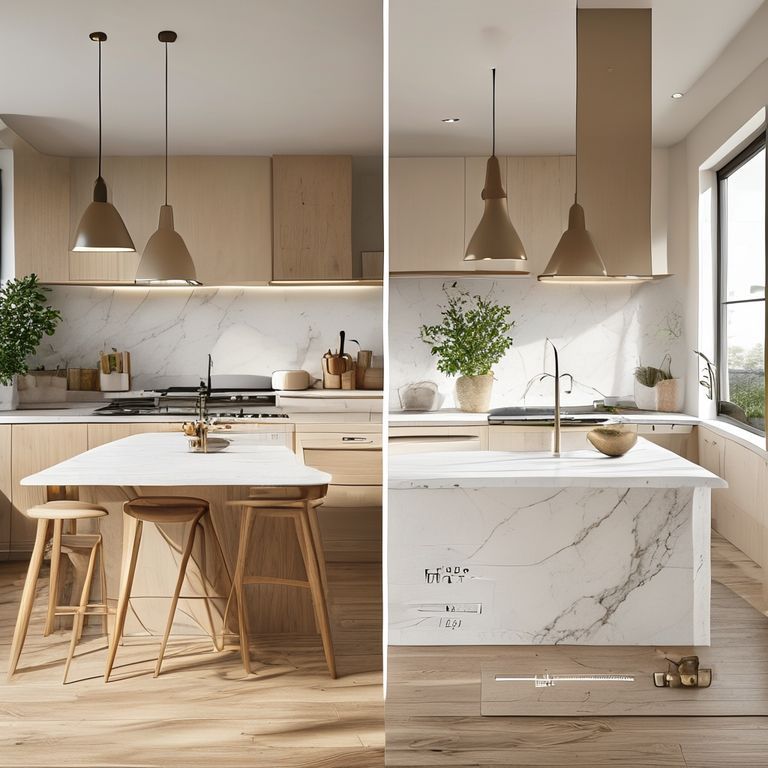
It sounds like such a minor distinction. We are talking about five measly millimeters—the width of a few credit cards stacked together. Yet, in the world of high-end interior design, those five millimeters are the difference between a kitchen that feels like a sleek, Parisian apartment and one that feels like a sprawling, rustic farmhouse. Choosing between 1.5cm and 2cm quartz isn’t just a technical specification; it’s a manifesto of your personal style.
Let’s start with the “Thin is In” movement. If you’ve been scrolling through architectural digests or following high-end European designers on Instagram lately, you’ve likely noticed a shift toward the ethereal. The 1.5cm slab is the darling of the minimalist world. There is an undeniable sophistication in a countertop that looks like it’s floating. When you opt for a 1.5cm thickness, you are leaning into a contemporary, “low-profile” aesthetic. It’s understated. It doesn’t scream for attention; instead, it whispers about precision and modern engineering.
For those living in urban condos or homes where space is at a premium, the 1.5cm slab is a godsend. Visually, it reduces the “bulk” of the cabinetry. It makes the kitchen feel more like a piece of integrated furniture rather than a heavy utility zone. When paired with handle-less cabinets and a monochromatic color palette, 1.5cm quartz creates a seamless, streamlined silhouette that is hard to achieve with thicker materials. It feels light, airy, and incredibly intentional.
However, the 1.5cm choice isn’t just about looking “cool.” It’s also about the architecture of your cabinets. Because it is lighter, it puts less stress on your floor joists and your cabinet carcasses. If you are retrofitting an older home with vintage cabinetry that might not be prepared for the weight of a small mountain, the 1.5cm slab offers a compromise that doesn’t sacrifice the luxury of quartz.
But let’s talk about the “look” of the edge. Many people assume that choosing a thinner slab means you are stuck with a thin edge. That’s a misconception. Fabrication has come a long way. You can take a 1.5cm slab and give it a mitered “apron” edge, making it look like a massive 6cm block of stone if you really want to. But if you keep it at its natural 1.5cm thickness with a simple eased edge, you achieve a “pencil-thin” look that is currently the height of luxury in Milanese design circles. It’s for the homeowner who values the “less is more” philosophy—someone who wants their kitchen to look like a gallery.
Of course, every choice has its trade-offs. While quartz is incredibly dense and hard, a 1.5cm slab naturally has less structural mass than its 2cm sibling. This doesn’t mean it’s “fragile”—quartz is one of the toughest materials on the planet—but it does mean that your fabricator needs to be a master of their craft. The support system underneath needs to be perfectly level. You can’t have gaps or uneven pressure points, because while quartz is hard, it doesn’t like to flex. If you’re the type of person who tends to move heavy cast-iron Dutch ovens around with a bit of “enthusiasm,” or if you have kids who might decide the kitchen island is a perfect stage for a dance routine, you might find yourself glancing over at the 2cm samples with a bit of longing.
The 1.5cm slab is for the curator. It’s for the person who sees their kitchen as a work of art. It’s for the renovation where every line must be sharp, every shadow must be intentional, and the overall vibe is one of effortless, lightweight elegance. It’s a bold choice because it moves away from the “standard,” and in the world of design, moving away from the standard is usually where the most beautiful results are found.
Now, let’s flip the script and look at the heavyweight champion: the 2cm quartz slab. If the 1.5cm is a silk suit, the 2cm is a bespoke wool coat. It’s substantial. It’s timeless. It’s the “gold standard” for a reason. When you walk into a kitchen with 2cm (or even 3cm) countertops, there is an immediate sense of permanence and security. It feels like the room is anchored.
The 2cm thickness is the traditionalist’s dream. It offers a visual “weight” that many people find comforting. It suggests that this kitchen is built to last for generations. If you are designing a kitchen with a more classic, transitional, or “shaker” style, the 1.5cm can sometimes look a bit too thin—almost like you ran out of budget at the last minute. The 2cm thickness, however, matches the proportions of traditional cabinetry perfectly. It provides enough “meat” on the edge to allow for more decorative edge profiles. Want a classic Ogee edge or a deep Bullnose? You need that extra 5mm to give the stone the profile it deserves.
Beyond the aesthetics, let’s get into the “lifestyle” aspect of 2cm quartz. This is the slab for the “home chef.” If your kitchen is a high-traffic zone where flour is flying, meat is being pounded, and the slow cooker is constantly bubbling, the 2cm slab provides that extra peace of mind. That additional thickness contributes to impact resistance. While it’s still highly unlikely you’ll crack a 1.5cm slab, the 2cm slab just feels more “bombproof.” It’s the psychological comfort of knowing that your countertop can handle the chaos of a busy family life without breaking a sweat.
There’s also the matter of overhangs. One of the most popular features in modern kitchens is the breakfast bar—that cantilevered section of the island where people pull up stools. If you want a significant overhang without visible steel support brackets underneath, the 2cm slab gives you more leeway. Its inherent structural integrity allows for slightly larger unsupported spans than the 1.5cm. It’s a practical consideration that affects how you interact with your space. Nobody wants to sit at an island and knock their knees on a bulky support beam if they don’t have to.
From a fabrication standpoint, 2cm is often the “sweet spot.” It’s thick enough to be handled with a bit more ease in the workshop, and it’s standard enough that most installers have their process down to a science. Because it’s so common, you might actually find a wider variety of colors and patterns available in 2cm than in 1.5cm in certain markets. It’s the “safe” choice, but “safe” doesn’t mean boring. It means reliable.
Let’s talk about the tactile experience. There is something incredibly satisfying about leaning against a 2cm countertop. It feels solid. When you set down a heavy grocery bag, the sound is a dull thud rather than a higher-pitched clack. It’s these tiny sensory details that contribute to the “luxury feel” of a home. We often focus on the eyes, but our hands and ears tell us just as much about the quality of our surroundings.
Cost is, of course, the elephant in the room. You might assume 1.5cm is significantly cheaper because there is less material. In reality, the price difference is often negligible once you factor in labor and installation. In some cases, the 1.5cm might even be more expensive to install because it requires more precise sub-countertop preparation or specialized handling to prevent snapping during transport. When you choose 2cm, you are often getting the best “value” in terms of durability per dollar.
So, how do you decide? It really comes down to the “soul” of your renovation.
Ask yourself: What is the story of this room? If the story is one of cutting-edge technology, sleek lines, and a “less is more” attitude, then 1.5cm is your protagonist. It will give you that “wow” factor of a kitchen that looks like it belongs in a design museum. It’s the choice for the trendsetters and the minimalists who want to push the boundaries of what a kitchen “should” look like.
But if the story is one of heritage, robust family meals, and a classic aesthetic that will look just as good in twenty years as it does today, then 2cm is your winner. It’s the sturdy foundation upon which a home is built. It’s the choice for those who want their kitchen to feel like a sanctuary—sturdy, reliable, and unapologetically substantial.
In the end, whether you choose 1.5cm or 2cm, remember that quartz is a remarkable material. It’s a blend of nature’s hardness and human ingenuity. Either choice is going to transform your space. The 5mm difference isn’t about “better” or “worse”—it’s about the “touch” you want to leave on your home. So, go back to that showroom, touch the edges, imagine your life unfolding on top of that stone, and listen to what the slab is telling you. Your kitchen already knows which one it wants; you just have to decide if you’re ready to live with it.









